Monday, April 20, 2009

Graphic illustration of the difference between the second best and the best projection

The graphic illustration of the difference:


Excerpt from:
Europe in the twilight of its demographics
Jehu Lentius – 1.12. 2008

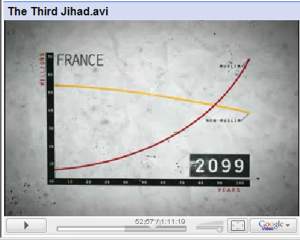
"Now the reader should see the film ‘The Third Jihad’ (Trinity, 2008). It is bothering, no doubt, but the situation in the USA is still several dimensions better than in Europe. In an interview with Mark Steyn commenting the general conviction that the Muslims in Europe ‘are so few, only some percent of the population’, he says: “Many people think it will ‘take centuries’ for them to become majorities”, there is shown the likely demographic devel­opment of Muslims and non-Muslims calculated for France’s actual fertility rates of 1.4 vs. 3.8..." :

unreal

(Excerpt continued)
"The result may surprise the optimist: The break even point is reached before the end of our century – around 2087. And this is merely a calculation on the basis of the demographic reproduction rates, not even considering (1) the ongoing family reuniting, (2) continuous further immigration, (3) the illegal immigrants of today (suppos­edly millions), (4) continuous illegal immigration, (5) repeated amnesties for hidden immigrants (as a strong motivation for trafficking of asylum seekers), (6) the fact that Muslim fertility could be increased deliberately as conscious means of politics (already outspoken by many Muslim leaders), (7) increasing emigration of endogen­ous Europeans (which already has begun in several countries), and (8) that political decisions during their grow­ing democratic power could lower the obstacles for Muslim immigration or even facilitate it (e.g., the EU-Africa commitments of the EU-Mediterranean ‘Barcelona Process’ etc.). All these powerful factors included, a better demographic simulation than the one above could result in a much more bothering timeline..."

But I'am afraid the truth is it dismantles 40-50 p.c. quicker than even Jehu Lentius imagined or calculated 1.12.2008, especially if you look critically at the official figures as we certainly did last summer in order to come closest to the truth. Our three alternative rising curves then begin a little higher on the y-axis, because we naturally have corrected til startingpoint i.e. made a corrected realistic population balanced sheet before we projected the groups of population, but our curves do not even rise as fast as does those refered to or calculated by Jehu Lentius 1.12.2008. And even then the three rising curves intersect with the falling curve at least 50 year before:

'Some will certainly contradict us persistently and perhaps one might even point out that the first diagram concerns France, the second Denmark. But does this really matter when I tell you that France might come first.'


Now I would prefered some video - all in good time

Sonia


'if your heart is filled use your brain'

Sunday, April 19, 2009

I dansk og engelsk version : Danish official Information is not OK

i

A Danish and an English version below:

Kvinder i Østrig: Kortfattet version om østrigske kvinder og deres fødsler

Officielt melder Max Planck Institute for Demographic Research, at Østrig ved udgangen af 2004 havde 16,6% ikke-østrigere i landet. Blandt disse ikke-østrigere medregnes ikke naturaliserede, der er født af indvandrere i Østrig og ej heller børnebørn af indvandrere. D.v.s. at 16,6% skal være en hel del højere, hvis vi går efter antallet af indbyggere af fremmed herkomst i Østrig. Desuden er der sket en nettotilstrømning siden 2004. Dertil kommer et forholdvis stabilt og mindre antal vestlige, der naturligvis skal fratrækkes.

Det officielle antal udenlandske statsborgere i Østrig udgjorde ved udgangen af 2004 9,6%, får vi oplyst af samme kilde.

Max Planck Institute for Demographic Research oplyser endvidere, at den samlede eller den totale fertilitet blandt kvinder i Østrig er 1,4 barn, som i øvrigt har ligget vedvarende stabilt siden midten af 1980erne. Eurostat (EU's statistikenhed) oplyste i 2004 at den totale fertilitet i Østrig var 1,42. I 2005 oplyste CIA at den totale fertilitet i Østrig udgjorde 1,36. Vi ved at indvandrerkvinder fra Sydasien, Mellemøsten og Afrika føder 3-4 børn i gennemsnit pr. kvinde, d.v.s. en etnisk fertilitet på fra 3 til 4. For at den samlede fertilitet i landet kan ende på 1,4, har en vis andel fremmede kvinder bidraget med fødsler og vis andel østrigske kvinder bidraget med andre fødsler.

Da der er en sammenhæng mellem de fødende kvinders andel, befolkningsandelen, fertiliteten blandt de fødende kvinder og den samlede fertilitet, kan vi herefter cirkaberegne eller estimere fertiliteten blandt østrigske kvinder til omkring 1 barn, når vi netop får oplyst om andelen af ikke-østrigere (>16,6%) og om den samlede fertilitet i Østrig (1,4 barn).

Absolut ingen af de resultater vi når frem til på dette grundlag harmonerer på nogen måde med de officielle oplysninger vi får om danske demografiske forhold.

Oplysningerne om Østrig stammer fra Max Planck Institute for Demographic Research, og de oplysninger (andre end de officielle) om danske, demografiske eller om øvrige europæiske, demografiske forhold, der stemmer overens med de netop her meddelte om østrigske forhold, stammer fra Information om Danmark.

Officielle, tilforladelige version

Udregningsprægede del af afsløringen med brug af de officielle østrigske oplysninger


Women in Austria: Brief version about Austrian women and their fertility

Max Planck Intitute for Demographic Research reports officially that Austria had 16.6% non-Austrians in the country ultimo 2004. Those non-Austrians do not include naturalized who are born by immigrants in Austria and not grandchildren of immigrants either. This implies that 16.6% has to be even higher, if we intend to count the percentage of inhabitants of foreign origine in Austria. In addition the net influx has increased the number further since 2004. A relatively stable and minor number of Westeners has to be subtracted.

The official number of foreign citizens in Austria amounted to 9.6% ultimo 2004, we are informed by the same source.

Max Planck Intitute for Demographic Research reports further that the total fertility among women is 1.4 child in Austria , and this number has been persistently stable since the midd 1980s. Eurostat (the Statical Bureau of EU) reported in 2004 that total fertility in Austria was 1.42. In 2005 CIA reported that the total fertility in Austria was 1.36. We know immigrant women from South Asia, the Middle East and Africa give birth to 3-4 children in average. The foreign ethnic fertilty is then 3 to 4 in average. For the total fertility to end up at 1.4 in the country a certain percentage of foreign women has contributed to the births, and a another certain percentage of Austrian women has to give other child-births.

As there is a coherence between the percentage of birth-giving women, percentage of population, the fertility among the birth-giving women and the total fertility, it is possible to calculate/estimate the fertility to about 1 child among Austrian women, when we have information about the percentage of non-Austrian (>16.6%) and about the total fertility in Austria (1.4 child).

Absolutely none of the results we get on this basic harmonize in any way to any degree with the official information we get about Danish Demografic relations.

The information on Austria originate from Max Planck Institute for Demographic Research, and the information (different from the official one) about Danish Demografic relations or about other European Demografic relations that matches the present reported information about Austria, originate from Information of Denmark

Official reliable version

Calculating version with the exposure using the official Austrian information approved by Max Planck Institute for Demographic Research

Grafic illustration of the difference between the second best and the best projection


J. E. Vig, 19. april 2009


www.lilliput-information.com


'if your heart is filled use your brain'

Saturday, April 18, 2009

Women in Austria: Persistent low fertility since the midd 1980s

Women in Austria: Persistent low fertility since the midd 1980s


Demographic Research a free, expedited, online journal of peer-reviewed research and commentary in the population sciences published by the Max Planck Institute for Demographic Research Konrad-Zuse Str. 1, D-18057 Rostock · GERMANY www.demographic-research.org


Dansk version


Information from: http://www.demographic-research.org/Volumes/Vol19/12/19-12.pdf

Austria has 8.3 mio. inhabitants ultimo 2007. As other Western European contries a substantial decrease in the number og births per Austian woman set in from the midd 1960s caused by the same reasons as for example in Denmark. After a so-called babyboom  that got its maximum in the midd 1960s after a total fertility of 2.8 in the beginning of 1960s the total fertility (the etnic Austrian and the etnic foreign fertity all together) has decreased until the midd 1980s, and thereafter it has been stable of about 1.4 children since. The continuing immigration to Austria indicates that the etnic Austrian fertility is still decreasing.

 Ultimo 2004 Austria has 788.600 (9.6%) foreign citizens. In addition 575.000 (7%) Austrian citizens born abroad. The last mentioned number rose from 5% in 2001. This means that foreign citizens, naturalized and some part of the first generation of children born abroad are counted to a percentage of 16,6% of the population ultimo 2004.

You have to add part of the second generation and the whole third generation similiar to the case in Denmark.

A doubling of the official number of foreigner in Austria to get the real number is not enough in 2009.

If we for at moment imagine that the part of the birth-giving non-Austrian women correspond to the part of the non-Austrians the total fertility of 1.4 can be calculated like this:


Number of children per non-Austrian woman: 3 or 3.5

Percentage of non-Austrian birth-giving women: 17% or 0.17

Percentage of Austrian birth-giving women: 100% - 17% = 83% or 0.83

Number of children per Austian woman: x


Equation (weighed average) for calculating the total fertility:

3*0,17 + x*0,83 =1,4

which gives the number of children a birth-giving Austrian woman, x: 1.07 children
If 3 is exchanged by 3.5 that is not unrealistic you get:

Number of children a birth-giving Austrian woman, x: 0.97 child

EUROSTAT reported the total fertility of Austria in 2004 to 1,42. In 2005 CIA reported the corresponding fertility to 1,36.

We have to add that non-Austrian women have a larger percentage in the birth-giving ages than the Austrians. This does not alter the fact that the fertility among Austrian women is close to 1 child.

And further more, we have to underline that the 16,6% non-Austrians inhabitants in Austria include the first generation of descendants born in Austria by immigrants and the percentage has increased substantial for the last 5 years.


Compare with information we have already given on the subject:

1.     lilliput-information, knowledge of and solutions to problems within the subjects...
I know the ethnic fertility is perhaps ... woman. Here the fertility level refers to the ethnic fertility. Tabel 1: Totalfertility and calculated ethnic fertility in some European
www.lilliput-information.com/ferteu.html
 
2. 
lilliput-information, knowledge of and solutions to problems within the subjects...
Assume for a moment that the increase in fertility from 1.14 to ... immigrant-group and continue the fertility-pattern of this group for ... 1.14 is the fertility among the ethnic Danes 
www.lilliput-information.com/engeuarb.html
 
3. 
lilliput-information, Information of Denmark, immigrants in Denmark,fag
Provisional comments to newest investigation of fertility among immigrants in ... demografic parameter of fertilityamong foreign women immigrated to Denmark. Fertility is the average
www.lilliput-information.com/engfer.html
 
4. 
lilliput-information, knowledge of and solutions to problems within the subjects...
English comments to the investigation of fertility among immigrants in ... demografic parameter of fertility among foreign women immigrated to Denmark. Fertility is the average
www.lilliput-information.com/stati/hyp.html
 
5. 
information of Denmark, engsamm.html
The fertility is the number of children ... that lead to the small fertility-number 1.2-1.4 ... of foreigners, and later on the fertility has most likely fallen further. International
www.lilliput-information.com/engsamm.html
 
6. 
lilliput-information, Information om Danmark, fremmede i Danmark, fertt.html
com/italy/life_and_customs/persistent_drop_in_ fertility_res.htm : ". In no ... 1.67 if the fertility of women born abroad ... in order of Total Fertility Rate (children): Rank Country
www.lilliput-information.com/fertt.html
 
7. 
lilliput-information, knowledge of and solutions to problems within the subjects...
estimating the demografic parameter of fertility among foreign women ... calculated by U.N. Fertility is the average number ... assume the idea that fertility among the foreigners adjust
www.lilliput-information.com/fert.html
 
8. 
lilliput-information, knowledge of and solutions to problems within the subjects...
pageid=1089,47613132&_dad=portal&_schema=PORTAL&mo=containsall&ms=fertility&saa=&p_action=SUBMIT &l=dk&co=equal&ci=,&po=equalπ=,) , estimeret til 1,28 hos CIA for 2005 (http://
www.lilliput-information.com/euarb.html
 
9. 
lilliput-information, Information om Danmark, fremmede i Danmark, forch.html
Total fertility in Denmark (a very small country of 5,447,084 inhabitants all in all) is officially reported to be 1.75 child per women. When the most foreign immigrants give 
www.lilliput-information.com/forch.html
 
10. 
lilliput-information, knowledge of and solutions to problems within the subjects...
international competition, the low western fertility, therefore the ageing of the populations, the weight of the welfare system compared with GNP, and the still increasing state-
www.lilliput-information.com/engvelg.html


2.       http://danmark.wordpress.com/2007/10/28/a-last-must-choose-between-good-and-bad/

3.       http://danmark.wordpress.com/2007/07/15/immigration-costs-in-sweden-amount-to-almost-297-pc-of-the-public-budget-2001/

4.       http://danmark.wordpress.com/2007/11/26/drawing-illustrates-the-way-back-to-reality-without-a-war/

5.       http://danmark.wordpress.com/2007/03/08/israelsk-forsker-kommer-til-samme-resultat/

6.       http://danmark.wordpress.com/2007/01/26/europæerne-tjente-penge-indvandrerne-føder-børn/

7.       http://danmark.wordpress.com/2006/11/17/the-number-muslims-in-europe/

8.      http://danmark.wordpress.com/2006/11/08/the-worlds-lowest-number-of-child-births-in-german-2/

9.       http://danmark.wordpress.com/2006/05/20/european-population-and-workforce/

10.   http://danmark.wordpress.com/2006/05/19/12/


J. E. Vig, 18. April 2009


'if your heart is filled use your brain'

Monday, January 12, 2009

From War Of Terror To Frontier War


img0.gif


We may experience a change – perhaps 

better times after all


A war of terror is perhaps too difficult to bring to an end without too many limitations and lost of citizens rights.

Right now the sheep are being separated from the goats. The split of Jew haters and Jews supporters may be the first step. When it has been going on for some time the violence shall increase. The split we experience will of necessity spread naturally to the whole of Europe.

This might lead to split of EU on the real or the concrete level, no longer on an ideologic level of phrases and general camp following thoughts and actions including new-Mercantilism and Eurabia.

Ideology gathers, but reality spread.

Earlier we actually have heard tiny peeps about an Europe with much less USA-involvement or without speculators’ engagement from the unknowing-parrots who have not understoond that especially such a system have basicly been made by themselves.

They and their predecessors have even done the same time after time, but most of them are historyless and just blinded by their own power or ideologic dreams about an abstract future, yes, then they forget the big pendulum of history that always returns, because it is the same people, the same human characters that make the mess every time. In addition they even have via Etic Order abolished the human characters as useful concepts, and created a new man to consolidate their power or secure themselves.

Ideology, Etics and Politics had to be melted together, two generations at the summit claimed, because they got their will by using their brains without wisdom.

Perhaps it shall give the necessary result that will show itselves, if it does: war of terror and treachery may perhaps be turned to a frontier war, where the enemies know each other and respectively their real alliances.

This war can then be won.

J. E. Vig

PS: How far has it gone


'if your heart is filled use your brain'
Thursday, September 04, 2008

THE LIES RUNS IN OVERTONES NOW

THE LIES RUNS IN OVERTONES NOW - 

IT'S A REPLACEMENT OF THE DANISH 

POPULATION THEY WORK ON


’They give birth fewer children’, so few that the official number 347,250 Non-Westeners 1 Juli 2008, documented: http://www.dst.dk/pukora/epub/Nyt/2008/NR339.pdf becomes official number 330,700 in the year 2040, according to Morgenavisen Jyllands-Posten 22 August 2008: http://jp.dk/indland/article1417575.ece , even though the immigration continues in even higher speed year after year:  http://www.lilliput-information.com/dk07.html (perhaps a negative number of child births is then the only solution to this most peculiar equation??)

Yes, the number 347,250 Non-Westeners 1 Juli 2008 we had to find and give as supplement to writings in Jyllands-Posten. We went to the official producer of public statistics in Denmark: http://www.dst.dk/pukora/epub/Nyt/2008/NR339.pdf. The number 347,250 already certainly did not harmonice with 330,700 in 2040 in Jyllands-Posten.

Try the link yourself, look in row ‘Ikke Vestlige lande’ and the column ‘I Alt’

Concentrate for at moment, the 330,700 in the projection-point 2040 has perhaps to be reduced even more in new corrected and official prognosis after the latest discoveries (in Danish) about child births, according to JP 22 August 2008. Add to this a SECRET prognosis that the public is not supposed to know about … how can that be, Mrs. Henderson?

In 2007 the Non-Westeners officially gave birth to 2.5 child (in Danish) in average, in 2008 officially less than 2 children (in Danish) according to Denmark’s Statistics. This was written by Hanne Fall Nielsen in Jyllands-Posten internet-edition 22 August 2008 and the printed edition the day after.   

In Jyllands-Posten 30 May 2004: http://jp.dk/arkiv/?id=361742 a SECRET prognosis was mentioned. Not even a hint to this SECRET prognosis was given in JP 22 August 2008.

We had to reweil this SECRET prognosis. We had to make make a new total run through of 3*5,742 spreadsheet cells in a varying annuity to be sure to get a much more correct account of the number of foreigners 1 July 2008 in Denmark. We must build on the concept of citizenship, naturalization and a realistic number of child births among the naturalized. The useless concepts ‘immigrants’ and ‘descendants’ with among other things a missing third generation, who gives birth to most the foreign children these years.

This correction is being made on a private initiative alone in Denmark among all the Western countries.

Result: There were more than the double of the official number 347,250 1 July 2008. We cannot let thing made be made by more than doubtful makers of hypotheses and acrobats close to the leaders in Denmark, when it project 200-300 p.c. (read the red section in Danish) differently in a single fall.

An alternative and fresh account of most foreign foreigners in Denmark 1 July 2008: http://danmark.wordpress.com/2008/08/30/dugfrisk-opgoerelse-antal-fremmede-indvandrere-netto-og-nettotilvaeksten-sfa-af-de-naturaliseredes-foedsler-i-perioden-1-januar-1979-16-juni-2008/

766,000-829,000 of total population in Denmark of a little more than 5.4 mill.

Put this information on your blogs and forward it to all your contacts….or make links to it on your blog or your website. You are welcome copy the whole and even give it your signature, if you want to, if you just copy the entire entry and do not add anything to it.!!

It is important to be aware of the timing and of concrete information, perhaps especially in this authumn (in Denmark), where the foreigners policy ranges high on the agenda.

Give the information to your contacts


J. E. Vig, M. Sc. (Economics), 4. September 2008


'if your heart is filled use your brain'

Tuesday, August 05, 2008

The expectations in Denmark build more and more on lies


– the number of naturalizations have increased substantial compared with 2007 – the mainsteam-media report the opposite for several days without any documentation at all.

For the last days we have read very often on TTVs that the number of granted naturalizations has decreased compared with granted number in 2007.

A lie of course.

Totally 3,648 naturalizations were granted in the year 2007. That is documented on http://www.statistikbanken.dk/statbank5a/default.asp?w=1024, when go to ‘Befolkning og valg’ and choose the map ‘Udlændinge’, click on the fourth link and click on ‘Vis tabel’ on below to the right

The yearly account from Denmarks Statistics includes both grown-ups and their children.

Danish naturalization have been granted by law two twice in 2008, law no. 158 of 6 Mars and law no. 461 of 17 June 2008. Their names and the municipalities of stay can be read respectively on: https://www.retsinformation.dk/Forms/R0710.aspx?id=115607 and https://www.retsinformation.dk/Forms/R0710.aspx?id=120244

6 Mars 2008 2,100 were granted of which 552 were granted on the condition that another citizenship was dissolved latest 30 April 2010. 17 June 2008 1,827 naturalizations were granted.

Naturalized children is not included in any of those numbers.

When we then add the numbers in the first 6 month of 2008 the result is 3,927 (excluded children). In the whole year 2007 the total number of naturalizations – grown-ups and children – we have documented above to be 3,648

The shysters of the main-stream media ‘interpret’ this as a decrease.

We don’t

J. E. Vig


PS: A new search-machine on http://www.lilliput-information.com


'if your heart is filled use your brain'

Friday, April 25, 2008

Number of Muslims in Germany

Number of Muslims in Germany

On the most excellent German blog Polically Incorrect run by Stefan Herren (on the portrate) we read this entry: http://www.pi-news.org/2007/10/stefan-herre-about-the-islamization-of-germany/


A small extraction:

“First of all, how many Muslims live in Germany? We don’t really know. The federal government says 3.1 to 3.4 million. This would mean about 4 percent of the total population. Similar estimates have been that until summer 2006 there were some 8 million people of immigrant background in Germany, of whom about 40% were Muslims. Yet the government admits that its figure is only an estimate, not based on verified statistics. Some observers, such as the Mideast expert Hans-Peter Raddatz, believe that the number is much higher.

A survey of the federal statistics authority in 2005, published June 2006, nearly doubled the 8 million number, to 15.3 million…”

--------------------------------------------------------------------------------

Lilliput-information.com

I am afraid we have the following critical and hopefully alsom some of them improving comments to this method:

As a starting point you assume that 40 p.c. is a pretty stationary and reliable figure. We studied the phenomenon for 20 years and came to following conclusion as for the concern of matters in Denmark:

Until Schengen-extension on 21. December 2007: extension from 15 to 24 countries:

We were not concerned about immigrants’ originated from: Western Europe (without the old Eastbloc), North America, Israel, Japan, Australia and New Zealand.


Until ultimo 2007 the number originating from those countries/areas were almost stable in Denmark varying from 80,000 til about 100,000 for years, varying with possibilities on the Danish labour market.


We then subtracted the official number citizens from those countries in the balance sheet accounts. We always use the yearly balance sheet.

Now we bore in mind that naturalized immigrants bear children who are counted as Danish citizens without being Danes.


By assuming that naturalized muslims still gave birth to 3,3-3,5 child a woman in average – so the authorities told us in midd 1990s – with a minor notiable source of error. But their descendants give birth to even 10 p.c. more children compared with their parents (even though they are immigrants) in Copenhagen (documentated), and elsewhere.


Of the naturalized it seems for years to be more 90-97 p.c. of naturalized originating from Islamic dominated countries/areas, when we before hand had subtracted those that clearly were not from most foreign country.


We then chose to use to use 4-5 p.c. p.a. increased originating from births alone, and put this growth-rate into an annuity with the yearly annuity according to the yearly take of most foreign immigrants:


We ended at 670,000 most foreign foreigners in http://www.lilliput-information.com/uscan.html instead of the official number 337.243. About 500,000 of those were estimated to be muslims primo 2006.


J. E. Vig, M. Sc. (Economics)

http://www.lilliput-information.com
http://informationomdanmark.blogspot.com (in Danish)
http://Danmark.Wordpress.com


'if your heart is filled use your brain'

Friday, January 04, 2008

Several Good Proposals - far from truth


There are several good

proposals –most of those

far from truth


The debate is running right now: http://hodja.wordpress.com/ (på dansk) and at http://gatesofvienna.blogspot.com/ Diskussionen foregår her (på engelsk)

The number of Muslims among the immigrants

(No Western country has legislation that permits registration of religion)


Historian and reporter Lars Hedegaard’s estimation of the number of Muslims in Denmark August 1 2004 in Morgenavisen Jyllands-Posten was as far from reality as you can almost get. He counted to 200,000 muslims in Denmark from some random register of names at Denmarks Statistics. Why not the weather forecast? Source has disappeared, indeed: http://www.jp.dk/indland/artikel:aid=2538202/


  1. What decides under the politically correctness is repetitions in the media without any contradictions. Lars Hedegaard certainly succeeded, indeed. Institute of Name Research, University of Copenhagen rejected his summer-activity 2004 as a satirical joke. You do not convert religion by naturalization in Denmark, and you are not sterilized either by just receiving a letter from Folketinget. Price: ddk 1000 per head.

  2. Your children do not convert from Islam - death penalty according to Sharia! 192,871 have been granted the Danish citizenship since 1979. Their children and their grandchildren the same. More than 90 p.c. of all naturalizations concern most foreign immigrants (outside Western Europe, North America, Israel, Japan, Australia and New Zealand) of which about 75 p.c. originate from muslim dominated countries/areas.

You can then expect a little more than 500,000 in Denmark included the naturalized and their descendants. You do not come much closer to reality than this per January 1 2006.


To this you can add 75%*11.087 for 2007 plus the number born children with muslims parents in 2007 (which is not registred).


They contributed to the development of Danish population according to the lack of children among the Danes – atmost the half of the needed 2.05-2.1 child a woman in average – and even got the population to rise by 19,625 to 4,447,084 January 1 2007.

A half of the Birth Cohort in Denmark born by most foreign immigrants


February 18 2007

J. E. Vig. M. Sc. (economics)

'if your heart is filled use your brain'

Tuesday, November 20, 2007

'The dollar is definitely not passé'

President of Iran Mahmoud Ahmadinehad recently used the following expression about the American currency dollar at the meeting with the oil producers in Saudi Arabia: "A worthless piece of paper".

The American dollar has since the last global war (WW2) been substantial overestimated, because USA made an agreement with Saudi Arabia on oil extraction and on foreign and security policy on way home from the Jalta Conference 4-11 February 1945.

It developed further on and petro dollar kept its rate of exchange at a level higher than corresponding to USA's ability to compete. The dollar was simply kept up, because an enormous amount of monetary units from the oil trade remained abroad and did not returned to USA to demand goods. Dollars was demanded everywhere after WW2.

This phenomenon has the American government aimed to reverse to get closer to its ability to compete in a globalizing world since 2000. In addition Iran was one the first oil countries that replaced its oil trade to the European compulsory Euro in the Euro-Zone.

A lot of rumours are told - also in Denmark. On the anti-war-front it is often reported that USA
is close to bankruptcy. Let me express it i this way: This rumour does distinctly not build on any insight at all. The war expenditures - that is mentioned in this connection - are mostly financed by government bonds. A substantial amount of those has been sold to among others China. This is a kind of safety net, 'where the believers hoped they have found a dead dog burried'. It's just about the time to remember 'Funny Ali'.

The war of interest-rates that actually has been fought across the Atlantic - as usual I am tempted remark - has among other things the effect that EU with a strong oil trading currency has severe difficulties with getting the real economy of EU going toward succes. They chose what we have called New-Merkantilism instead of making order on home front. 'Naturally it is quite different in Demark, as you might imagine'. Anyhow we have explained earlier why the Euro is not a protection against international competition, and why the currency rate and speculation do not secure the any dynamic capital creation that is the precondition for every responsible society in development, rather on the contrary.

That a new alliance between the Arabic countries and EU - the Mediterranean Process - is emerging might be overlooked by a few 'weak-sighted', even though the efforts has been held semi-secrete by the chosen ones and the European Elite. That is perhaps the reason why Iran uses this rhetoric. In addition there is still a lot of sanctions intact against Iran, and a continuing claim of an effective control with its atomic program.


19 November 2007
J. E. Vig, M. sc. (Economics)
Denmark
informationomdanmark@yahoo.com
http://www.lilliput-information.com
http://Danmark.wordpress.com

A new international monetary system shall be needed


'if your heart is filled use your brain'

Friday, October 26, 2007

When Krones and Pound turn to Euro

Euro light and Euro ultralight

Currency-sovereignty and independent finance policy
The prerequisite for the ddk to be coupled to the EURO is that the Danish government lives up to the expectations of the savings and other claims from the ECB - European Central Bank. It is just cracy to go on with a national currency-independence, when the EURO has been accepted by our politicians anyway. It must mean that the finance policy and the monetary policy in Denmark is being ruled directly as some equalizing yield to the coupling. If the claims are not met - concerning the amount of money, and the interest- and finance-policy, the coupling is given up, and the ddk is then floating free. As long as there are monetary-monopolies - the national central banks have monopoly of money-issuing - there can not be another monopoly above.

Denmark’s Constitution is being abolished too via the old EU-doctrine acquis communautaire, that implies all power transfered to (the European) community is being made European law, and at the same time drawn out of the nationational sets of laws. Invented by Jean Monnet in 1950s together with the road map tactics that really conflichts with the Danish Constitution (i.e. section 56).

Jean Monnet: http://www.lilliput-information.com/mon.html

Claims of convergency - Stability
The claims of convergency gives a hint of the firmness of rules. For instance in the Maastricht-treaty, article 104C you read: ‘After a general estimation the Council… states if there is a relativily big deficit’.

This is certainly not a stringent rule about the yearly deficit on the public finances that must not be bigger than 3 p.c. of BNP in market prices. You also read in the treaty that the interpretation of these claims is a matter for the Council of Ministers. The claims are generally almost radom and mostly inconsistent to one another. For instance the claim of convergency concerning the rate of inflation. It is the weakest of the claims. You also read that a country to secure price-stability must not reach a rate of inflation of more than 1.5 p.c. more than the average of the rates in the three most price-stable countries in the monetary union. This tells nothing at all about the real rate of inflation. The debt-claims are really inconsi-stent. The amount of deficit on the public finances - taxes minus the public expenses - which must not reach more than 3 p.c. of BNP (minus the require-ments of raw materials) is surely not so important as the claims about getting the debt of the state down to 60 p.c. of BNP. The half of the countries in the Euro-zone can not fulfill that last claim without accepting crisis of instability.

Stability is really not accounted by an index of prices that means some quantitative standards are to be fulfilled, and we then say the currency in stable. Stability includes the dynamics of capital formation, securing the process of investment, economic growth and high productivity. All this cannot be reached or calculated on the basis of some static conception.

Capital flight – Social crisis - Declining of rules
Foreigners as well as domestic people, which do not trust the new money, will transfer their values to other currencies, if oil-trade is not being based on Euro. The EMU will begin with a crisis. The capital flight will throw Europe into a social crisis, because the capital flight will force ECB to raise the common interest rate. This the southern countries and Belgium, Irland and Denmark - cannot get through. When the social crises is there the temptation is big to try to manage it with public investments and with a consciously public increase the amount of money. This means deficit on the public finances, and then we are back in Keynesianism, where the responsible in a - now 60 years old - era have followed the line of least resistance to remain in office. Very soon it will prove that the taken measures against the inflation as desribed in the Maastricht treaty will not be of any help. We will then face a lasting crisis thanks to the new currency of unit. This will break the currency-union.

Inflation - Social crises
The competent individuals of the ECB will certainly not be unscrupulous inflationists to start with. Through a price-stability oriented policy they will try to make the new currency truth-worthy. But they are left with the problem that stability-oriented policy have to be strengthed cause by the capital flight - and that the policy itself must meet national resistance, which will appear because of the sharpened structural and social crises. It is not the interest rate but the expectations of profit, i.e. the wage-rate which decide the activity in Europe.

A currency reform, where you state the dates of all the changes, and where you principally keep the national currency-sovereignty for three year in a changing phase have to be made by politician without any real insight at all and by reality-entrenched technocrates or made by traitors. When the speculation quite foreseeable is one of the mighty problems at the establishment, then it is nonsense. It was not quite unforeseeable.

Eventually a stop for capital flight
Article 73F in the Maastricht treaty deals with an Europe where control with capital movement may be introduced. The investors can then no longer escape to Swiss franc, yen or dollars. As if the investors were enough scared enough. Speculators/investors keep up with this very care- fully all the time.


A little Monetary History to light up


Let’s go back and perhaps revise a little from history. It is one the reasons why we are here. How the international monetary-system before the EURO was established? But first let’s turn to the representatives of Norway at the concluding negotiations in Bretton Woods in New Hampshire, New England, U.S.A. 1944.

The old international monetary system created the foundation of and urge to the belief in internationalism or the federal integration of Europe of today. It was constructed directly for this purpose. The system collapsed in the 1960s, and it broke finaly down when The U.S. Government defaulted on its payment in on August 15, 1971.

In 1930s all the nations of Europe was totally indebted. In the 1990s all the same nations in EU are indebted like EU itself. The result in the 1940s was war. But while the war killed people and destroyed material things a new international monetary system was created and finally agreed. Denmark did not participate in the money-plan negotiations e.g. because Denmark was placed in the lowest cathegory of debitors next to Abessinia. So let us look at the reaction from Norway.

Knut Gertz Wold represented Norway, he made the work as secretary and skilled assistance for the monetary-plans made in 1940s. Gertz Wold was employee in The Department of Finance. Christian Brinch and Finance Minister Paul Hartmann of course were involved. Gertz Wold seems to have done the work.

Some of the Bretton Woods Agreement’s monetary history was witten in The Truth Is that what You Believe In (?), chapter 2: http://www.lilliput-information.com/truth/tru2.html

Like in USA there was a large divergence between the centralbank and the officers in the Department of Finance in Norway.

Knut Gertz Wold belonged to a group of younger ’social-economists’, which had been educated by professor Ragnar Frisch in the 1930s. The chief of office Erik Brofoss from the Department of Reconstruction and Transportation belonged to the same group.

It looked very different in the Management of Norway’s Bank in London (in exile). Keilhau and Raedstad had quite other backgrounds. Their points of view shortly sketched:

They stated the primary theme after what had been declared should be shortrun credits. Alone this fact did not harmonize with another fact: Norway had not had any problems with obtaining short run credits in foreign countries not since the middle of the 18th century. The problem for Norway was entirely long run credits, especially those concerning the reconstruction after the war that Norway very much would have been without.

The plans and especially the Keynes-Plan (Keynes representing U.K.) did not by any mean take into account the varying ability of the countries to bear debt, and without forcing them to devaluation or to loose the trust of the foreign creditors either, Norway’s Bank considered.

[I give you all the credit you deserve, we used to say. But find out how much]

To be credit-worthy (Norway’s Bank considered) could be expressed in this way:

“Ability of a country to bear credit was in the opinion of the bank dependent of series of qualitative factors, such as for example laws, traditions, national character, structure of businesses ans. To connect changes in the currency-rates with problems of the balances of payments was, the bank considered, not durable, and it was a pure quantitative criteria that, if it was used, would lead to just crazy conditions”.

It certainly did. Today almost all countries are indebted to the international banks.

Norway’s Bank preferred parts of the White-Plan (Weiss or White re-presenting USA), if it had to choose, most of all because it did not require devaluation, when the deficit of a country on the running balance of payment reached a certain point. Norway’s Bank would as well prefer that The Tripartite Agreement-system from 1936 had continued, because it did not interfere with the monetary policy of a country, also though the system urged weak, perhaps dissipated governments to leap over the necessary monetary political interference. It was explained in “Truth..”, this system and the foundations of stability from 1932. To the final compromise of planning Norway’s objections were repeated.

Is money the most important of all, I ask? It is at any rate more important than war, I answer! Is there things in the background of World War II that has not been thrown light on in the official version of history? Was another war carried on, a war with just other aims or perhaps the same purpose, and were there some actors in the principal parts, actors just formally placed a little lower on the cast and perhaps behind or above the scene?

As mentioned earlier, at first in Keynes’ carrier ‘behind the scene’, later on after he has written ‘The Economic Consequences of The Peace’, and having received the Nobel Prize in the leading role ‘on the scene’.

In ‘The Worlds Crisis And Denmark’ Professor in Economics and member of the Danish Parliament L. V. Birck wrote in 1922:

“We live in a world, where ‘the state-machine’ we in reality should lean against is weakened in its foundation. It is hated by the riches, and just accepted by the poor. In Germany and Austria the owners of the economic society-power are the organized capital, which is preparing to destroy the parliamentary so-called democratic, and of the will of the people influenced state to take the power itself. In United States the conflict between political and economic temporary has been postponed by the fact that the political power at the latest selection of the president has got into the hands of the political oligarchy (mine: C.F.R. and Federal Reserve System). Everywhere we find the signs of the powerlessness of the state, and the possibilities to establish the power outside the state without oligarchy seem very distant for the moment)”. (unquote).

Now you have the possibility do compare with 1999- 2007!

In 1972 when Denmark joined the EEC we could not live secure without this membership, the politicians told us. Today they tell us that the NO-voters will prevent the East-European countries from EU-membership. When they very seldom talk about the EURO, they talk about the colour of the notes or they give us a vivid description of advantages, time and cost savings (in a monopoly- oligopoly price-setting bank-sector), the advantages to the speculators, to the producing businesses, and to on holyday going travellers, when they use the same currency.

‘When 11-15, perhaps more super-indebted deficit-countries write it on a new piece of paper instead of the old dirty papers, EURO most be strong’. The same rate of interest in Sicily and in Baden Würtenberg (where the district of Ruhr is situated) is not very easy to understand. It began instantly when the Euro was introduced:The deficit on the balance of household or deficit of the public finances in the region Sicily (amounted to 1 billion US$) can not be finances in January 1999. If the rules made for the European Central Bank in Frankfurt have to count, the collaps or political instability will be the result. In order to keep the capital - not necessarily domestic capital - in Europe the central bank will have to rise the interest rate. This results in more unemployment, and the ‘responsible’ national politicians will then have to bring their nations in focuse again. If the rules of the central bank do not count, the subsidy-economy, as we have seen it and felt it fin the 1990s in Denmark, will have to continue, and the lies must continue further more in EURO- STATE. Jacques Delors the former President of the European Commission - now a Bilderberger - proposed this Danish model in EUROPE No. 9. 1996 from EU Commission. This result is then a more and centralizied dictator-ship.

You cannot separate nation, central bank and welfare, and if you integrate them in a cyberstate, where the differences are very large, you have to choose between economic or political stability. You cannot have both.

I have even 10-12 seriously scientific objections more.

The EURO is a “junk-currency” even if its floating in oil, and that means: The EURO will fail, if Europe does not get much richer suddenly to secure its new artificial currency – the oil perhaps! How this should happen is not easy to foresee. Just wait a few years. Nobody has not - till now - been apple to remove the law of gravity either.

The debt of the states will be removed, when all fortunes accounted in EURO fall. Nearly everything has been tried before. Perhaps this was the purpose and the real meaning of the European Union.

A new International Monetary System is what is needed:

http://danmark.wordpress.com/2006/05/19/new-monetary-system/


J. E. Vig, Master of Economics

'if your heart is filled use your brain'

Sunday, July 15, 2007

Immigration-cost in Sweden 29.7 p.c. of the budget

Immigration-costs in Sweden amount
to almost 29.7 p.c. of the public
budget (in 2001)

Dansk udgave


It is the largest expenditure on the public Swedish Budget, but you cannot find it. Associated professor Lars Jansson publiced the book ‘Mångfall eller Välfärd’ in 2002. Latest Jansson refers to the period The Economist from June 2003 that writes Sweden is tortured by big economic problems caused by the burdens of the tremendous immigration, and that Sweden is the poorest country in Scandinavia today.

In the preface of the book Jansson writes: “The Swedes cliam information of the price of immigration, and how it has been financed. The immigrants cause the biggest expenditure of the public budget. Every municipality ought to give the information about the price of immigration.” Jansson estimates the immigration cost of the Swedish state to $33 bill. And refers to that just $778 mio has been shown on the Swedish public budget.

(In Swedish:)
Lars Janssons original calculation method is shown in the book “Mångkultur eller välfärd”, June 2002.

The economic load of Denmark caused by the foreign immigrants amounted officially to $1.63 bill. of a total public budget of about $86 bill. We had to correct this strongly misleading official expenditure: In 1997 the immigrant load in Denmark amounted to more than $15 bill., in 2001 to more than $22 bill.


Documentation of the corrected immigrant-expenditure in Denmark: http://danmark.wordpress.com/2006/06/21/immigrant-load/

When Sweden has more than the doubled number of immigrants compared with Denmark and also a substantial extra unemployment we find it a little funny to experience that the immigrants officially just cost a little more than the half of those in Denmark.

The load–budget has earlier been used to estimate expenditures of children, pensioners and school-children in Denmark.

The $22 bill. in Denmark is an estimate of course, but it is light years closer to reality than the public figure that does not even pay the rent of the flats of the immigrants.

After the Danish Welfare Commission wrote in the newspaper Borsen December 1st 2005 that the foreign immigrants consume 40 p.c. of the total welfare in Denmark caused by the facts that they are paid transfers and consume public service more than three times as often compared with the Danes, our calculation has become a little easier. Thanks to the commission.

In Sweden and in Denmark the power brokers have chosen the welfare-consuming foreigners and do without welfare to the weakest Danes already.

England 2006, Immigrants drain the economy:
http://www.bnp.org.uk/news_detail.php?newsId=1118

Jansson wrote: “A relatively expensive welfare was chosen in Sweden as well as in Denmark caused by a collective tax-financing over a lifetime (not taking or even taking into account the droping of fertility among Westeners). But the need for jobs has also driven the cost of the immigrants to destructive proportions.”

The Swedish and the Danish alternative calculation of the immigrant-load are totally independent, but the result is that the doubled number of immigrants cost about the doubled amount of money in almost the same culture. Not surprising, I hope.

But will the power brokers take the consequence of this?
http://danmark.wordpress.com/2006/05/18/real-welfare-real-globalization/

Latest update concerning Sweden (In Swedish:) Invandringens Ekonomi januar 2004 en sammenligning af Lars Janssons og Jan Ekbergs beregningmetoder: http://www.bgf.nu/kostnader/ie.html

Sonia

Complement dealing with the actual results of tax-financed welfare model (including the decreasing and matching fertility) :

http://danmark.wordpress.com/2006/06/14/welfare-for-40-years-and-the-results/

Will the welfare-model be re-arranged?:
http://dissidentpress.wordpress.com/2007/03/10/will-the-welfare-be-re-arranged/


'if your heart is filled use your brain'

'When everyting fails try the truth'

Labels: , ,

Sunday, October 29, 2006

Danish Account of Foreigners a Farce

The statistical account of immigrants a Farce in Denmark


“The statistics are useless. It certainly does not incount the number of a lot of decendants. Some immigrants of second generation leave the statistics, because their parents get the Danish citizenship. Other are not even registered, and the entire third generation of immigrants is not included in the official account.”

Member of the Danish Parliament Eyvind Vesselbo reports this – unfortunately 15 years too late – about the problems with the Danish accounts of population including the individuals of foreign background in five articles October 2nd 2006, three articles in Berlingske Tidende, one i Aarhus Stiftstidende, and one in Randers Amtsavis.

Thinktank member Erik Bonnerup and Eva Hofman-Bang, director of the School of Commerce in Ishoj and Taastrup agree with Vesselbo. Both of them underline however that they just focuse on the problem with the accounts related to the so-called integration and the problems in this connection.

Minister of Integration Rikke Hvilshoj who followed Bertel Haarder on the post refuses that the official statistics are problematic.

One of the articles in Berlingske Tidende October 2nd 2006 was actually an
interview of confirmation with E. Vesselbo by jte(?). In this way the newspaper secures that Vesselbo does not go off the rails. His answer to one of the five sharp one about the political motives behind his critic: “ Yes, if you say that is just the second generation of immigrants that has problem in the schools, you are wrong. And this has to be handled with. When you have an account, you could as well get the right one”, Vesselbo answers.

These five article on the foreigners’ statistical account were incidentitally the
only ones on the subject in Danish newspapers for the last two years. Even not in February 2006 when a corrected account for the last 26 years of citizenships by naturalization and births was presented we were meant to hear or read anything at all on this subject. Both innovations went in due form to the whole Danish Press.

It was of no interest.


Why? :
  • The question of the real number of foreign immigrants and their decendants January the 1st 2006 is not a subject that the Danes have know anything realistic about.
  • How the number of foreigners will increase for the next 40-50 years is not a subject to be concerning the Danes.
  • When the Danes do not know some realistic facts they are not able to correspond verbally to what they are told.
  • Call it a Democracy?


That the consequences of the continuing intake that even increased last year is
becoming a catastrophe within a very short range of years, has to held secret.
Yes, even if the immigration were stoped right now, the catastrophe would just be postponed 10-12 years.


Six Good Reasons: http://www.lilliput-information.com/six.html or
http://lilliput-information.blogspot.com/2006/03/six-good-reasons.html or
http://dissidentpress.wordpress.com/2006/10/23/22/

Correction of 26 years’ defects: http://www.lilliput-information.com/uscan.html

Especially the number of Turks and Pakistanis: http://www.lilliput-information.com/engtyda.html

Our Future – Interested? : http://lilliput-information.blogspot.com/2005/10/our-future-demografically.html

Will Europe be darkened: http://www.lilliput-information.com/engeudark.html

Europe does not need immigrants: http://dissidentpress.wordpress.com/2006/10/23/europe-does-not-need-immigrants/

Welfare a practically Study: http://lilliput-information.blogspot.com/2005/11/welfare-practical-study.html

The Swedes a minority year 2050, say at Swedish official researcher:
http://danmark.wordpress.com/2006/06/20/svensk-forskerne-svenskerne-i-mindretal/ (in Danish)

Danish University Professor cannot use the official statistic of population: http://www.lilliput-information.com/forehel.html (in Danish)


29 October 2006
J. E. Vig, M. Sc. (Economics)


'if your heart is filled use your brain'

Thursday, October 05, 2006

First and last hidden lie

The first hidden disastrous ideology-lie is also the last in the 20th and also the 21th Century -
exposed in a very short version

That ideologies have their starting point in the systems of ideas of Hegel and of Platon a.o. can definitely not be refused. But it is very faulty to disregard the general influence of the thinkers of the Age of Enlightenment have had on the emerge of the idea about a community of the world starting with the Socialistic Internationale in the 1840s. That is what is done e.g. in the book signed by Henry Morgenthau Junior (the former American Finance Minister) just after World War II. 'Germany is our problem' is the title. It was written by H. D. White (originally Weiss) but signed by H. Morgenthau. "Theological considerations", John Maynard Keynes - who was chosen to make the bizarre agenda of macro-economics in the Western World after World War II - called the similiar reactions after the World War I (i 1919).

Doctor Wundt and his bestial experimenthal-psychology should have been mentioned as well as Hegel and his mad philosophy about God's consciousness before the Creation. It is not fair to ignore Wundt's internationalism. Now we perhaps can see why. Perhaps The Truth... from which this is an extract will help you further. "They, who sign the Versailles Treaty will sign the death sentence to many millions of men, women and children", J. M. Keynes wrote on page 147 in his book 'The Economic Conquences Of ´The War', published December 12th 1919. He was thinking of Germans.

To ignore communism at the same time he proposes that Germany is transformed to an agriculture-state can not be ascribed to wise American thinking. Other explanation are certainly needed. Communism is dead. Oh, I see, I did not notice. What about Comm-UN-ism.
Germany could supply about 40 mill. with foodstuffs, when Germany was an agriculture nation, John M. Keynes wrote. So early in the industrial development it would have had the consequence that about 15 mill. have had to try to emigrate from Germany, Keynes wrote. Keynes also goes through the pure possibilities that such an emigration-project might have succeded. An accept of the consequences of a similiar arrangement after the World War II, as proposed by Morgenthau, has to build on even worse - let us say the same - 'theological considerations'.

I wonder if another puppet will propose the same solution for the third time, when the European Union collapses with the EURO. Notice that internationalism of today was the first and last ideology in reality since 1776.

Short on Science - development


'if your heart is filled use your brain'

Tuesday, May 30, 2006

International Competition and Welfare without Ideology

International Competition and Welfare


An obstinate and persistent propaganda about an idea from 1930s bore fruit. Very well, a better system of hospital-treatment and new schools did not seem to be the worst. But it certainly did not stop here. The ideology had got off the ground, and ideologies always continue towards the clouds, from where you perhaps are aware of that it is not easy to listen to and to look at the Earth.

The system of welfare in Denmark built on services and transfers as private right, but arranged with collective financing, so that the originators of the project imagined that individuals of the society should receive a little more from the society than they actually paid in taxes. This was of course nonsense, because the public cannot give you anything, before it has collected it via taxes[1], printed too many notes or borrowed the money.

Welfare and Globalization in an European context

In Ireland the export income was 7.5 times larger than the public transfers to unemployed, expelled and pensioners in 2004. In Denmark 1.95 times.

Welfare + Globalization – Ideology = Future

Denmark as an example: Population 5,427,459 – a little smaller than Berlin or Paris distributed on larger area

The chairman of the headmasters’ union Peter Kuhlmann confirmed April 9 2006:

”… that the new reform of the gymnasium has not tempted more in the gymnasium to choose the scientific subjects. That is caused by lack of well-qualified scientific education in the Folkeschool…”

Welfare and globalization are closely connected problems, the gained sources of finance from globalization is the basis of welfare. An overall solution of the two parts in the Danish reality is the presumption to get any of them solved.

Welfare is almost totally tax-financed transfers and public services in Denmark, i.e. the payments and the services are private rights but the finance is collective.

In other European countries nations the principle of insurance is much more dominating, i.e. also individual financing. Globalization is a new smart word for the international competition. Even where the principle of insurance is leading the development there is heavy considerations of what to do to secure the home front.

Shifting Danish governments have built up the welfare system over a period of 40 years, developed the society further or chosen to dismantle it. By this the country has come in a situation, where we will hit natural stops of financing the welfare a few years from now. Taxation yield cannot finance the welfare, and the rate of taxation, the prices on the export goods and the state debt stops the development also via globalization.

To increase the share on the labour market in order to increase the yield from taxation is one strong side; and strong interests try to make us believe in this one-sided solution. That a much bigger production is needed is simply totally ignored.

It is central to make it attractive to establish new businesses and to extend the part of the existing that are fit for the development with strong international competition and welfare.

The welfare in Denmark cannot be financed, if the country as the country has been structured has to continue to export to get enough income of which the welfare must be financed.

From this starting point the way must be found, regardless what you may have learnt of or misused of John Maynard Keynes’s works and apart from this have learnt of welfare-ideological assumption-logic. There are a few possibilities of choise to adapt, but not a lot, and it is certainly an urgent matter. Export-incomes simply have to be gained. At the same time the total consumption has to be reduced, simply to because there is too little capital in the sector of production.

It has become advantageous to invest the capital outside the production in Denmark or invest it abroad. This implies that more than 594,112 (in 2004) or more than 22 p.c. are unemployed or expelled, cf. table 2 and table 1 respectively below.

Globalization means that the countries outside Western Europe actually have become more able to take over a lot the productions that earlier had been in clover here. Outside Western Europe and USA you do not have a fully developed industrial society, and even enriched or loaded with a welfare system.

The development of globalization has been active since the early 1980s, where outsourcing began from USA. The businesses reflag, establish new firms in Eastern European and Asian areas, where the cost level is substantial lower than here, or the foreign countries start businesses that as time goes by easily drive out the most wage-heavy Western businesses of competition.

The respective governments in the Europe must try to adapt to this reality, even though it perhaps might be regarded as substantial deviation from at least one ideological project, when you look carefully at the welfare and also at EU.

It is not possible to fight against the globalization with other means than bloc and import policy that just postpone the pain for the time being or end up in regimes fare from democracy. EU is such an experiment to restrain the competition from outside. And as EU is an ideological project it obvious continues its rather hopeless battle against the development. The same for all the other ideological conscious. They imagine they fight globalization, that they have completely misunderstood, and they believe the governments in the rich countries have started globalization as an ideological project, if not it must – in their imagination - be the result entirely of the liberalistic way of thinking. It is not. While the economic summit of the world are at a meeting indoor the demonstrations are active outdoor. That the participants in the summit-meeting try to find protection against the worst effects of globalization that developing and the less developed countries actually benefit from is far from understood among the demonstrators in the streets outside. You can also say that the countries that take up the challenge have not yet reached a level of development or dismantling as the situation in most the Western countries.

The fact is however that the swing of the pendulum leads the development to the countries that from their own points of view need development, and away from the West that will develope or dismantle, if no big changes are to take place in the way the responsible think and act in the West. All ideology still harms here.

Farewell to the ideologies – or collapse
Immigration to Western Europe built on an ideology or view of the world: by moving the many poor and oppressed in the Third world to the Western world the problems world wide would be solved, they imagine. That figures, numbers of births uncover the dimensions of the project, and it’s impossible success does not enter the brains of ideologists, because figures and logic is realism – idealism attend to moods, feelings including false sentimentality as the subject to be directed from.

A lot of businesses were/are very much interested in getting cheap labour force in to press the wages to a more tolerable level, the money wages had been forced through by strong unions – often monopolies – while the taxes as never before rose at the same time to make it possible for the welfare-elite to develop its project towards the clouds.

The business interest of lower rates of wage was no ideology, even though the ideological liberal way of thinking rather has to be blamed in another connection as we shall see.

It appeared however that chiefly immigrants without the needed qualifications went to Western Europe from the Middle East, South Asia and Africa. A few coped with the labour market, but the big majority were let in, and just draw extra from the welfare that has been built up without any demand from the ordinary citizens by the Danish ambitious ideologists.

The Danish Welfare Commission has in the May-report 2005 shown that immigrants consume more than three times more of the public budget compared with the Danish relatively to their percentage part of the population. [compare with the Welfare Commission in Boersen December 1 th 2005].

That distribution of ages influences this fact is in a realistic analysis without any relevance to the problem. Even the government has proven this in Denmark (in it’s thinktank the Rockwool-foundation). Much of what was expected from this project has not been fulfilled, compare with: http://www.lilliput-information.com/six.html eller http://www.lilliput-information.com (in Danish)

Immigrants draw 40 p.c. of the social welfare, the earlier Minister of Social Affaires Henriette Kjaer was referred to have reported May 1th 2005: www.filtrat.dk. And Aarhus municipality: “58 p.c. of the immigrants on social welfare and alike are unfitted for work – the politicians are upset”.

The liberal wing cannot reject that the imagination about the free movement of the labour force was tried in EF/EU (read details below). It was an ideological miss, an imbalance that has to be rectified, if it is possible. It was however easy to reach agreement with other in the ideological family about this theme. The International has sung the song about people that could settle down, where they were pleased in order finally to hear the trumpets of Jerico or Judgments Day.

But there is always mistakes in the ideological problems. After the collapse of the Eastern Bloc it ought to be obvious to anyone what ideology – every ideology – leads to. But no, now almost incredible numbers of civil servants were employed and a whole so-called industry of refugees grew up. And this automatically lead to tax-payment to all those who had built up the welfare system, to those acting in the welfare system, and to those protecting the unworried continuing of the system from the beginning of the 1980s with a Danish Foreigners’ Law with a jurisdiction extended to whole world and with turned up burden of proof.

In the period 1960-2001: Tax-payments more than doubled, and the state debt was multiplied 9.7 times accounted in fixed prices, the number of helpers doubled while the number that needed help was multiplied with three, and the original population decreased every year from 1968. Documentation: http://www.lilliput-information.com/engvelg.html

In spite of these facts the song sounded that the immigration created employment, and this was what was needed, the ideology-mislead leaders maintained. Latest the song has changed to that we need the workforce, and that is the reason why we have to have more immigrants. Perhaps it should be well-qualified immigrants this time, but the question still is: Where are they expected to come from? We certain do not need employment that further limits the saleable production and the export is my answer.

It was income from export to pay our very expensive welfare system that was needed.

Already from 1968 there was a birth-deficit among the Danes every year[2]. This will succeed in the long run when you have a system, where payments and finance are arranged in a way that they should equalized between the citizens in a lifetime. In the first decade of the 21st century big shares of older people appear because of this birth-deficit, and this big share of elderly come at the same time as the workforce decreases caused by decreased accession. Additionally we have the problem of globalization that actually has become a much bigger hurdle to overcome caused by the many ideological mistakes.

Competing ideologies created a fateful arrangement
In the period while the economy-consideration still were debated publicly among the political selected (until about the midd 1980s) you could frequently hear about e.g. import and export rates as respectively the share of GNP that the import respectively the export accounted for of the total disposal amount.

This worried the responsible, because especially in Denmark we had to import so much to create the necessary export using our skills. Denmark was/is very vulnerable towards inflation. And it came, and it became unpopular at last even among its earlier strongest spokesmen. It was caused by - inspired by John Maynard Keynes’s theory bits – a public surplus-consumption that rised its share from 14 p.c. to 28 p.c. of GNP that was even tripled in the period.[3] Reality showed itself.

We also were expected to understand that the vulnerability of the country has disappeared since we entered EU, that ideological was thought of as an almost self-sufficient bloc a la USA.

The Danish national account is defective caused by ideological fragments, primery originating from John Maynard Keynes’ works, that was built into the Danish national account by Viggo Kampmann. That is the reason why we will not use this account very much. The defective fragments were built in while Viggo Kampmann was a civil servant. Later on he became Prime Minister from 1960 to 1962.

Denmark is a country that from the course of nature has not given us much more to supply than agriculture production in newer times. Relatively late there was however created an industrial establishment that gradually took the lead in the foreign trade and the income after WW2. An effective system of schools and education was just the condition of that to happen.

Then the abrupt radical change came (but put into plans long before) to the total system of education in the 1960, because the task was to built up a tax-financed and ideology-ruled system of welfare and a massive public sector belonging together. A public sector to solve a lot of problems that almost nobody outside the leading welfare-elite had understood they had[4].

An obstinate and persistent propaganda about an idea from 1930s bore fruit. Very well, a better system of hospital-treatment and new schools did not seem the worst. But it certainly did not stop here. The ideology had got off the ground, and ideologies always continue towards the clouds, from where you a aware of that it is not easy to listen to and to look at the Earth.

A small supplement:

The economic reality is that it is the producers in every society who drive the economy forwards, savings is regarded as the fuel of this process.

What the consumers – private and public – give out does not start the economy, but perhaps it maintains the plant. The other thing has never happened, and will never happen. Sometimes we hear economy-commentators report that the expenditures spend on private consumption amounts to a certain percent of the entire demand. We also hear a lot of nonsense about consumer-expectations. To give the reader an impression that almost the opposite is deciding the following is mentioned: In the end the 1920s the private consumption in USA amounted to just 8.5 p.c. of the producers’ total expenditures. I.e. consumption of factors for production was 12 times bigger than the private consumption.

The process of production consists of a lot of complex stages – a lot more today. It is a necessary implication of this that total combined expenditures at all those stages/levels have to substantial exceed the expenditures of consumption. As an illustration you might imagine that total capital apparatus gradually transformed to final consumption; this could just happen in a period of several years (here 12). What has been paid on consumption – private as well as public – originate from production, while production originate from capital included expenditures on factors for production, of which wage-pay is a central factor-pay, that in the first link originate from savings. Therefore, the more savings the more real capital is created and accumulated in order to produce and consume more.

You could accept the following fact:Government expenditures and private consumption do not stimulate, but drain the economy. That is true regardless if you find these expenditures fair or you do not. This is deciding to understand.

The results of changing ideologic treatement can be read
Table 1

Not working outside the working ages in 2004

[The workforce that supply themselves on labour market: 2,867,000]

Outside the labour market
Folk-Pensioners:749,435
Early retirement pensioners[5]: 269,135
In between early retirement and Folk-pensioners: 205,761
Total: 1,224,331

Source : New from Denmark’s Statistics: No 326, 29 July 2005

Table 2 Not working in the working ages (16-66 years) in 2004

In the working ages 16-66 years
Registred unemployed: 335,000
Clients of social security: 144,000
Revalidents: 26,748
Municipal activated: 49,268
Job center-activated: 19,269
On leave: 7,535
On yield of unemployment: 12.302

Total: 594,142

Source : New from Denmark’s Statistics: No 326, 29 July 2005 [6]

Total tabel 1 og Tabel 2 : 1,818,473

Table 3 Other receivers of public transfers and public civil servants in 2004:

Receivers of sickness- and childbirth benefits: 423,858
Public employed: 874,500
Total: 1,298,358

Total of table 1, table 2 and table 3 number of receivers of transfers as basis of living and public employed: 3,116,831 of a population of 5,427,459

To reach the total number of the population the number of healthy employed in saleable production and about 1 mio. children and young ones less than 18 years have to be added, and the number of receivers of sickness- and childbirth benefits in the public sector have to be subtracted, some of the last mentioned and some of young ones less than 18 years are obviously included in number mentioned above.

Public running costs: 771.6 bill. dkr. in 2004 and 801,6 bill. dkr. (budget 2006)
Of this transfers: 336.7 bill. dkr. in 2004 and 375,4 bill. dkr. (budget 2006)
Export income totally: 656.6 bill. dkr. in 2004 and 663.1 bill. dkr. (budget 2006)

Source : New from Denmark’s Statistics: No 30, 24 January 2006
Source : New from Denmark’s Statistics: No 131, 29 March 2006

Just one comparing example:

In Ireland the export income was 7.5 times larger than the public transfers to unemployed, expelled and pensioners in 2004. In Denmark the factor was 1.95. Source: http://www.cso.ie/statistics/expend_social_welfare.htm and
http://www.cso.ie/statistics/botrade.htm

Denmark has larger public running costs than export income. Of every dkr of export income 0.51 dkr. is used on transfers, and of every dkr. of export income 0.66 dkr. is used on public running costs, mostly transfers and public wages.

Without further you conclude that the export income that we want to increase in order to make free scope for the financing on home front, is not officially expected to increase in the same rate as the public running costs and the public transfers.

The export is just used as an indicator here, and with this comparison it is relatively easy to compare the figures in this reading with the corresponding results in other countries that have done much better, Ireland, Iceland and the Czech Republic.

With 2,867,000 in the workforce in 2004 distributed on 594,192 unemployed and expelled, 874,500 public employees and about 1,400,000 in saleable production subtracted all in all 423,858 receivers of sickness- and childbirth benefits the society cannot continue to finance the welfare payments and also finance the needed expenditures concerning 1,224,331 pensioners and alike in reality outside the labour market. The last number even increases relatively and not just the intake, but also the workforce itself are expected to drop absolutely.

The official number in the workforce in period 2001-2005 has been reduced by more than 30,000. The official number outside the workforce has been increased by more than 50,000 in the same period. Even more distance between a smaller workforce and a increasing number in the ages of pension is expected. According to Erhvervsbladet 4 Marsh 2006 10 out of 14 Labour Market Councils estimate that the workforce will fall by 8,000 more in the year 2007. The Danish Welfare Commission prognosticated 350,000 fewer in the workforce and 400,000 more in the group of pensioners in the year 2040, if the parameters of development is maintained as today. This implies a budget deficit of about 100 bill. dkr. a year.

6 April 2006 Danish union of Employers reports that 50,000 will leave the labour market as pensioners and alike the next 4 years. Assumed their jobs are not filled by others, this implies a lost of income and lost a extra public expenditure of about 15 bill. dkr. a year in 4 years.

One thing is that the employees are expelled from workforce, another is that the scale of groups of ages is staggered substantial in the future caused by ageing and the lack of intake to the workforce – caused by the low birth rate since 1968, and later on the immigration that demonstrably three times as often as for the Danes leads to receivers of transfers from the young ages in even second and third generation: http://www.lilliput-information.com/six.html#_ftn5 , according to the Danish Welfare Commission in Boersen 1 November 2005, and former Socialminister Henriette Kjær 1 May 2005, read below.

In the groups early pensioners cf. table 1 and other not-working in the ages 16-66 years cf. table 2 there were 863,277 of which about 100,000 treatment-demanding mentally ill, prostitutes, treatment-demanding alcoholics, drug-misusers and homeless, according to the Danish Welfare Commission, source: Analysis Report, May 2004, chapter 9.Immigrants and their later descendants in all generations are according to the Danish Welfare Commission represented 3 times as often when it comes to draw on the public sector, and the groups on early retirement also have surplus-representation compared with their share of the population.

The Rockwool Foundation reported in 2001 that 36 p.c. of the non-Western women in Denmark supply themselves on labour market; among the Danish women 72 p.c. supply themselves. I.e. 64 p.c. of the non-Western women are not disposal for the labour market. Of those about 13,000 did not receive public transfers, according to Ritzaus 10 Marsh 2005 (one year later, of course), but the rest received early retirement pension and alike. They are on the other hand underrepresented in the group of Folk-pensioners, and in the receiver group in between, where their share amount to about 10 p.c. against the Danes’ 22.6 p.c.

If we stick to the correction of foreigner account of 25 years on http://www.lilliput-information.com/uscan.html (most foreign foreigners about 13 p.c.), the share of most foreign immigrants and descendants among the unemployed and the expelled: 3 multiplied with about 13 p.c. equal about 40 p.c. This is their draw on the services and the payments. This figure was confirmed by former Social Minister Henriette Kjaer who reported this concerning the social security (cf. above).

[In addition third check of our correction to the number of foreigners in Denmark]

The estimated number of foreign receivers in the working ages, cf. table 1 and table 2: not less than : (594,142 + 269,235)*0.40 = 345,351

I.e. not less than 345,000 of the receivers of transfers in the working ages were immigrants and their descendants in 2004 [today more like 100,000 more], and 458,000 were Danes.

Increased saleable production and export – the system of welfare reformed
If the welfare as we have known it for 40 years, shall be preserved, the country necessary has to be prepared for the reorganization towards the strong international competition globally. The immigration is the liberal and international ideological part of. Therefore substantial changes have to be introduced. These changes must perhaps be bigger than changes from vegetable to animal production in the last half of the 1800s under the European agriculture crisis.

In reality the crisis then arose caused by the carrying capacity of American rails made possible by the new processes of performing hard steal. The freight rates a ton dropped immense, and lead to an advantage of competition for the American grain coming far away from the Midd West finally to be supplied in Europe at substantial lower prices on both bread grain and feeding grain. This had nothing to do with ideology. It was simply an invention. The PC was also an invention.

It will be almost impossible to make changes among the politicians as the VKR-government accepted the ideological welfare policy already in 1968, and also because no politician will risk his skin, and everybody knows it might be their turn to take responsibility of necessity after a change of government.

Therefore all will participate with small bits and aim at that the others to face the music, when the projects as here have long-term impacts. In addition more than 60 p.c. of voters are employed by the public, sent on daily benefits or social security.The system then continues until it dissolves itself – precisely like other ideological projects – or are stopped by the creditors.

You might expect small adjustments without any real impacts in the political space. And this will with mathematical certainty lead the country directly to the state’s bankruptcy, where the welfaresystem shall being abolished randomly stick by stick, when we assume that the war does not come, before quickly increasing deficits on the public budget are realized. At the same time we will experience falling export incomes, and the outsourcing will increase further caused by the neglected tax-decreased, even quicker wastage from the workforce coming from both the increase in the group of pensioner, the expelling from the workforce, and the lacking intake to the workforce in the other end.

The ideologists will continuing maintain that peace and no danger are ruling, and the last 20 p.c. will never discover/admit anything has happened, even after the war.

Nevertheless it must right to point at some ways that could save the system that a lot of people have got used to is ruling, and that among other things decide their rent. Some of it must be suggested dismantled, because the development has shown that it does not have the impacts they used as an argument including the benefits that was assumed when the system was arranged.

When it is officially maintained that the purpose of the ongoing (May 2006) agreement attempts concerning the welfare-negotiations unbalanced should be to get more individuals into the workforce, then it will just effect the yield of taxation in upward direction, and at the same time even increase the incentives to accept more immigration, i.e. and inflow at a higher speed.

Well then, the questions of globalization and of welfare has not been linked. This will undoubtedly be fateful. More tax-payments to finance the welfare do not solve any of the problems fundamentally. The complex of problems is even getting worse, as we shall see. Perhaps the catastrophe is being postponed a little, and this is in every case almost the longest engaged professional politicians a prepared to go in the thoughts and actions, when something big has to happen in their world building mostly on party loyalty fare from reality.

Let us take their words for granted: More to the workforce, i.e. more who supply themselves on the labour market than today. Does this implies more jobs in saleable production, or does it imply more public employed (is to answered below)

Areas of problems

1. Childbirths in Denmark:

a. In average the first child is born about the mother’s 28th years – hereafter we are in difficulties to get more children.

b. 15-20 p.c. of the women of age 40 in the Western countries have no children – this figure has increased substantially.

c. The number of abortions has recently risen again to more than 15,000 of a birth cohort of 68,000-70,000.

As b. concerns it is distinct characterizing for original European being unemployed or expelled from the labour market that they don’t dare to bear children.

2. Immigrants

3. European directives and recommendations

4. Welfare arrangements, generally

5. Educations and research

6. Income-tax reductions

The taxes have to cover the public expenditures. With increasing intake to group of more than 65 years old, and still fewer in the workforce caused by lacking childbirths and the expelling from the labour market it become impossible to get the yield of taxes to cover the public expenditures. Already in 2010 a deficit on budget of 40 bill. dkr.

If the taxes are increased, the total tax-base of which the taxes are accounted from, and also included in, will be decreased, because the saleable production and the export go down caused by the worsen status of competition.

This might seem like a problem corresponding to squaring the circle, but it is no, as the circle and the square has nothing to do with ideology.

The system of welfare in Denmark built on services and transfers as private right, but arranged with collective financing, so that the originators of the project imagined that individuals of the society should receive a little more from the society than they actually paid in taxes. This was of course nonsense, because the public cannot give you anything, before it has collected it via taxes[7], printed too many notes or borrowed the money. But we skip this detail. We look at the impacts of the way of thinking among the political leaders, and we try to give some instruction of where the system must be cleansed from ideology.

All welfare-ideology, liberalism, internationalism, keynesianism, Europeanism, all ideology must be removed from the ruling Danish welfare-system.

1. Childbirths:

It could given a try to effect the age in which the first child is born and effect the the number of women who give birth – “without sending the women anywhere”.

By the number of children could eventually be increased. The proposal from the government about varying transfers to individual in the education system could perhaps have an effect, even though the proposal in the open was made to increase the number of tax-payers by stimulating the students to finish the education earlier. When we know that a substantial but unknown amount of grants/scholarships are paid to young ones who speculate in these payments, and often change their study with pleasure to maintain the payments, you could say that the arrangement have the same effect as supplementary social security in a number of cases. Some new regulations are not expected to be without effects here, perhaps more is needed (read below).

One proposal of how the number of childbirths can be increased among unemployed and expelled individuals of more than 30 years of age, is to transfer a public payment according to the difference between their present payment and the lowest wage on the labour market for five years, when they give birth to their first child after the mothers 29th year. The payment is effective for both parents.

Total expenditures in connection with abortion that does not have medical or criminal indication must be collected from the miscarrying herself or from the father to the child.

Public measured out and assigned gifts to families with children do increase the incentive to give birth among childless, or gifts to elderly or other marginal groups of voters who could threaten a coming election. This does have any other

explanation than distribution-political causes. In Turkey and Thailand they distribute kitchen-machines before the election. There is not much difference. All these public assigned gifts must re-arranged to lower taxes, that increases the demand for the workforce in an increasing saleable production.

2. Immigrants

When 40 p.c. of the unemployed and expelled in the working ages in Denmark belong to a part-population that amount to 13 p.c. totally, it is difficult even for the Danish Welfare Commission to find solutions to financing-problem for the welfare system by manipulating this very large part of the problem in 2006 after 25 years of mass-immigration to be a central part of the solution to the problem in the future.

In other of the government’s thinktanks it is much easier to do so.

The immigration still increased from 11,369 new in 2004 to 12,644 new foreign citizens in 2005, of which 9.730 came from areas outside Western Europe, North America, Israel, Japan, Australia and New Zealand.

2006 Free immigration:
No doubt, the liberalism will also have concessions after the international has harvested the most of yield from immigration for the last 25 years:

Already before the election in 2001 a so-call green-card-arrangement was introduced. It implies a maximum tax rate of 25 p.c. of the earning for the first three years for foreign, high-educated key-employees. With this taxation the concerned get the same rights and the same admission to the public financed Danish welfare as the Danes who of course must pay the full price. Even such a high price that our saleable products cannot be produced and sold in sufficient amount to finance the welfare in the future. So, you see the leading figures certainly do know what is wrong
Documentation: http://www.workindenmark.dk/ Taxation/0/1/0

The arrangement has shown itself not to have the intended effects. The reason must be found in the fact that the qualified began immigrating to USA and England in the beginning of the 1980s.

In the spring of 2006 a new arrangement is being introduced that permits immigrants without further to cross the border to Denmark and look for a job for 6 month, without any formal application. Uncles, cousins, brothers-in-law are already here.

With Danish voters NO by referendum twice to more EU the Danish politicians compete to secure that Denmark accept the coming EU-rules beforehand:

3. EU-directives and recommendations

First step

Interior market 1986 with four freedoms, where products, services, capital and workforce could move freely between the member states from 1. January 1993. All EU-citizens.

Second step

Schengen co-operation was decided in 1985 and lead actual to co-operation with Amsterdam-treaty coming into force 1 May 1999. Every border control inside EU was removed. Citizens from other parts of the world in principle got the same right to move around freely. Common minimum rules and regulation of immigration must secure that one member-state not just transfer its burdens to the other member state.

Third step:

25 November 2003 where EU-directive was decided: about status of the third-world-immigrants as residents after five years unbroken and legal stay in EU were given free movement in EU too.

Next step

11 January 2005 EU-Commission published a so-called greenbook about the method to manage the economic migration (between member states with e.g. different economic policy) in order to get common rules. A point of view that was strengthened two month later by the publication of another greenbook with the title: ‘Demografic changes – need for a new solidarity between generations’.
7 November 2005 the Commissioner for Justice and Interior Matters, the Italian Franco Fratinni, a USA inspired Green Card-system that gives high educated from the whole world the possibility to gain access and permission to work in all member states.

In need of common EU-immigration-policy

Tammerfors-declaration 1999, point 18:

The European Union must secure a more justice treatment of third-world-citizens who have taken legal residence in EU. A more effective integration-policy that admits rights and duties that can be compared with those of EU-citizens, and it continues with a Holy Hymn about racism, different treatment, economics, culturel and social relations.

A directive in the summer 2001: About conditions for third-world-citizens’ entry and stay in connection with employment as employees and practicing independent businesses.

Marsh 2004: EU-Directive about the conditions for third-world-citizens entry and stay in connection with studies, other education or apprentice, also called the students’ directive.

A directive: October 2005 the Council decided a directive about special entry-procedure for third-world-citizens in connection with scientific investigation and two other recommendations.

How to go on:

A road map with initiatives to be proposed in the period 2006-2009.

According the refused EU-Constitution (section 51-54) a decided road map meant that the politicians in the member-states practically were not independent as the Danish Constitution strongly presupposes they definitely are in it’s section 56. Practically a road map meant/mean that the politicians were/are bound by this road map declaration, and that they even had/have to work for the realization of the scheduled decisions, and certainly not decide otherwise in their national legislation until the final decision could be made.

The solution is not difficult to see. It just assumes to overcome the ideological scruples. But this task perhaps cannot be overcome before the light has been turned off over Europe.

4. Welfare arrangements, generally

The arrangement for transfer-receivers in between early retirement and Folk-pensioners was introduced with an argument that hard physical worn-out on the labour market created a need for early gradually transition to the a pensioner’s life, and in addition it was maintained that this arrangement would substantial reduce the unemployment/expelling among young ones. The arrangement has especially been used by school teachers, pedagogists and library-employees. With increasing duration of life and an transition in progress to generally lesser physical demanding work, the arrangement has become a general early retirement arrangement that already exists.

It benefits to increase the age-limit for folk-pensioners corresponding to the projection of the longer life time.

Public finance of cancellation of debt to unemployed and expelled to make it worth to earn money again will certainly be useful. Especially in country where you are heavily run down, if you loose your job and have debt at the same time.

Different leave arrangements that e.g. give freedom for parents from work in about a year just make the production more expensive without any other ideological aim/need is satisfied. That small businesses do not dare to hire young women in the birth-giving ages must be understood. They almost have to hire and pay for two to get one.

5. Educations and research

are extremely central to get arranged realistic. Ideology has replaced teaching in disciplines of tools and of basic skills. It is quickly becoming a catastrophe.

In the areas ‘education’, ‘health’, and ’social care’ 630,000 or 22 p.c. of the total workforce employed in 2001 (according to the Danish Welfare Commission). Precisely how many in each of three sectors and the distribution between kinds of institutions and sizes measured by number of clients, pupils, students, patients is not available information to throw light on. Taken into account that the area has more than doubled since 1960, even accounted by the percentage it takes up of the total GNP we have to have this kind of informations, that might make us able to account some measures of productivity (achievement divided with the amount of resources) and measures of effectivity (objectives related to resources).

Primo April 2005 DR-text-tv reported that education of the children amounts to 30 p.c. of the working hours of Folk-school teachers: This situation has been prepared and created by lots of changed school laws and the union’s agreements of common consent for more decades. It started much higher, not by chance, and was continued for 40 years in Denmark by both liberal and formally more socialistic originators as useful political marionets. It started with basic values of life that had to be changed. The parents was not fit for upbringing, if they did not accepted ideologists’ values. Later on we had to hear the excuse that the pedagogists and the teachers had to take over the upbringer’s role. The parents were actually not fit, if they had not attended a targeting course organized by the knowing masters of mind control: http://www.lilliput-information.com/revo.html (in Danish). The whole history: http://www.lilliput-information.com/engeune.html
(in English) and http://www.lilliput-information.com/wu.html (in English)

Now you perhaps better understand why Dutch 9 years old school pupils are educated twice as much at half the costs. Or take some other areas: About 10 p.c. of the students drop out from the higher educations, and the yearly intake on the engineer educations in Denmark has decreased with 50 p.c. from 1985 to 1995[8].

Without detailed accounts of distributed resources and individuals you cannot exposure the problems. 11 April 2005 TV2-News reported that 57 p.c. of the Folk-school teachers who teaches in the subject ‘Danish’ had not chosen ‘Danish’ in their education on the college of education, and according to this 97 p.c. of those who teaches in the nature subjects and subjects of technology the same. The most demented is that we did not get this information long before the school actually broke down. That pupils learn the ideology is a central part of the basis evaluation to find out which pupils who are doing well, and who are doing unsatisfactory right from the kindergartens and the Folk-school.

Knowledge and competences must be brought in front:
If Denmark shall have a chance in these years with reflaging, there have to concentrated whole-hearted and consequently on knowledge and competences that can bring us in front in Western world. The workforce to take care of the growing elderly-part in the population will never become a problem. The second most dangerous development we witnessed for two generations now is the teachers’ – especially in the upper secondary school (gymnasium) – reproduction of their own irrelevant competences that mostly are not business-relevant at all, if we shall survive as civilized nation. It is not better in the Folk-school, but here we have to concentrate on Danish, English, German, mathematic, biology, economics, data and history, because it is not possible to replace large parts of the teachers’ staff here, and at the same time find a development-carrying substitute that will make the pupils fit for a new the upper secondary school.

The means to rectify the imbalance in 3-5 years are in the comparative advantages that Denmark should have utilized on education area at once in 1960s instead of letting young unknowing people decide, where to go with everything using other people’s money with good help from some of the so-called modern teachers in the upper secondary school. We have to import relevant education systems and textbooks (eventually translated them) from Ireland, Holland, England, Germany and USA, and perhaps hire a few teachers from these nations to key positions here.

USA began to tackle the questions of globalization action oriented already in the beginning of the 1980s: http://www.lilliput-information.com/curint.htm. England did the same.

Ireland’s production was half of the Danish production in 1970. Today Ireland’s production per inhabitant is 10 p.c. larger than the Danish.

Regardless if we shall see the welfare system break gradually down because of impossible finances, perhaps with a last grasp for inflation formally outside the Euro-zone, and just for as long EU has not stopped it, we can expect more cheap import products with an education and research sector, where 2 of 3 educated still turn their eyes towards the public sector in a country where a steady growing part of the population refered to public assigned transfers as their conditions of life. Exchange of products and factors included knowledge with the wage-light areas will be topical for years to come towards the end.

A long row of the humanities educations must simply have a very low or no intake of students. And if it cannot succeed to break down the ideology on what the free choice of education leads to after years influence from teachers in the upper secondary school, there have to be introduced an education-duty corresponding to the total costs of education and a stop for assigning public grants to education that will not give any employment in the saleable production sector, and just by natural resignation in lot years to come.

The public financed grants could be removed and replaced by loans, just like a duty might be introduced to cover the total costs. Grants and so-called free education is generous and unequal, partly because a lot of educated do not get employment with their choice of education, partly because those who do not take a higher education actually pay for the education that even pay off a substantial higher wage. You can just give reasons for this by including élite-thinking. At the same time our plants of production are being consumed to it’s own destruction or reflaged away.

The repay of the private costs of education might follow an annuity loan of 20 years’ duration[9].

6. Income-tax-reduction

The wages have to be reduced with 30-35 p.c. [10]. The income tax can be changes to a kind of source taxation, when it come to wage a proportional wage-tax collected directly and finally at the source as an wage sum tax, paid directly by the employers, primery to remove the tax control[11]

The yield from wage sum tax has to be reduced with an amount corresponding to a available wage increase of about 2-3 p.c. The coporation tax must be reduced at least to the Irish level, and this could be the only tax on businesses. The different contributions on the wage-pay slip apart from pension savings are being gathered after a reduction with 50 p.c. in one contribution to an indiviualized education foundation.

All daily benefits, transfers, supports and pensions must be paid as tax free amounts.

This will imply some public budget deficits the first years, but as the arrangement attracts a lot advanced businesses the drop in tax yield will fully be replaced within 10 years, because capital will be injected into production sector, the opposite of what is happening now, where it is drained to the last drop of capital, and therefore clear out looking for cost savings. The result will be a dominating sector of knowledge based production with high educated and well-paid employees.

A lot new business and an increased production in the existing businesses are the results. This will automatically draw the workforce into employment and create purchacing-power to so-called welfare . Here the turning of world in the universe is followed. That a mental turning of the pole also is needed nobody shall doubt. 40 years with the pyramid turned upside down by ideology.

“Now back to reality” we might call this project after 40 years in Danish Utopia.

6 May 2006
M. Sc. (Economics) Joern E. Vig
Denmark

——————————————————————————–

[1] To start with they were operating with a weak deficit-budgetting that citizens experienced the first 10 years, where the inflation gradually increased substantially, and the lending rate rose to about 22 p.c. in 1979. Notice that the welfare system came to the first test in this decade, where two oil-price-chocks hit in 1974 with more than 400 p.c. and in 1979 with less. They were called the reasons to the mass-unemployment from 1973. This definitely was not the truth.

[2] 2,05 - 2,10 child a woman is needed to overcome the infant mortality and the reproduction to secure a stable population in the Western communities.

[3] I addition the transfers amounted to 20 p.c. in 1960 and 44 p.c. in 2001 of GNP; the last mentioned percent even accounted on the basis of tripled GNP – the triple is partly unrealistic as the ideology was built into the national account e.g. so that public consumption was artificial transformed to be production instead.

[4] The number of employees in the public sector rised from 406,000 in 1960 to 844,000, 874,500 or 925,410 in 2004 (of a workforce of 2.87 mill in 2004). The number differs depending on if you look at the different accounts of the state published by www.dst.dk or you look at the account of ATP-foundation.

[5] How large a share of this group that actually is fit for the Danish labour market or rather belongs to another labour market that they have left is not easy to spell out and publish information about via the available public statistics.

[6] This was the coherent social statistics from mentioned source. In New from Denmark’s Statistics nr. 22 of 2 February 2006 the unemployment is reported converted to fulltime unemployed from 573,100 in 2004 and 543,100 in 2005 that converted allegedly amounts
to respectively 176,400 and 157,400 fulltime unemployed – here counted as unemployed members of unemployment fund.

[7] To start with they were operating with a weak deficit-budgetting that citizens experienced the first 10 years, where the inflation gradually increased substantially, and the lending rate rose to about 22 p.c. in 1979. Notice that the welfare system came to the first test in this decenium, where two oil-price-chocks came in 1974 with more than 400 p.c. and in 1979 with less. They were called the reasons to the mass-unemployment from 1973. This definitely was not the whole truth.

[8] E.g. mathematics of vectors that is the basic of electronics and advanced physics was abolished already in the beginning of the 1980s in the upper secondary school (gymnasium) with reference to that the recruited pupils in the upper secondary schools found the subject too difficult. Now you do not find the Danish word ‘vektor’ in the dictionary when you will try to translate from Danish to English.

[9] It was fateful from the start to give free entry to the educations, and even do so by letting almost all the costs of education be tax-financed. In UN the answer to the public U-90-report from 1960s: ‘You must be able to afford it’. There is a chance to get rid of this ideology-element now, but it will certainly meet tremendous resistance among the young ones who understand this element as a well-acquired right, almost limited to a nature law, even though it has been ruling just on the cost of the other half of the population that do not take a higher education.

[10] Not in order to compete with the wage-light areas about the wage-heavy productions, but because our products are too expensive to be sold in sufficient amounts to repay the statedebt and at the same time create new job in the sector of saleable production. This is the task.

[11] It has been proven more than 25 years ago that all progression in the taxation scale depending on height of income has no meaning. The progression is being fully equalized by larger deductions in the income from which to calculate the tax.


'if your heart is filled use your brain'

Tuesday, May 09, 2006

You are not

Information of Denmark

You are not

Mark Steyn does not write for The Telegraph any more. You are not, when you write something wrong – politically incorrectness – and you really have to understand this. When even freedom-fighters ostensibly to secure their freedom give up their freedom to die away, we all must understand – nothing but a dissenting opinion on the light values invented as late as possible for the purpose in the last forty years.

And we happily don’t.

Mark Steyn does not write in good faith but with good consciousness, and even though his figures have to be substantial corrected to show an even more realistic upcoming ragnarok they still might inspire some worried ones to do something to go to prison.

THE CENTURY AHEAD

It's the Demography, Stupid

The real reason the West is in danger of extinction.

BY MARK STEYN

Most people reading this have strong stomachs, so let me lay it out as baldly as I can: Much of what we loosely call the Western world will not survive this century, and much of it will effectively disappear within our lifetimes, including many if not most Western European countries. There'll probably still be a geographical area on the map marked as Italy or the Netherlands--probably--just as in Istanbul there's still a building called St. Sophia's Cathedral. But it's not a cathedral; it's merely a designation for a piece of real estate. Likewise, Italy and the Netherlands will merely be designations for real estate. The challenge for those who reckon Western civilization is on balance better than the alternatives is to figure out a way to save at least some parts of the West.One obstacle to doing that is that, in the typical election campaign in your advanced industrial democracy, the political platforms of at least one party in the United States and pretty much all parties in the rest of the West are largely about what one would call the secondary impulses of society--government health care, government day care (which Canada's thinking of introducing), government paternity leave (which Britain's just introduced). We've prioritized the secondary impulse over the primary ones: national defense, family, faith and, most basic of all, reproductive activity--"Go forth and multiply," because if you don't you won't be able to afford all those secondary-impulse issues, like cradle-to-grave welfare.

Americans sometimes don't understand how far gone most of the rest of the developed world is down this path: In the Canadian and most Continental cabinets, the defense ministry is somewhere an ambitious politician passes through on his way up to important jobs like the health department. I don't think Don Rumsfeld would regard it as a promotion if he were moved to Health and Human Services.

The design flaw of the secular social-democratic state is that it requires a religious-society birthrate to sustain it. Post-Christian hyperrationalism is, in the objective sense, a lot less rational than Catholicism or Mormonism. Indeed, in its reliance on immigration to ensure its future, the European Union has adopted a 21st-century variation on the strategy of the Shakers, who were forbidden from reproducing and thus could increase their numbers only by conversion. The problem is that secondary-impulse societies mistake their weaknesses for strengths--or, at any rate, virtues--and that's why they're proving so feeble at dealing with a primal force like Islam.

Speaking of which, if we are at war--and half the American people and significantly higher percentages in Britain, Canada and Europe don't accept that proposition--then what exactly is the war about?We know it's not really a "war on terror." Nor is it, at heart, a war against Islam, or even "radical Islam." The Muslim faith, whatever its merits for the believers, is a problematic business for the rest of us. There are many trouble spots around the world, but as a general rule, it's easy to make an educated guess at one of the participants: Muslims vs. Jews in "Palestine," Muslims vs. Hindus in Kashmir, Muslims vs. Christians in Africa, Muslims vs. Buddhists in Thailand, Muslims vs. Russians in the Caucasus, Muslims vs. backpacking tourists in Bali. Like the environmentalists, these guys think globally but act locally.Yet while Islamism is the enemy, it's not what this thing's about. Radical Islam is an opportunistic infection, like AIDS: It's not the HIV that kills you, it's the pneumonia you get when your body's too weak to fight it off. When the jihadists engage with the U.S. military, they lose--as they did in Afghanistan and Iraq. If this were like World War I with those fellows in one trench and us in ours facing them over some boggy piece of terrain, it would be over very quickly. Which the smarter Islamists have figured out. They know they can never win on the battlefield, but they figure there's an excellent chance they can drag things out until Western civilization collapses in on itself and Islam inherits by default.That's what the war's about: our lack of civilizational confidence.

As a famous Arnold Toynbee quote puts it: "Civilizations die from suicide, not murder"--as can be seen throughout much of "the Western world" right now. The progressive agenda--lavish social welfare, abortion, secularism, multiculturalism--is collectively the real suicide bomb. Take multiculturalism. The great thing about multiculturalism is that it doesn't involve knowing anything about other cultures--the capital of Bhutan, the principal exports of Malawi, who cares? All it requires is feeling good about other cultures. It's fundamentally a fraud, and I would argue was subliminally accepted on that basis. Most adherents to the idea that all cultures are equal don't want to live in anything but an advanced Western society. Multiculturalism means your kid has to learn some wretched native dirge for the school holiday concert instead of getting to sing "Rudolph the Red-Nosed Reindeer" or that your holistic masseuse uses techniques developed from Native American spirituality, but not that you or anyone you care about should have to live in an African or Native American society. It's a quintessential piece of progressive humbug.

Then September 11 happened. And bizarrely the reaction of just about every prominent Western leader was to visit a mosque: President Bush did, the prince of Wales did, the prime minister of the United Kingdom did, the prime minister of Canada did . . . The premier of Ontario didn't, and so 20 Muslim community leaders had a big summit to denounce him for failing to visit a mosque. I don't know why he didn't. Maybe there was a big backlog, it was mosque drive time, prime ministers in gridlock up and down the freeway trying to get to the Sword of the Infidel-Slayer Mosque on Elm Street. But for whatever reason he couldn't fit it into his hectic schedule. Ontario's citizenship minister did show up at a mosque, but the imams took that as a great insult, like the Queen sending Fergie to open the Commonwealth Games. So the premier of Ontario had to hold a big meeting with the aggrieved imams to apologize for not going to a mosque and, as the Toronto Star's reported it, "to provide them with reassurance that the provincial government does not see them as the enemy."Anyway, the get-me-to-the-mosque-on-time fever died down, but it set the tone for our general approach to these atrocities. The old definition of a nanosecond was the gap between the traffic light changing in New York and the first honk from a car behind. The new definition is the gap between a terrorist bombing and the press release from an Islamic lobby group warning of a backlash against Muslims. In most circumstances, it would be considered appallingly bad taste to deflect attention from an actual "hate crime" by scaremongering about a purely hypothetical one. Needless to say, there is no campaign of Islamophobic hate crimes. If anything, the West is awash in an epidemic of self-hate crimes. A commenter on Tim Blair's Web site in Australia summed it up in a note-perfect parody of a Guardian headline: "Muslim Community Leaders Warn of Backlash from Tomorrow Morning's Terrorist Attack." Those community leaders have the measure of us.Radical Islam is what multiculturalism has been waiting for all along. In "The Survival of Culture," I quoted the eminent British barrister Helena Kennedy, Queen's Counsel. Shortly after September 11, Baroness Kennedy argued on a BBC show that it was too easy to disparage "Islamic fundamentalists." "We as Western liberals too often are fundamentalist ourselves," she complained. "We don't look at our own fundamentalisms."Well, said the interviewer, what exactly would those Western liberal fundamentalisms be? "One of the things that we are too ready to insist upon is that we are the tolerant people and that the intolerance is something that belongs to other countries like Islam. And I'm not sure that's true."Hmm. Lady Kennedy was arguing that our tolerance of our own tolerance is making us intolerant of other people's intolerance, which is intolerable. And, unlikely as it sounds, this has now become the highest, most rarefied form of multiculturalism. So you're nice to gays and the Inuit? Big deal. Anyone can be tolerant of fellows like that, but tolerance of intolerance gives an even more intense frisson of pleasure to the multiculti masochists. In other words, just as the AIDS pandemic greatly facilitated societal surrender to the gay agenda, so 9/11 is greatly facilitating our surrender to the most extreme aspects of the multicultural agenda.For example, one day in 2004, a couple of Canadians returned home, to Lester B. Pearson International Airport in Toronto. They were the son and widow of a fellow called Ahmed Said Khadr, who back on the Pakistani-Afghan frontier was known as "al-Kanadi." Why? Because he was the highest-ranking Canadian in al Qaeda--plenty of other Canucks in al Qaeda, but he was the Numero Uno. In fact, one could argue that the Khadr family is Canada's principal contribution to the war on terror. Granted they're on the wrong side (if you'll forgive my being judgmental) but no one can argue that they aren't in the thick of things. One of Mr. Khadr's sons was captured in Afghanistan after killing a U.S. Special Forces medic.

Another was captured and held at Guantanamo. A third blew himself up while killing a Canadian soldier in Kabul. Pa Khadr himself died in an al Qaeda shootout with Pakistani forces in early 2004. And they say we Canadians aren't doing our bit in this war!In the course of the fatal shootout of al-Kanadi, his youngest son was paralyzed. And, not unreasonably, Junior didn't fancy a prison hospital in Peshawar. So Mrs. Khadr and her boy returned to Toronto so he could enjoy the benefits of Ontario government health care. "I'm Canadian, and I'm not begging for my rights," declared the widow Khadr. "I'm demanding my rights."As they always say, treason's hard to prove in court, but given the circumstances of Mr. Khadr's death it seems clear that not only was he providing "aid and comfort to the Queen's enemies" but that he was, in fact, the Queen's enemy. The Princess Patricia's Canadian Light Infantry, the Royal 22nd Regiment and other Canucks have been participating in Afghanistan, on one side of the conflict, and the Khadr family had been over there participating on the other side. Nonetheless, the prime minister of Canada thought Boy Khadr's claims on the public health system was an excellent opportunity to demonstrate his own deep personal commitment to "diversity." Asked about the Khadrs' return to Toronto, he said, "I believe that once you are a Canadian citizen, you have the right to your own views and to disagree."That's the wonderful thing about multiculturalism: You can choose which side of the war you want to fight on. When the draft card arrives, just tick "home team" or "enemy," according to taste. The Canadian prime minister is a typical late-stage Western politician: He could have said, well, these are contemptible people and I know many of us are disgusted at the idea of our tax dollars being used to provide health care for a man whose Canadian citizenship is no more than a flag of convenience, but unfortunately that's the law and, while we can try to tighten it, it looks like this lowlife's got away with it. Instead, his reflex instinct was to proclaim this as a wholehearted demonstration of the virtues of the multicultural state. Like many enlightened Western leaders, the Canadian prime minister will be congratulating himself on his boundless tolerance even as the forces of intolerance consume him.

That, by the way, is the one point of similarity between the jihad and conventional terrorist movements like the IRA or ETA. Terror groups persist because of a lack of confidence on the part of their targets: The IRA, for example, calculated correctly that the British had the capability to smash them totally but not the will. So they knew that while they could never win militarily, they also could never be defeated. The Islamists have figured similarly. The only difference is that most terrorist wars are highly localized. We now have the first truly global terrorist insurgency because the Islamists view the whole world the way the IRA view the bogs of Fermanagh: They want it, and they've calculated that our entire civilization lacks the will to see them off.We spend a lot of time at The New Criterion attacking the elites, and we're right to do so. The commanding heights of the culture have behaved disgracefully for the last several decades. But if it were just a problem with the elites, it wouldn't be that serious: The mob could rise up and hang 'em from lampposts--a scenario that's not unlikely in certain Continental countries. But the problem now goes way beyond the ruling establishment. The annexation by government of most of the key responsibilities of life--child-raising, taking care of your elderly parents--has profoundly changed the relationship between the citizen and the state. At some point--I would say socialized health care is a good marker--you cross a line, and it's very hard then to persuade a citizenry enjoying that much government largesse to cross back. In National Review recently, I took issue with that line Gerald Ford always uses to ingratiate himself with conservative audiences: "A government big enough to give you everything you want is big enough to take away everything you have." Actually, you run into trouble long before that point: A government big enough to give you everything you want still isn't big enough to get you to give anything back. That's what the French and German political classes are discovering.
Go back to that list of local conflicts I mentioned. The jihad has held out a long time against very tough enemies. If you're not shy about taking on the Israelis, the Russians, the Indians and the Nigerians, why wouldn't you fancy your chances against the Belgians and Danes and New Zealanders?So the jihadists are for the most part doing no more than giving us a prod in the rear as we sleepwalk to the cliff. When I say "sleepwalk," it's not because we're a blasé culture. On the contrary, one of the clearest signs of our decline is the way we expend so much energy worrying about the wrong things. If you've read Jared Diamond's bestselling book "Collapse: How Societies Choose to Fail or Succeed," you'll know it goes into a lot of detail about Easter Island going belly up because they chopped down all their trees. Apparently that's why they're not a G-8 member or on the U.N. Security Council. Same with the Greenlanders and the Mayans and Diamond's other curious choices of "societies." Indeed, as the author sees it, pretty much every society collapses because it chops down its trees.

Poor old Diamond can't see the forest because of his obsession with the trees. (Russia's collapsing even as it's undergoing reforestation.) One way "societies choose to fail or succeed" is by choosing what to worry about. The Western world has delivered more wealth and more comfort to more of its citizens than any other civilization in history, and in return we've developed a great cult of worrying. You know the classics of the genre: In 1968, in his bestselling book "The Population Bomb," the eminent scientist Paul Ehrlich declared: "In the 1970s the world will undergo famines--hundreds of millions of people are going to starve to death." In 1972, in their landmark study "The Limits to Growth," the Club of Rome announced that the world would run out of gold by 1981, of mercury by 1985, tin by 1987, zinc by 1990, petroleum by 1992, and copper, lead and gas by 1993.None of these things happened. In fact, quite the opposite is happening. We're pretty much awash in resources, but we're running out of people--the one truly indispensable resource, without which none of the others matter. Russia's the most obvious example: it's the largest country on earth, it's full of natural resources, and yet it's dying--its population is falling calamitously.

The default mode of our elites is that anything that happens--from terrorism to tsunamis--can be understood only as deriving from the perniciousness of Western civilization. As Jean-Francois Revel wrote, "Clearly, a civilization that feels guilty for everything it is and does will lack the energy and conviction to defend itself."And even though none of the prognostications of the eco-doom blockbusters of the 1970s came to pass, all that means is that 30 years on, the end of the world has to be rescheduled. The amended estimated time of arrival is now 2032. That's to say, in 2002, the United Nations Global Environmental Outlook predicted "the destruction of 70 percent of the natural world in thirty years, mass extinction of species. . . . More than half the world will be afflicted by water shortages, with 95 percent of people in the Middle East with severe problems . . . 25 percent of all species of mammals and 10 percent of birds will be extinct . . ."Etc., etc., for 450 pages. Or to cut to the chase, as the Guardian headlined it, "Unless We Change Our Ways, The World Faces Disaster."Well, here's my prediction for 2032: unless we change our ways the world faces a future . . . where the environment will look pretty darn good. If you're a tree or a rock, you'll be living in clover. It's the Italians and the Swedes who'll be facing extinction and the loss of their natural habitat.

There will be no environmental doomsday. Oil, carbon dioxide emissions, deforestation: none of these things is worth worrying about. What's worrying is that we spend so much time worrying about things that aren't worth worrying about that we don't worry about the things we should be worrying about. For 30 years, we've had endless wake-up calls for things that aren't worth waking up for. But for the very real, remorseless shifts in our society--the ones truly jeopardizing our future--we're sound asleep. The world is changing dramatically right now, and hysterical experts twitter about a hypothetical decrease in the Antarctic krill that might conceivably possibly happen so far down the road there are unlikely to be any Italian or Japanese enviro-worriers left alive to be devastated by it.In a globalized economy, the environmentalists want us to worry about First World capitalism imposing its ways on bucolic, pastoral, primitive Third World backwaters. Yet, insofar as "globalization" is a threat, the real danger is precisely the opposite--that the peculiarities of the backwaters can leap instantly to the First World. Pigs are valued assets and sleep in the living room in rural China--and next thing you know an unknown respiratory disease is killing people in Toronto, just because someone got on a plane. That's the way to look at Islamism: We fret about McDonald's and Disney, but the big globalization success story is the way the Saudis have taken what was 80 years ago a severe but obscure and unimportant strain of Islam practiced by Bedouins of no fixed abode and successfully exported it to the heart of Copenhagen, Rotterdam, Manchester, Buffalo…What's the better bet? A globalization that exports cheeseburgers and pop songs or a globalization that exports the fiercest aspects of its culture? When it comes to forecasting the future, the birthrate is the nearest thing to hard numbers. If only a million babies are born in 2006, it's hard to have two million adults enter the workforce in 2026 (or 2033, or 2037, or whenever they get around to finishing their Anger Management and Queer Studies degrees). And the hard data on babies around the Western world is that they're running out a lot faster than the oil is. "Replacement" fertility rate--i.e., the number you need for merely a stable population, not getting any bigger, not getting any smaller--is 2.1 babies per woman. Some countries are well above that: the global fertility leader, Somalia, is 6.91, Niger 6.83, Afghanistan 6.78, Yemen 6.75. Notice what those nations have in common?Scroll way down to the bottom of the Hot One Hundred top breeders and you'll eventually find the United States, hovering just at replacement rate with 2.07 births per woman. Ireland is 1.87, New Zealand 1.79, Australia 1.76. But Canada's fertility rate is down to 1.5, well below replacement rate; Germany and Austria are at 1.3, the brink of the death spiral; Russia and Italy are at 1.2; Spain 1.1, about half replacement rate. That's to say, Spain's population is halving every generation. By 2050, Italy's population will have fallen by 22%, Bulgaria's by 36%, Estonia's by 52%. In America, demographic trends suggest that the blue states ought to apply for honorary membership of the EU: In the 2004 election, John Kerry won the 16 with the lowest birthrates; George W. Bush took 25 of the 26 states with the highest. By 2050, there will be 100 million fewer Europeans, 100 million more Americans--and mostly red-state Americans.As fertility shrivels, societies get older--and Japan and much of Europe are set to get older than any functioning societies have ever been. And we know what comes after old age. These countries are going out of business--unless they can find the will to change their ways. Is that likely? I don't think so. If you look at European election results--most recently in Germany--it's hard not to conclude that, while voters are unhappy with their political establishments, they're unhappy mainly because they resent being asked to reconsider their government benefits and, no matter how unaffordable they may be a generation down the road, they have no intention of seriously reconsidering them. The Scottish executive recently backed down from a proposal to raise the retirement age of Scottish public workers. It's presently 60, which is nice but unaffordable. But the reaction of the average Scots worker is that that's somebody else's problem. The average German worker now puts in 22% fewer hours per year than his American counterpart, and no politician who wishes to remain electorally viable will propose closing the gap in any meaningful way.This isn't a deep-rooted cultural difference between the Old World and the New. It dates back all the way to, oh, the 1970s. If one wanted to allocate blame, one could argue that it's a product of the U.S. military presence, the American security guarantee that liberated European budgets: instead of having to spend money on guns, they could concentrate on butter, and buttering up the voters. If Washington's problem with Europe is that these are not serious allies, well, whose fault is that? Who, in the years after the Second World War, created NATO as a postmodern military alliance? The "free world," as the Americans called it, was a free ride for everyone else. And having been absolved from the primal responsibilities of nationhood, it's hardly surprising that European nations have little wish to reshoulder them. In essence, the lavish levels of public health care on the Continent are subsidized by the American taxpayer. And this long-term softening of large sections of the West makes them ill-suited to resisting a primal force like Islam.There is no "population bomb." There never was. Birthrates are declining all over the world--eventually every couple on the planet may decide to opt for the Western yuppie model of one designer baby at the age of 39. But demographics is a game of last man standing. The groups that succumb to demographic apathy last will have a huge advantage. Even in 1968 Paul Ehrlich and his ilk should have understood that their so-called population explosion was really a massive population adjustment. Of the increase in global population between 1970 and 2000, the developed world accounted for under 9% of it, while the Muslim world accounted for 26%. Between 1970 and 2000, the developed world declined from just under 30% of the world's population to just over 20%, the Muslim nations increased from about 15% to 20%.Nineteen seventy doesn't seem that long ago. If you're the age many of the chaps running the Western world today are wont to be, your pants are narrower than they were back then and your hair's less groovy, but the landscape of your life--the look of your house, the layout of your car, the shape of your kitchen appliances, the brand names of the stuff in the fridge--isn't significantly different. Aside from the Internet and the cell phone and the CD, everything in your world seems pretty much the same but slightly modified.And yet the world is utterly altered. Just to recap those bald statistics: In 1970, the developed world had twice as big a share of the global population as the Muslim world: 30% to 15%. By 2000, they were the same: each had about 20%.And by 2020?So the world's people are a lot more Islamic than they were back then and a lot less "Western." Europe is significantly more Islamic, having taken in during that period some 20 million Muslims (officially)--or the equivalents of the populations of four European Union countries (Ireland, Belgium, Denmark and Estonia). Islam is the fastest-growing religion in the West: In the U.K., more Muslims than Christians attend religious services each week.Can these trends continue for another 30 years without having consequences? Europe by the end of this century will be a continent after the neutron bomb: The grand buildings will still be standing, but the people who built them will be gone. We are living through a remarkable period: the self-extinction of the races who, for good or ill, shaped the modern world.What will Europe be like at the end of this process? Who knows? On the one hand, there's something to be said for the notion that America will find an Islamified Europe more straightforward to deal with than M. Chirac, Herr Schroeder & Co. On the other hand, given Europe's track record, getting there could be very bloody. But either way this is the real battlefield. The al Qaeda nutters can never find enough suicidal pilots to fly enough planes into enough skyscrapers to topple America. But unlike us, the Islamists think long-term, and, given their demographic advantage in Europe and the tone of the emerging Muslim lobby groups there, much of what they're flying planes into buildings for they're likely to wind up with just by waiting a few more years. The skyscrapers will be theirs; why knock 'em over?The latter half of the decline and fall of great civilizations follows a familiar pattern: affluence, softness, decadence, extinction. You don't notice yourself slipping through those stages because usually there's a seductive pol on hand to provide the age with a sly, self-deluding slogan--like Bill Clinton's "It's about the future of all our children." We on the right spent the 1990s gleefully mocking Mr. Clinton's tedious invocation, drizzled like syrup over everything from the Kosovo war to highway appropriations. But most of the rest of the West can't even steal his lame bromides: A society that has no children has no future.

Permanence is the illusion of every age. In 1913, no one thought the Russian, Austrian, German and Turkish empires would be gone within half a decade. Seventy years on, all those fellows who dismissed Reagan as an "amiable dunce" (in Clark Clifford's phrase) assured us the Soviet Union was likewise here to stay. The CIA analysts' position was that East Germany was the ninth biggest economic power in the world. In 1987 there was no rash of experts predicting the imminent fall of the Berlin Wall, the Warsaw Pact and the USSR itself.Yet, even by the minimal standards of these wretched precedents, so-called post-Christian civilizations--as a prominent EU official described his continent to me--are more prone than traditional societies to mistake the present tense for a permanent feature. Religious cultures have a much greater sense of both past and future, as we did a century ago, when we spoke of death as joining "the great majority" in "the unseen world." But if secularism's starting point is that this is all there is, it's no surprise that, consciously or not, they invest the here and now with far greater powers of endurance than it's ever had. The idea that progressive Euro-welfarism is the permanent resting place of human development was always foolish; we now know that it's suicidally so.To avoid collapse, European nations will need to take in immigrants at a rate no stable society has ever attempted. The CIA is predicting the EU will collapse by 2020. Given that the CIA's got pretty much everything wrong for half a century, that would suggest the EU is a shoo-in to be the colossus of the new millennium. But even a flop spook is right twice a generation. If anything, the date of EU collapse is rather a cautious estimate. It seems more likely that within the next couple of European election cycles, the internal contradictions of the EU will manifest themselves in the usual way, and that by 2010 we'll be watching burning buildings, street riots and assassinations on American network news every night. Even if they avoid that, the idea of a childless Europe ever rivaling America militarily or economically is laughable. Sometime this century there will be 500 million Americans, and what's left in Europe will either be very old or very Muslim. Japan faces the same problem: Its population is already in absolute decline, the first gentle slope of a death spiral it will be unlikely ever to climb out of. Will Japan be an economic powerhouse if it's populated by Koreans and Filipinos? Very possibly. Will Germany if it's populated by Algerians? That's a trickier proposition.Best-case scenario? The Continent winds up as Vienna with Swedish tax rates.

Worst-case scenario: Sharia, circa 2040; semi-Sharia, a lot sooner--and we're already seeing a drift in that direction.In July 2003, speaking to the U.S. Congress, Tony Blair remarked: "As Britain knows, all predominant power seems for a time invincible but, in fact, it is transient. The question is: What do you leave behind?"Excellent question. Britannia will never again wield the unrivalled power she enjoyed at her imperial apogee, but the Britannic inheritance endures, to one degree or another, in many of the key regional players in the world today--Australia, India, South Africa--and in dozens of island statelets from the Caribbean to the Pacific. If China ever takes its place as an advanced nation, it will be because the People's Republic learns more from British Hong Kong than Hong Kong learns from the Little Red Book. And of course the dominant power of our time derives its political character from 18th-century British subjects who took English ideas a little further than the mother country was willing to go.

A decade and a half after victory in the Cold War and end-of-history triumphalism, the "what do you leave behind?" question is more urgent than most of us expected. "The West," as a concept, is dead, and the West, as a matter of demographic fact, is dying.What will London--or Paris, or Amsterdam--be like in the mid-'30s? If European politicians make no serious attempt this decade to wean the populace off their unsustainable 35-hour weeks, retirement at 60, etc., then to keep the present level of pensions and health benefits the EU will need to import so many workers from North Africa and the Middle East that it will be well on its way to majority Muslim by 2035. As things stand, Muslims are already the primary source of population growth in English cities. Can a society become increasingly Islamic in its demographic character without becoming increasingly Islamic in its political character?

This ought to be the left's issue. I'm a conservative--I'm not entirely on board with the Islamist program when it comes to beheading sodomites and so on, but I agree Britney Spears dresses like a slut: I'm with Mullah Omar on that one. Why then, if your big thing is feminism or abortion or gay marriage, are you so certain that the cult of tolerance will prevail once the biggest demographic in your society is cheerfully intolerant? Who, after all, are going to be the first victims of the West's collapsed birthrates? Even if one were to take the optimistic view that Europe will be able to resist the creeping imposition of Sharia currently engulfing Nigeria, it remains the case that the Muslim world is not notable for setting much store by "a woman's right to choose," in any sense.I watched that big abortion rally in Washington in 2004, where Ashley Judd and Gloria Steinem were cheered by women waving "Keep your Bush off my bush" placards, and I thought it was the equivalent of a White Russian tea party in 1917. By prioritizing a "woman's right to choose," Western women are delivering their societies into the hands of fellows far more patriarchal than a 1950s sitcom dad. If any of those women marching for their "reproductive rights" still have babies, they might like to ponder demographic realities: A little girl born today will be unlikely, at the age of 40, to be free to prance around demonstrations in Eurabian Paris or Amsterdam chanting "Hands off my bush!"Just before the 2004 election, that eminent political analyst Cameron Diaz appeared on the Oprah Winfrey show to explain what was at stake:"Women have so much to lose. I mean, we could lose the right to our bodies. . . . If you think that rape should be legal, then don't vote. But if you think that you have a right to your body," she advised Oprah's viewers, "then you should vote."Poor Cameron. A couple of weeks later, the scary people won. She lost all rights to her body. Unlike Alec Baldwin, she couldn't even move to France. Her body was grounded in Terminal D.But, after framing the 2004 presidential election as a referendum on the right to rape, Miss Diaz might be interested to know that men enjoy that right under many Islamic legal codes around the world. In his book "The Empty Cradle," Philip Longman asks: "So where will the children of the future come from? Increasingly they will come from people who are at odds with the modern world. Such a trend, if sustained, could drive human culture off its current market-driven, individualistic, modernist course, gradually creating an anti-market culture dominated by fundamentalism--a new Dark Ages."Bottom line for Cameron Diaz: There are worse things than John Ashcroft out there.Mr. Longman's point is well taken. The refined antennae of Western liberals mean that whenever one raises the question of whether there will be any Italians living in the geographical zone marked as Italy a generation or three hence, they cry, "Racism!" To fret about what proportion of the population is "white" is grotesque and inappropriate. But it's not about race, it's about culture. If 100% of your population believes in liberal pluralist democracy, it doesn't matter whether 70% of them are "white" or only 5% are. But if one part of your population believes in liberal pluralist democracy and the other doesn't, then it becomes a matter of great importance whether the part that does is 90% of the population or only 60%, 50%, 45%.Since the president unveiled the so-called Bush Doctrine--the plan to promote liberty throughout the Arab world--innumerable "progressives" have routinely asserted that there's no evidence Muslims want liberty and, indeed, that Islam is incompatible with democracy. If that's true, it's a problem not for the Middle East today but for Europe the day after tomorrow. According to a poll taken in 2004, over 60% of British Muslims want to live under Shariah--in the United Kingdom. If a population "at odds with the modern world" is the fastest-breeding group on the planet--if there are more Muslim nations, more fundamentalist Muslims within those nations, more and more Muslims within non-Muslim nations, and more and more Muslims represented in more and more transnational institutions--how safe a bet is the survival of the "modern world"?Not good."What do you leave behind?" asked Tony Blair. There will only be very few and very old ethnic Germans and French and Italians by the midpoint of this century. What will they leave behind? Territories that happen to bear their names and keep up some of the old buildings? Or will the dying European races understand that the only legacy that matters is whether the peoples who will live in those lands after them are reconciled to pluralist, liberal democracy? It's the demography, stupid. And, if they can't muster the will to change course, then "What do you leave behind?" is the only question that matters.

Mr. Steyn is a syndicated columnist and theatre critic for The New Criterion, in whose January issue this article appears.

'if your heart is filled use your brain'

Saturday, May 06, 2006

Put welfare and competition into reality


Information of Denmark

From ideology to reality

An obstinate and persistent propaganda about an idea from 1930s bore fruit. Very well, a better system of hospital-treatment and new schools did not seem to be the worst. But it certainly did not stop here. The ideology had got off the ground, and ideologies always continue towards the clouds, from where you perhaps are aware of that it is not easy to listen to and to look at the Earth.

The system of welfare in Denmark built on services and transfers as private right, but arranged with collective financing, so that the originators of the project imagined that individuals of the society should receive a little more from the society than they actually paid in taxes. This was of course nonsense, because the public cannot give you anything, before it has collected it via taxes
[1], printed too many notes or borrowed the money.


Welfare and Globalization in an European context

In Ireland the export income was 7.5 times larger than the public transfers to unemployed, expelled and pensioners in 2004. In Denmark 1.95 times.

Welfare + Globalization – Ideology = Future

Denmark as an example: Population 5,427,459 – a little smaller than Berlin or Paris distributed on larger area


The chairman of the headmasters’ union Peter Kuhlmann confirmed April 9 2006:

”… that the new reform of the gymnasium has not tempted more in the gymnasium to choose the scientific subjects. That is caused by lack of well-qualified scientific education in the Folkeschool…”

Welfare and globalization are closely connected problems, the gained sources of finance from globalization is the basis of welfare. An overall solution of the two parts in the Danish reality is the presumption to get any of them solved.
Welfare is almost totally tax-financed transfers and public services in Denmark, i.e. the payments and the services are private rights but the finance is collective.

In other European countries nations the principle of insurance is much more dominating, i.e. also individual financing. Globalization is a new smart word for the international competition. Even where the principle of insurance is leading the development there is heavy considerations of what to do to secure the home front.

Shifting Danish governments have built up the welfare system over a period of 40 years, developed the society further or chosen to dismantle it. By this the country has come in a situation, where we will hit natural stops of financing the welfare a few years from now. Taxation yield cannot finance the welfare, and the rate of taxation, the prices on the export goods and the state debt stops the development also via globalization.

To increase the share on the labour market in order to increase the yield from taxation is one strong side; and strong interests try to make us believe in this one-sided solution. That a much bigger production is needed is simply totally ignored.
It is central to make it attractive to establish new businesses and to extend the part of the existing that are fit for the development with strong international competition and welfare.

The welfare in Denmark cannot be financed, if the country has to continue to export to get enough income of which the welfare must be financed as the country has been structured.

From this starting point the way must be found, regardless what you may have learnt of or misused of John Maynard Keynes’s works and apart from this have learnt of welfare-ideological assumption-logic. There are a few possibilities of choise to adapt, but not a lot, and it is certainly an urgent matter. Export-incomes simply have to be gained. At the same time the total consumption has to be reduced, simply to because there is too little capital in the sector of production.

It has become advantageous to invest the capital outside the production in Denmark or invest it abroad. This implies that more than 594,112 (in 2004) or more than 22 p.c. are unemployed or expelled, cf. table 2 and table 1 respectively below.
Globalization means that the countries outside Western Europe actually have become more able to take over a lot the productions that earlier had been in clover here. Outside Western Europe and USA you do not have a fully developed industrial society, and even enriched or loaded with a welfare system.

The development of globalization has been active since the early 1980s, where outsourcing began from USA. The businesses reflag, establish new firms in Eastern European and Asian areas, where the cost level is substantial lower than here, or the foreign countries start businesses that as time goes by easily drive out the most wage-heavy Western businesses of competition.

The respective governments in the Europe must try to adapt to this reality, even though it perhaps might be regarded as substantial deviation from at least one ideological project, when you look carefully at the welfare and also at EU.
It is not possible to fight against the globalization with other means than bloc and import policy that just postpone the pain for the time being or end up in regimes fare from democracy. EU is such an experiment to restrain the competition from outside. And as EU is an ideological project it obvious continues its rather hopeless battle against the development. The same for all the other ideological conscious. They imagine they fight globalization, that they have completely misunderstood, and they believe the governments in the rich countries have started globalization as an ideological project, if not it must – in their imagination - be the result entirely of the liberalistic way of thinking. It is not. While the economic summit of the world are at a meeting indoor the demonstrations are active outdoor. That the participants in the summit-meeting try to find protection against the worst effects of globalization that developing and the less developed countries actually benefit from is far from understood among the demonstrators in the streets outside. You can also say that the countries that take up the challenge have not yet reached a level of development or dismantling as the situation in most the Western countries.
The fact is however that the swing of the pendulum leads the development to the countries that from their own points of view need development, and away from the West that will develope or dismantle, if no big changes in the way the responsible think and act in the West are to take place in. All ideology still harms here.

Farewell to the ideologies – or collapse
Immigration to Western Europe built on an ideology or view of the world: by moving the many poor and oppressed in the Third world to the Western world the problems world wide would be solved, they imagine. That figures, numbers of births uncover the dimensions of the project, and it’s impossible success does not enter the brains of ideologists, because figures and logic is realism – idealism attend to moods, feelings including false sentimentality as the subject to be directed from.

A lot of businesses were/are very much interested in getting cheap labour force in to press the wages to a more tolerable level, the money wages had been forced through by strong unions – often monopolies – while the taxes as never before rose at the same time to make it possible for the welfare-elite to develop its project towards the clouds.

The business interest of lower rates of wage was no ideology, even though the ideological liberal way of thinking rather has to be blamed in another connection as we shall see.

It appeared however that chiefly immigrants without the needed qualifications went to Western Europe from the Middle East, South Asia and Africa. A few coped with the labour market, but the big majority were let in, and just draw extra from the welfare that has been built up without any demand from the ordinary citizens by the Danish ambitious ideologists.

The Danish Welfare Commission has in the May-report 2005 shown that immigrants consume more than three times more of the public budget compared with the Danish relatively to their percentage part of the population. [compare with the Welfare Commission in Boersen December 1 th 2005].

That distribution of ages influences this fact is in a realistic analysis without any relevance to the problem. Even the government has proven this in Denmark (in it’s thinktank the Rockwool-foundation). Much of what was expected from this project has not been fulfilled, compare with: http://www.lilliput-information.com/six.html

Immigrants draw 40 p.c. of the social welfare, the earlier Minister of Social Affaires Henriette Kjaer was referred to have reported May 1th 2005: http://www.filtrat.dk/. And Aarhus municipality: “58 p.c. of the immigrants on social welfare and alike are unfitted for work – the politicians are upset”.

The liberal wing cannot reject that the imagination about the free movement of the labour force was tried in EF/EU (read details below). It was an ideological miss, an imbalance that has to be rectified, if it is possible. It was however easy to reach agreement with other in the ideological family about this theme. The International has sung the song about people that could settle down, where they were pleased in order finally to hear the trumpets of Jerico or Judgments Day.

But there is always mistakes in the ideological problems. After the collapse of the Eastern Bloc it ought to be obvious to anyone what ideology – every ideology – leads to. But no, now almost incredible numbers of civil servants were employed and a whole so-called industry of refugees grew up. And this automatically lead to tax-payment to all those who had built up the welfare system, to those acting in the welfare system, and to those protecting the unworried continuing of the system from the beginning of the 1980s with a Danish Foreigners’ Law with a jurisdiction extended to whole world and with turned up burden of proof.

In the period 1960-2001: Tax-payments more than doubled, and the state debt was multiplied 9.7 times accounted in fixed prices, the number of helpers doubled while the number that needed help was multiplied with three, and the original population decreased every year from 1968. Documentation: http://www.lilliput-information.com/engvelg.html

In spite of these facts the song sounded that the immigration created employment, and this was what was needed, the ideology-mislead leaders maintained. Latest the song has changed to that we need the workforce, and that is the reason why we have to have more immigrants. Perhaps it should be well-qualified immigrants this time, but the question still is: Where are they expected to come from? We certain do not need employment that further limits the saleable production and the export is my answer.

It was income from export was needed to pay our very expensive welfare system.

Already from 1968 there was a birth-deficit among the Danes every year[2]. This will succeed in the long run when you have a system, where payments and finance are arranged in a way that they should equalized between the citizens in a lifetime. In the first decade of the 21st century big shares of older people appear because of this birth-deficit, and this big share of elderly come at the same time as the workforce decreases caused by decreased accession. Additionally we have the problem of globalization that actually has become a much bigger hurdle to overcome caused by the many ideological mistakes.

Competing ideologies created a fateful arrangement
In the period while the economy-consideration still were debated publicly among the political selected (until about the midd 1980s) you could frequently hear about e.g. import and export rates as respectively the share of GNP that the import respectively the export accounted for of the total disposal amount.
This worried the responsible, because especially in Denmark we had to import so much to create the necessary export using our skills. Denmark was/is very vulnerable towards inflation. And it came, and it became unpopular at last even among its earlier strongest spokesmen. It was caused by - inspired by John Maynard Keynes’s theory bits – a public surplus-consumption that rised its share from 14 p.c. to 28 p.c. of GNP that was even tripled in the period.[3] Reality showed itself.

We also were expected to understand that the vulnerability of the country has disappeared since we entered EU, that ideological was thought of as an almost self-sufficient bloc a la USA.
The Danish national account is defective caused by ideological fragments, primery originating from John Maynard Keynes’ works, that was built into the Danish national account by Viggo Kampmann. That is the reason why we will not use this account very much. The defective fragments were built in while Viggo Kampmann was a civil servant. Later on he became Prime Minister from 1960 to 1962.

Denmark is a country that from the course of nature has not given us much more to supply than agriculture production in newer times. Relatively late there was however created an industrial establishment that gradually took the lead in the foreign trade and the income after WW2. An effective system of schools and education was just the condition of that to happen.
Then the abrupt radical change came (but put into plans long before) to the total system of education in the 1960, because the task was to built up a tax-financed and ideology-ruled system of welfare and a massive public sector belonging together. A public sector to solve a lot of problems that almost nobody outside the leading welfare-elite had understood they had[4].

An obstinate and persistent propaganda about an idea from 1930s bore fruit. Very well, a better system of hospital-treatment and new schools did not seem the worst. But it certainly did not stop here. The ideology had got off the ground, and ideologies always continue towards the clouds, from where you a aware of that it is not easy to listen to and to look at the Earth.

A small supplement:
The economic reality is that it is the producers in every society who drive the economy forwards, savings is regarded as the fuel of this process.

What the consumers – private and public – give out does not start the economy, but perhaps it maintains the plant. The other thing has never happened, and will never happen. Sometimes we hear economy-commentators report that the expenditures spend on private consumption amounts to a certain percent of the entire demand. We also hear a lot of nonsense about consumer-expectations. To give the reader an impression that almost the opposite is deciding the following is mentioned: In the end the 1920s the private consumption in USA amounted to just 8.5 p.c. of the producers’ total expenditures. I.e. consumption of factors for production was 12 times bigger than the private consumption.

The process of production consists of a lot of complex stages – a lot more today. It is a necessary implication of this that total combined expenditures at all those stages/levels have to substantial exceed the expenditures of consumption. As an illustration you might imagine that total capital apparatus gradually transformed to final consumption; this could just happen in a period of several years (here 12). What has been paid on consumption – private as well as public – originate from production, while production originate from capital included expenditures on factors for production, of which wage-pay is a central factor-pay, that in the first link originate from savings. Therefore, the more savings the more real capital is created and accumulated in order to produce and consume more.

You could accept the following fact: Government expenditures and private consumption do not stimulate, but drain the economy. That is true regardless if you find these expenditures fair or you do not. This is deciding to understand.

The results of changing ideologic treatement can be read

Table 1
Not working outside the working ages in 2004
[The workforce that supply themselves on the labour market: 2,867,000]

Outside the labour market:
Folk-Pensioners 749,435
Early retirement pensioners[5] 269,135
In between early retirement and
Folk-pensioners 205,761
Total 1,224,331

Source : New from Denmark’s Statistics: No 326, 29 July 2005

Table 2
Not working in the working ages (16-66 years) in 2004
In the working ages 16-66 years


Registred unemployed 335,000
Clients of social security 144,000
Revalidents 26,748
Municipal activated 49,268
Job center-activated 19,269
On leave 7,535
On yield of unemployment 12.302
Total 594,142

Source : New from Denmark’s Statistics: No 326, 29 July 2005 [6]

Total tabel 1 og Tabel 2 : 1,818,473

Table 3
Other receivers of public transfers and public civil servants in 2004:

Receivers of sickness- and childbirth benefits 423,858
Public employed 874,500
Total 1,298,358

Total of table 1, table 2 and table 3 number of receivers of transfers as basis of living and public employed: 3,116,831 of a population of 5,427,459

To reach the total number of the population the number of healthy employed in saleable production and about 1 mio. children and young ones less than 18 years have to be added, and the number of receivers of sickness- and childbirth benefits in the public sector have to be subtracted, some of the last mentioned and some of young ones less than 18 years are obviously included in number mentioned above.

Public running costs: 771.6 bill. dkr. in 2004 and 801,6 bill. dkr. (budget 2006)
Of this transfers: 336.7 bill. dkr. in 2004 and 375,4 bill. dkr. (budget 2006)
Export income totally: 656.6 bill. dkr. in 2004 and 663.1 bill. dkr. (budget 2006)

Source : New from Denmark’s Statistics: No 30, 24 January 2006
Source : New from Denmark’s Statistics: No 131, 29 March 2006

Just one comparing example:
In Ireland the export income was 7.5 times larger than the public transfers to unemployed, expelled and pensioners in 2004. In Denmark the factor was 1.95. Source: http://www.cso.ie/statistics/expend_social_welfare.htm and http://www.cso.ie/statistics/botrade.htm

Denmark has larger public running costs than export income. Of every dkr of export income 0.51 dkr. is used on transfers, and of every dkr. of export income 0.66 dkr. is used on public running costs, mostly transfers and public wages.

Without further you conclude that the export income that we want to increase in order to make free scope for the financing on home front, is not officially expected to increase in the same rate as the public running costs and the public transfers.

The export is just used as an indicator here, and with this comparison it is relatively easy to compare the figures in this reading with the corresponding results in other countries that have done much better, Ireland, Iceland and the Czech Republic.

With 2,867,000 in the workforce in 2004 distributed on 594,192 unemployed and expelled, 874,500 public employees and about 1,400,000 in saleable production subtracted all in all 423,858 receivers of sickness- and childbirth benefits the society cannot continue to finance the welfare payments and also finance the needed expenditures concerning 1,224,331 pensioners and alike in reality outside the labour market. The last number even increases relatively and not just the intake, but also the workforce itself are expected to drop absolutely.

The official number in the workforce in period 2001-2005 has been reduced by more than 30,000. The official number outside the workforce has been increased by more than 50,000 in the same period. Even more distance between a smaller workforce and a increasing number in the ages of pension is expected. According to Erhvervsbladet 4 Marsh 2006 10 out of 14 Labour Market Councils estimate that the workforce will fall by 8,000 more in the year 2007. The Danish Welfare Commission prognosticated 350,000 fewer in the workforce and 400,000 more in the group of pensioners in the year 2040, if the parameters of development is maintained as today. This implies a budget deficit of about 100 bill. dkr. a year.

6 April 2006 Danish union of Employers reports that 50,000 will leave the labour market as pensioners and alike the next 4 years. Assumed their jobs are not filled by others, this implies a lost of income and lost a extra public expenditure of about 15 bill. dkr. a year in 4 years.
One thing is that the employees are expelled from workforce, another is that the scale of groups of ages is staggered substantial in the future caused by ageing and the lack of intake to the workforce – caused by the low birth rate since 1968, and later on the immigration that demonstrably three times as often as for the Danes leads to receivers of transfers from the young ages in even second and third generation: http://www.lilliput-information.com/six.html#_ftn5 , according to the Danish Welfare Commission in Boersen 1 November 2005, and former Socialminister Henriette Kjær 1 May 2005, read below.

In the groups early pensioners cf. table 1 and other not-working in the ages 16-66 years cf. table 2 there were 863,277 of which about 100,000 treatment-demanding mentally ill, prostitutes, treatment-demanding alcoholics, drug-misusers and homeless, according to the Danish Welfare Commission, source: Analysis Report, May 2004, chapter 9.

Immigrants and their later descendants in all generations are according to the Danish Welfare Commission represented 3 times as often when it comes to draw on the public sector, and the groups on early retirement also have surplus-representation compared with their share of the population.

The Rockwool Foundation reported in 2001 that 36 p.c. of the non-Western women in Denmark supply themselves on labour market; among the Danish women 72 p.c. supply themselves. I.e. 64 p.c. of the non-Western women are not disposal for the labour market. Of those about 13,000 did not receive public transfers, according to Ritzaus 10 Marsh 2005 (one year later, of course), but the rest received early retirement pension and alike. They are on the other hand underrepresented in the group of Folk-pensioners, and in the receiver group in between, where their share amount to about 10 p.c. against the Danes’ 22.6 p.c.

If we stick to the correction of foreigner account of 25 years on http://www.lilliput-information.com/uscan.html (most foreign foreigners about 13 p.c.), the share of most foreign immigrants and descendants among the unemployed and the expelled: 3 multiplied with about 13 p.c. equal about 40 p.c. This is their draw on the services and the payments. This figure was confirmed by former Social Minister Henriette Kjaer who reported this concerning the social security (cf. above).
[In addition third check of our correction to the number of foreigners in Denmark]
The estimated number of foreign receivers in the working ages, cf. table 1 and table 2: not less than : (594,142 + 269,235)*0.40 = 345,351

I.e. not less than 345,000 of the receivers of transfers in the working ages were immigrants and their descendants in 2004 [today more like 100,000 more], and 458,000 are Danes.


Increased saleable production and export – the system of welfare reformed.


If the welfare as we have known it for 40 years, shall be preserved, the country necessary has to be prepared for the reorganization towards the strong international competition globally. The immigration is the liberal and international ideological part of. Therefore substantial changes have to be introduced. These changes must perhaps be bigger than changes from vegetable to animal production in the last half of the 1800s under the European agriculture crisis.

In reality the crisis then arose caused by the carrying capacity of American rails made possible by the new processes of performing hard steal. The freight rates a ton dropped immense, and lead to an advantage of competition for the American grain coming far away from the Midd West finally to be supplied in Europe at substantial lower prices on both bread grain and feeding grain. This had nothing to do with ideology. It was simply an invention. The PC was also an invention.

It will be almost impossible to make changes among the politicians as the VKR-government accepted the ideological welfare policy already in 1968, and also because no politician will risk his skin, and everybody knows it might be their turn to take responsibility of necessity after a change of government.

Therefore all will participate with small bits and aim at that the others to face the music, when the projects as here have long-term impacts. In addition more than 60 p.c. of voters are employed by the public, sent on daily benefits or social security.The system then continues until it dissolves itself – precisely like other ideological projects – or are stopped by the creditors.

You might expect small adjustments without any real impacts in the political space. And this will with mathematical certainty lead the country directly to the state’s bankruptcy, where the welfaresystem shall being abolished randomly stick by stick, when we assume that the war does not come, before quickly increasing deficits on the public budget are realized. At the same time we will experience falling export incomes, and the outsourcing will increase further caused by the neglected tax-decreased, even quicker wastage from the workforce coming from both the increase in the group of pensioner, the expelling from the workforce, and the lacking intake to the workforce in the other end.

The ideologists will continuing maintain that peace and no danger are ruling, and the last 20 p.c. will never discover/admit anything has happened, even after the war.

Nevertheless it must right to point at some ways that could save the system that a lot of people have got used to is ruling, and that among other things decide their rent. Some of it must be suggested dismantled, because the development has shown that it does not have the impacts they used as an argument including the benefits that was assumed when the system was arranged.

When it is officially maintained that the purpose of the ongoing (May 2006) agreement attempts concerning the welfare-negotiations unbalanced should be to get more individuals into the workforce, then it will just effect the yield of taxation in upward direction, and at the same time even increase the incentives to accept more immigration, i.e. and inflow at a higher speed.

Well then, the questions of globalization and of welfare has not been linked. This will undoubtedly be fateful. More tax-payments to finance the welfare do not solve any of the problems fundamentally. The complex of problems is even getting worse, as we shall see. Perhaps the catastrophe is being postponed a little, and this is in every case almost the longest engaged professional politicians a prepared to go in the thoughts and actions, when something big has to happen in their world building mostly on party loyalty fare from reality.
Let us take their words for granted: More to the workforce, i.e. more who supply themselves on the labour market than today. Does this implies more jobs in saleable production, or does it imply more public employed (is to answered below)

Areas of problems

1. Childbirths in Denmark:
a. In average the first child is born about the mother’s 28th years – hereafter we are in difficulties to get more children.
b. 15-20 p.c. of the women of age 40 in the Western countries have no children – this figure has increased substantially.
c. The number of abortions has recently risen again to more than 15,000 of a birth cohort of 68,000-70,000.
As b. concerns it is distinct characterizing for original European being unemployed or expelled from the labour market that they don’t dare to bear children.
2. Immigrants
3. European directives and recommendations
4. Welfare arrangements, generally
5. Educations and research
6. Income-tax reductions

The taxes have to cover the public expenditures. With increasing intake to group of more than 65 years old, and still fewer in the workforce caused by lacking childbirths and the expelling from the labour market it become impossible to get the yield of taxes to cover the public expenditures. Already in 2010 a deficit on budget of 40 bill. dkr.

If the taxes are increased, the total tax-base of which the taxes are accounted from, and also included in, will be decreased, because the saleable production and the export go down caused by the worsen status of competition.

This might seem like a problem corresponding to squaring the circle, but it is no, as the circle and the square has nothing to do with ideology.
The system of welfare in Denmark built on services and transfers as private right, but arranged with collective financing, so that the originators of the project imagined that individuals of the society should receive a little more from the society than they actually paid in taxes. This was of course nonsense, because the public cannot give you anything, before it has collected it via taxes[7], printed too many notes or borrowed the money. But we skip this detail. We look at the impacts of the way of thinking among the political leaders, and we try to give some instruction of where the system must be cleansed from ideology.


All welfare-ideology, liberalism, internationalism, keynesianism, Europeanism, all ideology must be removed from the ruling Danish welfare-system.


1. Childbirths:
It could given a try to effect the age in which the first child is born and effect the the number of women who give birth – “without sending the women anywhere”.

By the number of children could eventually be increased. The proposal from the government about varying transfers to individual in the education system could perhaps have an effect, even though the proposal in the open was made to increase the number of tax-payers by stimulating the students to finish the education earlier. When we know that a substantial but unknown amount of grants/scholarships are paid to young ones who speculate in these payments, and often change their study with pleasure to maintain the payments, you could say that the arrangement have the same effect as supplementary social security in a number of cases. Some new regulations are not expected to be without effects here, perhaps more is needed (read below).

One proposal of how the number of childbirths can be increased among unemployed and expelled individuals of more than 30 years of age, is to transfer a public payment according to the difference between their present payment and the lowest wage on the labour market for five years, when they give birth to their first child after the mothers 29th year. The payment is effective for both parents.
Total expenditures in connection with abortion that does not have medical or criminal indication must be collected from the miscarrying herself or from the father to the child.

Public measured out and assigned gifts to families with children do increase the incentive to give birth among childless, or gifts to elderly or other marginal groups of voters who could threaten a coming election. This does have any other explanation than distribution-political causes. In Turkey and Thailand they distribute kitchen-machines before the election. There is not much difference. All these public assigned gifts must re-arranged to lower taxes, that increases the demand for the workforce in an increasing saleable production.

2. Immigrants
When 40 p.c. of the unemployed and expelled in the working ages in Denmark belong to a part-population that amount to 13 p.c. totally, it is difficult even for the Danish Welfare Commission to find solutions to financing-problem for the welfare system by manipulating this very large part of the problem in 2006 after 25 years of mass-immigration to be a central part of the solution to the problem in the future.
In other of the government’s thinktanks it is much easier to do so.

The immigration still increased from 11,369 new in 2004 to 12,644 new foreign citizens in 2005, of which 9.730 came from areas outside Western Europe, North America, Israel, Japan, Australia and New Zealand.

2006 Free immigration:
No doubt, the liberalism will also have concessions after the international has harvested the most of yield from immigration for the last 25 years:
Already before the election in 2001 a so-call green-card-arrangement was introduced. It implies a maximum tax rate of 25 p.c. of the earning for the first three years for foreign, high-educated key-employees. With this taxation the concerned get the same rights and the same admission to the public financed Danish welfare as the Danes who of course must pay the full price. Even such a high price that our saleable products cannot be produced and sold in sufficient amount to finance the welfare in the future. So, you see the leading figures certainly do know what is wrong. Documentation: http://www.workindenmark.dk/

The arrangement has shown itself not to have the intended effects. The reason must be found in the fact that the qualified began immigrating to USA and England in the beginning of the 1980s.
In the spring of 2006 a new arrangement is being introduced that permits immigrants without further to cross the border to Denmark and look for a job for 6 month, without any formal application. Uncles, cousins, brothers-in-law are already here.
With Danish voters NO by referendum twice to more EU the Danish politicians compete to secure that Denmark accept the coming EU-rules beforehand:

3. EU-directives and recommendations

First step:
Interior market 1986 with four freedoms, where products, services, capital and workforce could move freely between the member states from 1. January 1993. All EU-citizens.

Second step:
Schengen co-operation was decided in 1985 and lead actual to co-operation with Amsterdam-treaty coming into force 1 May 1999. Every border control inside EU was removed. Citizens from other parts of the world in principle got the same right to move around freely. Common minimum rules and regulation of immigration must secure that one member-state not just transfer its burdens to the other member state.

Third step:
25 November 2003 where EU-directive was decided: about status of the third-world-immigrants as residents after five years unbroken and legal stay in EU were given free movement in EU too.

Next step:
11 January 2005 EU-Commission published a so-called greenbook about the method to manage the economic migration (between member states with e.g. different economic policy) in order to get common rules. A point of view that was strengthened two month later by the publication of another greenbook with the title: ‘Demografic changes – need for a new solidarity between generations’.

7 November 2005 the Commissioner for Justice and Interior Matters, the Italian Franco Fratinni, a USA inspired Green Card-system that gives high educated from the whole world the possibility to gain access and permission to work in all
member states.

In need of common EU-immigration-policy

Tammerfors-declaration 1999, point 18:
The European Union must secure a more justice treatment of third-world-citizens who have taken legal residence in EU. A more effective integration-policy that admits rights and duties that can be compared with those of EU-citizens, and it continues with a Holy Hymn about racism, different treatment, economics, culturel and social relations.

A directive in the summer 2001: About conditions for third-world-citizens’ entry and stay in connection with employment as employees and practicing independent businesses.

Marsh 2004: EU-Directive about the conditions for third-world-citizens entry and stay in connection with studies, other education or apprentice, also called the students’ directive.

A directive: October 2005 the Council decided a directive about special entry-procedure for third-world-citizens in connection with scientific investigation and two other recommendations.

How to go on:
A road map with initiatives to be proposed in the period 2006-2009.

According the refused EU-Constitution (section 51-54) a decided road map meant that the politicians in the member-states practically were not independent as the Danish Constitution strongly presupposes they definitely are in it’s section 56. Practically a road map meant/mean that the politicians were/are bound by this road map declaration, and that they even had/have to work for the realization of the scheduled decisions, and certainly not decide otherwise in their national legislation until the final decision could be made.

The solution is not difficult to see. It just assumes to overcome the ideological scruples. But this task perhaps cannot be overcome before the light has been turned off over Europe.

4. Welfare arrangements, generally
The arrangement for transfer-receivers in between early retirement and Folk-pensioners was introduced with an argument that hard physical worn-out on the labour market created a need for early gradually transition to the a pensioner’s life, and in addition it was maintained that this arrangement would substantial reduce the unemployment/expelling among young ones. The arrangement has especially been used by school teachers, pedagogists and library-employees. With increasing duration of life and an transition in progress to generally lesser physical demanding work, the arrangement has become a general early retirement arrangement that already exists.
It benefits to increase the age-limit for folk-pensioners corresponding to the projection of the longer life time.
Public finance of cancellation of debt to unemployed and expelled to make it worth to earn money again will certainly be useful. Especially in country where
you are heavily run down, if you loose your job and have debt at the same time.
Different leave arrangements that e.g. give freedom for parents from work in about a year just make the production more expensive without any other ideological aim/need is satisfied. That small businesses do not dare to hire young women in the birth-giving ages must be understood. They almost have to hire and pay for two to get one.

5. Educations and research
are extremely central to get arranged realistic. Ideology has replaced teaching in disciplines of tools and of basic skills. It is quickly becoming a catastrophe.

In the areas ‘education’, ‘health’, and ’social care’ 630,000 or 22 p.c. of the total workforce employed in 2001 (according to the Danish Welfare Commission). Precisely how many in each of three sectors and the distribution between kinds of institutions and sizes measured by number of clients, pupils, students, patients is not available information to throw light on. Taken into account that the area has more than doubled since 1960, even accounted by the percentage it takes up of the total GNP we have to have this kind of informations, that might make us able to account some measures of productivity (achievement divided with the amount of resources) and measures of effectivity (objectives related to resources).

Primo April 2005 DR-text-tv reported that education of the children amounts to 30 p.c. of the working hours of Folk-school teachers: This situation has been prepared and created by lots of changed school laws and the union’s agreements of common consent for more decades. It started much higher, not by chance, and was continued for 40 years in Denmark by both liberal and formally more socialistic originators as useful political marionets. It started with basic values of life that had to be changed. The parents was not fit for upbringing, if they did not accepted ideologists’ values. Later on we had to hear the excuse that the pedagogists and the teachers had to take over the upbringer’s role. The parents were actually not fit, if they had not attended a targeting course organized by the knowing masters of mind control: http://www.lilliput-information.com/revo.html (in Danish).
The whole history: http://www.lilliput-information.com/engeune.html (in English)
and http://www.lilliput-information.com/wu.html (in English)

Now you perhaps better understand why Dutch 9 years old school pupils are educated twice as much at half the costs. Or take some other areas: About 10 p.c. of the students drop out from the higher educations, and the yearly intake on the engineer educations in Denmark has decreased with 50 p.c. from 1985 to 1995[8].

Without detailed accounts of distributed resources and individuals you cannot exposure the problems. 11 April 2005 TV2-News reported that 57 p.c. of the Folk-school teachers who teaches in the subject ‘Danish’ had not chosen ‘Danish’ in their education on the college of education, and according to this 97 p.c. of those who teaches in the nature subjects and subjects of technology the same. The most demented is that we did not get this information long before the school actually broke down. That pupils learn the ideology is a central part of the basis evaluation to find out which pupils who are doing well, and who are doing unsatisfactory right from the kindergartens and the Folk-school.

Knowledge and competences must be brought in front:
If Denmark shall have a chance in these years with reflaging, there have to concentrated whole-hearted and consequently on knowledge and competences that can bring us in front in Western world. The workforce to take care of the growing elderly-part in the population will never become a problem. The second most dangerous development we witnessed for two generations now is the teachers’ – especially in the upper secondary school (gymnasium) – reproduction of their own irrelevant competences that mostly are not business-relevant at all, if we shall survive as civilized nation. It is not better in the Folk-school, but here we have to concentrate on Danish, English, German, mathematic, biology, economics, data and history, because it is not possible to replace large parts of the teachers’ staff here, and at the same time find a development-carrying substitute that will make the pupils fit for a new the upper secondary school.

The means to rectify the imbalance in 3-5 years are in the comparative advantages that Denmark should have utilized on education area at once in 1960s instead of letting young unknowing people decide, where to go with everything using other people’s money with good help from some of the so-called modern teachers in the upper secondary school. We have to import relevant education systems and textbooks (eventually translated them) from Ireland, Holland, England, Germany and USA, and perhaps hire a few teachers from these nations to key positions here.

USA began to tackle the questions of globalization action oriented already in the beginning of the 1980s: http://www.lilliput-information.com/curint.htm . England did the same.

Ireland’s production was half of the Danish production in 1970. Today Ireland’s production per inhabitant is 10 p.c. larger than the Danish.
Regardless if we shall see the welfare system break gradually down because of impossible finances, perhaps with a last grasp for inflation formally outside the Euro-zone, and just for as long EU has not stopped it, we can expect more cheap import products with an education and research sector, where 2 of 3 educated still turn their eyes towards the public sector in a country where a steady growing part of the population refered to public assigned transfers as their conditions of life. Exchange of products and factors included knowledge with the wage-light areas will be topical for years to come towards the end.
A long row of the humanities educations must simply have a very low or no intake of students. And if it cannot succeed to break down the ideology on what the free choice of education leads to after years influence from teachers in the upper secondary school, there have to be introduced an education-duty corresponding to the total costs of education and a stop for assigning public grants to education that will not give any employment in the saleable production sector, and just by natural resignation in lot years to come.
The public financed grants could be removed and replaced by loans, just like a duty might be introduced to cover the total costs. Grants and so-called free education is generous and unequal, partly because a lot of educated do not get employment with their choice of education, partly because those who do not take a higher education actually pay for the education that even pay off a substantial higher wage. You can just give reasons for this by including élite-thinking. At the same time our plants of production are being consumed to it’s own destruction or reflaged away.
The repay of the private costs of education might follow an annuity loan of 20 years’ duration[9].

6. Income-tax-reduction
The wages have to be reduced with 30-35 p.c. [10]. The income tax can be changes to a kind of source taxation, when it come to wage a proportional wage-tax collected directly and finally at the source as an wage sum tax, paid directly by the employers, primery to remove the tax control[11]

The yield from wage sum tax has to be reduced with an amount corresponding to a available wage increase of about 2-3 p.c. The coporation tax must be reduced at least to the Irish level, and this could be the only tax on businesses. The different contributions on the wage-pay slip apart from pension savings are being gathered after a reduction with 50 p.c. in one contribution to an indiviualized education foundation.
All daily benefits, transfers, supports and pensions must be paid as tax free amounts.

This will imply some public budget deficits the first years, but as the arrangement attracts a lot advanced businesses the drop in tax yield will fully be replaced within 10 years, because capital will be injected into production sector, the opposite of what is happening now, where it is drained to the last drop of capital, and therefore clear out looking for cost savings. The result will be a dominating sector of knowledge based production with high educated and well-paid employees.

A lot new business and an increased production in the existing businesses are the results. This will automatically draw the workforce into employment and create purchacing-power to so-called welfare. Here the turning of world in the universe is followed. That a mental turning of the pole also is needed nobody shall doubt. 40 years with the pyramid turned upside down by ideology. “Now back to reality” we might call this project after 40 years in Utopia.

6 May 2006
M. Sc. (Economics) Joern E. Vig
Denmark

[1] To start with they were operating with a weak deficit-budgetting that citizens experienced the first 10 years, where the inflation gradually increased substantially, and the lending rate rose to about 22 p.c. in 1979. Notice that the welfare system came to the first test in this decade, where two oil-price-chocks hit in 1974 with more than 400 p.c. and in 1979 with less. They were called the reasons to the mass-unemployment from 1973. This definitely was not the truth.
[2] 2,05 - 2,10 child a woman is needed to overcome the infant mortality and the reproduction to secure a stable population in the Western communities.
[3] I addition the transfers amounted to 20 p.c. in 1960 and 44 p.c. in 2001 of GNP; the last mentioned percent even accounted on the basis of tripled GNP – the triple is partly unrealistic as the ideology was built into the national account e.g. so that public consumption was artificial transformed to be production instead.
[4] The number of employees in the public sector rised from 406,000 in 1960 to 844,000, 874,500 or 925,410 in 2004 (of a workforce of 2.87 mill in 2004). The number differs depending on if you look at the different accounts of the state published by http://www.dst.dk/ or you look at the account of ATP-foundation.
[5] How large a share of this group that actually is fit for the Danish labour market or rather belongs to another labour market that they have left is not easy to spell out and publish information about via the available public statistics.
[6] This was the coherent social statistics from mentioned source. In New from Denmark’s Statistics nr. 22 of 2 February 2006 the unemployment is reported converted to fulltime
unemployed from 573,100 in 2004 and 543,100 in 2005 that converted allegedly amounts
to respectively 176,400 and 157,400 fulltime unemployed – here counted as unemployed members of unemployment fund.
[7] To start with they were operating with a weak deficit-budgetting that citizens experienced the first 10 years, where the inflation gradually increased substantially, and the lending rate rose to about 22 p.c. in 1979. Notice that the welfare system came to the first test in this decenium, where two oil-price-chocks came in 1974 with more than 400 p.c. and in 1979 with less. They were called the reasons to the mass-unemployment from 1973. This definitely was not the whole truth.
[8] E.g. mathematics of vectors that is the basic of electronics and advanced physics was abolished already in the beginning of the 1980s in the upper secondary school (gymnasium) with reference to that the recruited pupils in the upper secondary schools found the subject too difficult. Now you do not find the Danish word ‘vektor’ in the dictionary when you will try to translate from Danish to English.
[9] It was fateful from the start to give free entry to the educations, and even do so by letting almost all the costs of education be tax-financed. In UN the answer to the public U-90-report from 1960s: ‘You must be able to afford it’. There is a chance to get rid of this ideology-element now, but it will certainly meet tremendous resistance among the young ones who understand this element as a well-acquired right, almost limited to a nature law, even though it has been ruling just on the cost of the other half of the population that do not take a higher education.
[10] Not in order to compete with the wage-light areas about the wage-heavy productions, but because our products are too expensive to be sold in sufficient amounts to repay the statedebt and at the same time create new job in the sector of saleable production. This is the task.
[11] It has been proven more than 25 years ago that all progression in the taxation scale depending on height of income has no meaning. The progression is being fully equalized by larger deductions in the income from which to calculate the tax


'if your heart is filled use your brain'

Saturday, April 29, 2006

Peace in our time

Information of Denmark

Peace in our time ?


Try: http://hodja.wordpress.com/
Based on the official numbers of immigrants - please, multiply with at least 2, so 10 years becomes 5 years etc. :

"Frits Bolkestein, an impressive center-right Dutch politician and a former E.U. commissioner, began: "Within 10 years, they will have an absolute majority in both Amsterdam and Rotterdam. We are staring into the face of a shortly to be divided community. Muslims have the right to their own schools,...”so there is no gay teachers are tolerated but anti-Semitism is, and the Holocaust is not a subject for teaching…”
"Unemployment of immigrants has gone from 9 percent in 2001 to 16 percent today (IoD: Please, add all the other categories to reach at least 60 p.c.). Immigrants tend to marry women from their home country, and they have little contact with Dutch society except for the Iranians. Eighteen percent of Moroccan men are suspected of crimes, compared to 4 percent of Dutch men. Half the Turkish and Moroccan population believe their cultures are incompatible with Dutch habits.
"I was born in Amsterdam," he then said sadly, "and I resent the idea that the whole culture is to be changed. But these people are there to stay, and we wanted to draw attention to the dark side and risks of these changes."
Other immigrant-target Western countries are beginning to get the message that Islamic immigrants in particular have not come to the West to join it, but to overcome it. One participant at the meeting noted: "In France, the majority of young Muslims believe that French society is dying, committing suicide. More like 10 percent to 20 percent of them believe that they are in the process of replacing European civilization with an Islamic one."

Swedish leading researcher: Sverige, Metro inrikes, September 29th 2005:
Year 2050 more than half of the Swedish population will be immigrants or second generation immigrants. According to Thomas Lindh, leading researcher at the Institute of Future Research in Stockholm: http://www.lilliput-information.com/lindh.html (in Danish)

Information of Denmark:
Between 2030 and 2040 the immigrants and their descendants take the majority in Denmark. http://www.lilliput-information.com/edu/index.html

Danish professor at the University of Copenhagen, August 20th 2005: http://www.berlingske.dk/grid/viden/artikel:aid=616170

The Danes become a minority in Denmark:
"... Danish citizens give birth to too few children and new immigrants much more that the Danes of foreign origin in less than 100 years will be a majority in the society...." (IoD: Please, add the foreign of foreign origin to this and get much closer)

Information of Denmark April 28th 2005:
No reaction from the politicians or from the population, caused by the lack of real possibility for protests anywhere in the so-called open society. They have given up years ago.

Only a defensive role of collective guilt and lots of lies are presented by the media and by the professional politicians. Professional primery refering to their high wages, and their abilities to do what they are told to do between the selections.

With the leading forces in the European Union strongly inspired by ideology-founder from 1960s and 1970s Jürgen Habermas to multiply the stream of immigrants with a factor gradually increasing from 8 to 14 from now until 2024, an European-Arabic Dialog from 1970s, now MEDA or the Barcelona-Process as a document of an agreement and a course for making a brand new axis (new alliances), and clearly emerging and developing across the Mediterranean with 85,000 km of coast line, and no real recognition of what the future after their own deaths might bring, the line has been drawn. In addition an European monetary unit depending on Arabic Oil. It should not be difficult to take a fateful decision...and they did…. Peace in Our Time, as the one made by Neville Chamberlain and Adolf Hitler in Munich 29-30 September 1938.

But can they be sure??

I hope not!

http://www.lilliput-information.com/ by Joern E. Vig

'if your heart is filled use your brain'

Tuesday, March 28, 2006

Six Good Reasons


Information of Denmark collects and forwards politically incorrect information. The menthal-robots don’t want to know it, because the truth disturb the cyberspace or scrap that the power-brokers feed them with daily

Six Good Reasons
- why all the most foreign immigrants and their descendants have to counted:

Before 1970 Denmark had almost no foreign immigrants.
Officially 337.243 foreigners[1] and their descendants included the ones with a Danish citizenship or about 6 p. c. of the population stayed in Denmark 1 January 2006. Associated professor Hans Oluf Hansen Copenhagen University reported in the newspaper Berlingske Tidende 20 August 2005 that the original Danes would become a minority before the end of this century, if it continues[2].
As on the other hand the official Danish projection of population was presented in the newspaper Jyllands-Posten 29 August 1999 (refered to in JP 21 August 2005[3]), and it showed 13.7 p.c. immigrants and descendants totally in the year 2020[4], professor P. C. Matthiessen who commented the figures, was almost attacked via the media.

The account is even in a worse way:
Information of Denmark reports: There were already more than 690,000 most foreign foreigners, naturalized and their children 1. January 2006 corresponding to more than 13 p.c., and Danes will for certain become a minority between 2035 and 2045, if it continues: http://www.lilliput-information.com/uscan.html (corrected official status in English) and http://www.lilliput-information.com/edu/index.html (realistic projection in Danish)

To be able to prove the magnitude of the project might help us to be able to tell where we are, and it might perhaps also tell us how quickly we move towards a rather doubtful future. But was it meant to be(?) When we look at what happens in the community, it seems beyond doubt that the so-called activities of integration do not have much effect, at least definitely not the official expected effect.

Recently Danish authorities had to admit this:
Second and third generation of immigrants and their descendants even commit a larger share of the criminal acts relatively to their share of population than their parents – even when this account has been corrected from the defective official account of population that paradoxically overestimate the criminality among immigrants. 82 p.c. of the crimes among youngster less than 18 years in Copenhagen (2004) were commited by foreigners[5]. And the group of immigrants in those ages amounted 28 p.c. of all in those ages in Copenhagen, compare Denmarks’s Statistics matr. BEF3 mentioned with figures in http://www.lilliput-information.com/domv.html (in Danish).

Second and third generation gave birth to 10 p.c. more children a woman in average than their parents did, accounted in a period of six years in Copenhagen, compare with the manager of the bureau of statistics Claus Woll, the newspaper Soendagsavisen 25 January 2004.

Second and third generation have a weaker connection to the labourmarket than their parents[6]

The number of immigrant from the mentioned areas is the only number of visitors that always increases – in periods an exponential increase – for the whole 26 years period from 1979.

The immigrants from less developed countries load the Danish public sector three times more than the Danes in average – according to the latest reports from the public established Commission of Welfare, supplemented with a few quotations from the same: “…the immigration from less developed countries to Denmark laod the public finances substantially. The participation in working is low – especially the women. Among those on the labour market the unemployment is high – among other things because a lot of them do not the qualification to get a job at a lowest wages of the market…” “…Immmigrants from less developed countries receive more from the public fonds than they contribute via taxes. The reason is that they have low career participation and as a rule do not leave the country again before they get old. They receive 2.6 mio. dkr. more in a lifetime than they contribute to the public sector…”

The word integration has been used as a magic formula for 25 years precisely like the remark “Sesam-Sesam open up” in the 1001 Nights’ fairytale. In the fairytale it works, and that is just the way of the Postmodernist – free in the air floating.


The brief account of the number:
- from the number births to the number of foreign immigrants

Three most essential reasons of the low number of births among Western women:

1. In average the first cild is born when the mother is about 28 years or more - this mean it become more difficult to get more children thereafter.
2. 15-20 p.c. of the women in the age of 40 in the Western countries has no children – this figure has increased substantially
3. Abortions have increased to an amount of more than 15,000 of a birth cohort of 68,000-70,000 in Denmark, compare DR-texttv 20 Mars 2006.

Point 2 is characteristic for European unemployed or expelled women from the labour market (20-25 p.c.) who do not dare to give birth to children. The same pattern was retrieved, and is clearly found today in the old Eastbloc.

The number of births has been reported in more details on:
http://www.lilliput-information.com/fertt.html - in the world) (in Danish)
http://www.lilliput-information.com/ferteu.html - in Europe (in English)
http://www.lilliput-information.com/fertty.html - in Germany (in Danish)
http://www.lilliput-information.com/fertfr.html - from number of children to the percentage of foreign immigrants (in Danish)

There is just one reason why population in Denmark has increased for the last 26 years: The steady increased influx of immigrants and their births. The Danes just give birth to half of what is needed to secure a stable Danish population, when the deaths has been subtracted.

In 1979 5.117.000 lived in Denmark. 1 January 2006 the population amounted 5.427.459. It looks as if the difference must be a little more than 317,000. The number of Danes has decreased (very characteristic) since 1968, when the average number of births a woman got lower than 2.1. The 317,000 is less than half of the story that we proved in quite another too (read below).

Since 1979 Folketinget (the Danish parliament) has given Danish citizenship to 189,910 individuals since 1979, compare Danmark’s Statistics Statisticbank, and the children that the naturalized have born after they got the letter from Folketinget is being accounted as if they are Danes. 1 January 2006 the result is that more than 690,000 with most foreign origin in Denmark from areas outside Western Europe, North America, Israel, Japan, Australia and New Zealand. It has been proved using another method on: http://www.lilliput-information.com/uscan.html

I.e. there were 4,737,459 (5,427,459 –690,000) Danes and Westerners (of which about 74,000 other Westerners) in Denmark, and this corresponds to the decrease in the number of children among Westerners, as this has been recognized in the whole Western world. A decreased of about 3.0 - 3.5 per mille a year all over Europe. This results in 4,732,488 for the 26 years period[7]. There was 99,796 foreign citizens in Denmark in 1980, compare table 31 in Statistical Yearbook 1987 from Danmark’s Statistics), of which about 47.880 were foreigners from the areas subjects to this reading. This number has more than doubled in the 26 years period.
Granted Danish citizenships before 1979 has not included, and the Danish women (as mentioned) gave birth to too few children already from the famous year 1968, so the difference is even bigger.

A total going through and prove (by use of quite another method) of the true development for last 26 years has been given on: http://www.lilliput-information.com/uscan.html . As for the immigration from Turkey and Pakistan for the last 26 years read:
http://www.lilliput-information.com/engtyda.html

Changing political leaders in Denmark and all over Europe perhaps were worried of their fellow countrymen to die out caused by too few births, and as an nearby result to get lower and lower tax-payments. They got an idea, a splendid idea accompanied with the leading figures of the world:

The population surplus of some islamic contries
Years 1998/2050 (in millions)

Compare: UN World Population Prospects, 1998 revision:

Iran: 64 mio./115 mio.
Tyrkey: 65 mio./101 mio.
Egypt: 66 mio./115 mio.
Bangladesh: 123 mio./212 mio.
Pakistan: 142 mio./345 mio.

The result remains the same, and the end-result is reached even quicker – about double as quickly.

The deciding for the political, so-called professional leaders with their eyes to number one: “It shall not happen before we have gone”.
But here we to prepare them for joyful truth that the political effect on stability, and what is worse shall begin long before the Danes have become a minority in their country about 35 to 45 years from now (27 Mars 2006), and obviously longer before the Danes have died out …does it not look like this already?

Recomment this file
http://www.lilliput-information.com/

M. Sc. (Economics) Joern E. Vig, Denmark


[1] Fom areas outside Western Europe, North America, Israel, Japan, Australia and New Zealand.
[2] http://www.berlingske.dk/grid/viden/artikel:aid=616170 (in Danish)
[3] http://www.jp.dk/arkiv:aid=3213638:ssid=404746 (in Danish)
[4] In this account all later generations of descendants than the first have got the predicate Danish.
[5] http://nyhederne.tv2.dk/article.php?id=1700989 (in Danish)
[6] Documentation of 18 October 2005:
”The Sons of the Immigrants do not get Work”
By Martin H. Damsgaard and Christian Friis Hansen
http://epaper.jp.dk/18-10-2005/demo/JP_04-01.html (in Danish)
“..Sons of immigrants supply the workforce to a still smaller degree on market of labour in the town Aarhus. According to the chairman of the Thinktank for Integration of the government Erik Bonnerup, Aarhus have to take action as quickly as possible. It is a substantial problem that might load the economy of the town seriously, and you ought improve the situation as quickly as possible…”

Immigrants on the German and Danish labor market, Rockwool Foundation (another so-called Thinktank), October 2004:
”…Germany has had an decreasing trend in the employment for non-Western immigrants since the midd 1980s, and this is a development that can traced back to the beginning of the 1970s. This development has its parallel in Denmark, where the employment frequency decreased markedly form 1985 to 1994. Even though the employment has increased afterwards not least caused by the economic boom, the employment among non-Western immigrants has never reached its earlier level.
Founded on sequence-data from Denmark we can conclude that much of the explanation to the decreasing trend of employment is that the new non-Western immigrants who has arrived in Denmark after the 1970s, have had a much weaker connection to the labour market from earliest beginning until 1999 every year’s of the newcomers have in this way had a lower career participation than the ones from the year before…”
[7] 5.117.000*(1-0,003)^26 = 4.732.488


'if your heart is filled use your brain'

Sunday, November 27, 2005

European population and workforce

Information of Denmark

Population of European Union and the workforce

‘Half a million immigrants every year’. 15 November 2005 Christian Daily Newspaper in Denmark reported so: Spain needs 500,000-600,000 young fit immigrants a year for the next 15 years to compensate for one of the smallest numbers of births. But this cannot be the only possible solution, experts maintain.

The Spanish birth rate was reported 1,26 a woman in 2002, estimated to 1.28 by CIA for 2005, in the article mentioned above is reported 1.32, called a weak increase from the historical low birth rate 1.14 earlier. 1.32 may also refer to an expected or a provisional statement. It appears from Eurostat’s statistical presentations that the old 15 EU-countries are alleged to have a total fertility of 1.46. Among all the 25 EU-countries the average is accounted totally to 1.49, and certainly not as EU-Commissioner Vladimir Spidla was reported to have alleged on DR-Texttv 18 Mars 2005 that this figure represented the average for Ethnic European peoples all together, and the Danish Minister of Commerce and Economics also wrongly maintained in the Danish press 2 November 2004 the fertility 1.746 was the one of the Danes. In Denmark the total fertility is far higher (1.74) than the European average, Eurostat reports. The reason for this must be that the non-Western part of the population in Denmark representing an average fertility of 3,5 child a woman or more is far the highest in Europe.
As the report of Eurostat deals with the total fertility-figure of the EU-countries and the single countries, we can conclude that these fertility-figures have been accounted as a mix of the group representing high fertility, i.e. non-Western women, and of the group representing low fertility, the Western, among those the Danes. If we assume that the Danish women do not bear more children in average, but perhaps even fewer children a woman than the average of the Spanish women that is strongly influenced by Catholic traditions the following waged averages could suit the problem in Denmark[1] :

I: 1,26*(1-x) + 3,5*x = 1,74

Assume for a moment that the increase in fertility from 1.14 to 1.32 among Spanish women just happened the same way as it did in Denmark: The naturalized and the children of the naturalized are accounted as Danes, even though they belong to the immigrant-group and continue the fertility-pattern of this group for generations after the naturalization:

II: 1,14*(1-x) + 3,5*x =1,74

x is the part of the bearing who are non-Western, 1-x is the part of Western among the bearing, 1.26 or 1.14 is the fertility among the ethnic Danes and other Western immigrants in Denmark, 3.5 the expected fertility among the non-Western immigrants in Denmark, and 1.74 is the official total Danish fertility for 2005. x or the part of bearing women with a non-Western background is calculated by the solving the equations I and II to respectively about 21 p.c. and about 25 p.c. As the non-Western has an about 25 p.c. larger part in its population less than 25 years old compared with the Danes’ part less than 25 years old, and the births begin in lower ages in the non-Western group. This means that 21 and 25 p.c. of the birth-giving cannot be the typical part to characterize the population’s part. From the calculated estimates the rate of immigrants will be:

12-15 p.c. of the inhabitants in Denmark
or according to equation II
15-18 p.c. of the inhabitants of Denmark

If the increasing take in of immigrants to EU is being camouflaged just like it is in Denmark, it results in as little noise as possible and as little turmoil as possible in the ethnic originale population: According to the netsite of Eurostat almost 436,000 new citizenships were handed out to immigrants in 2002 in all EU-countries. In 2003 988,600 immigrated to EU (according to Fischer Almanach 2002-2004), and there was an excess of births of more than 300,000 children of immigrants the same year. The real increase in the number of immigrants and the increase originated from births among immigrants was calculated after the subtraction of 436,000 new citizens. This means the immigration and the number of immigrant-births actually are too small, as the 2.3 mio. lacking ethnic Europeans has in this way got somebody else to take their places and the number of places all in all has in addition to this been extended with about 1,290,000 in 2003.

Since 2002 a solution to the financial crash of welfare-systems has been needed in more EU-countries caused by the ageing of the European population, and not at least caused by the extra not less than 12-18 p.c. immigrants and their descendants originating from non-Western countries until now, immigrants with continuous weaker connections to the European labour market for the last 30 years. The published solution for Spain’s future is 500,000-600,000, now immigrants fit for work every year. In percentage terms something similar in Denmark. Spain has 40,3 mio. inhabitants. Denmark has 1/8 of Spain’s population, EU has 9.5 times larger number of inhabitants all in all. It has to be underlined that the countries Germany, France, Greece, Spain and Portugal had close to zero economic growth for last three years, and an accelerated outsourcing of jobs since millennium shift. On this background we must ask from where the jobs are expected to come, and also where to find all these immigrants fit for work and even well educated are expected to be found. In China?

Simply we can’t understand that the Danish chairman of a Danish government think tank Hans Kornoe Rasmussen and EU-Commissioner Vladimir Spidla are able to suggest a gradual 12-doubling of the immigration to Europe in the period till 2024, i.e. in 19 years. From where do these gentlemen intend to get the workforce that they maintain we need ? A non-Marxist well-documented analysis not based on profound unrealistic assumptions clearly shows that apart from mostly the tax financed and wage heavy care sector for elderly we certainly are short of jobs in the trading and production lines now and in the future, and that we are loosing in the international competition caused by wage-difference e.g. to the Far East without a corresponding tax financed welfare-system. An immigration to EU of up to10 mio. immigrants fit for work every year (to perhaps a lower wage and a lower taxation) combined with continuously about 1 mio. a year (births included) of immigrants as for the last 30 years, immigrants who definitely and easy foreseen just have contributed to further the catastrophe of the natural collapse of the welfare-system. We are told that the solution is to found here. The designed project for the future are as hopeless, even more hopeless than our experience tells us about the first immigration-wave from 1983 to 2005. The Danish Welfare Commission experiments in the same spirit with an example of calculation based on 30,000 fit and well-educated immigrants a year (excluded the burdens on the budget from their families and births among them) added to the yearly 10,000 non-Western immigrants still with very bad employment-opportunities in Denmark. If you assume equal rights is in force, I would say that family reunion and births will be made topical, also among the future fit and well-educated immigrants. This has the consequence that the future take in of immigrants must be even substantial larger according to the assumption-logical models and this immigration must even last eternal, the Welfare-Commission admits. Here we perhaps find the work of Welfare-Commission brought into agreement with work of planners in the European Union.

Just the fact that all generations of so-called descendants of immigrants until now have shown a continuous humbler connection to the group that contribute positively to the public budget in an area marked more and more by the international competition should get thinking people to understand that even a multi-doubling of the immigration can only have the purpose to get Europe on its knees. That it will happen should not be a secret. The Euro-Union is absolutely no counterbalance to the unsocial tendencies in the international competition as pointed out by incompetent analysers of the Centralistic kind that maintained this for years. On the contrary it will even strengthen these tendencies further, because it forces to adjustment of the working life to monetary commandoes. Take for example the price-rises on property made by the politicians. The only way to stop those rises was/ is to limit the European activity and employment as a necessary impact of the inflation-preventing steps that are built in by necessity in the chosen type of Euro-Union; it was designed and constructed to be exactly such a monetary arrangement. The same with the protecting duty on import of competitive products from low-wage-areas. The European Central Bank (ECB) has to follow a totally common policy in all 12 Euro-countries, later perhaps more, without having any other economic-political tools intact to turn to. If they will refer to another devastating immigration-project or to an area of deflation on its way to serious political unstability and eventually war does not matter at all. The whole wretched business was programmed in advance, and there has been warned properly of everything in good time. If not, I do not dare to characterize the political elite of Europe.

Try:
Frontiers appear from the preliminary frontier-less terror: http://www.lilliput-information.com/treji.html

M. Sc. (Economics) Joern E. Vig, Denmark
www.lilliput-information.com/indexx.htm

[1] You cannot rely on the official accounts of population among several other things because the naturalized citizens and the offspring of the naturalized are not counted in. Even the new (from 1991) categories ‘immigrants’ and ‘descendants’ do not include later generations of descendants than the first generation.


'if your heart is filled use your brain'

Saturday, November 12, 2005

Welfare - a practical study


Will the welfare be rearranged?
a practical study

In all the Western welfare-democracies the debate is going on in these years: Is it possible to rearrange the welfare, and if it is possible, is it necessary then to make substantial changes or just larger or smaller adjustments? In all the countries the welfare is financed partly by the insurance principle partly tax-financed. The taxes are mainly income tax and value added taxation. In Norway 1.3 mio. live on public transfers (2005), of which 625,000 are pensioners of age (Norway’s population 4.4 mio.), in Germany the official unemployment (2005) on about 10 p.c. has to be doubled in reality, when the expelled ones without any connection to the insurance arrangement on the German labour market are counted in.
The international competition that has to be called globalisation these years pushes the development further. The developing countries, the Eastern countries and the Far East begin to supply products and labour to much lower prices respectively much lower wages compared with those of the old welfare-democracies.
The official accounted Danish working force that should include the number who supply their working force on the labour market has to be corrected, because expelled ones – over the years a very varying but always increasing group – from the group of receivers of unemployment funds, and then transferred to social security or early retirement pension without having any other handicaps than those of the community have to be counted in in working force as unemployed:


Table 1

År 2001:

Population: 5,400,000

Working force: 2,900,000 or >=3,300,000

Receivers of transfers in the working ages: 1,100,000 or <=700,000
Other receivers of transfers: 722,000

Public employed: 850,000

Employed by saleable production: 950,000 or 1.050,000


The official number in the working force has been reduced by more than 30,000 in period 2001-2005. The official number outside the working force in the working ages 15-66 years old has increased by more than 50,000 in the same period. The Danish Welfare Commission maintains that there still are 200,000 more in the working force than outside the working force. Here we have to remember that about 1 mio are 18 years old or younger. Only a part of those are included in the figure 1,1000,000 in table 1. Close on 40 p.c. or 440,000 of the 1,1000,000 on public transfers in table 1 are immigrants, descendants of immigrants, naturalized or descendants of naturalized (se below).
To this must be added the question of ageing that has resulted in a skew age distribution with an increasing part of elderly. This contributes further to the support-problem. The Danish model of welfare has ostensible been constructed to equalize the payments between yielder and receiver on lifetime-basic. This will not be possible in future with a continuous smaller working force and a continuously increased number outside the working force in the working ages. It is even further impossible to finance the existing arrangement, when the development of the population continues with:
A distribution of ages changing to a relatively larger number pensioners of age
Unsuited immigrants for the labour market
The immigrants receive 40 p. c. of social security, the former Minister Social Security maintained. May 1st 2005 Aarhus Municipality (the second largest city of Denmark), according to http://www.filtrat.dk/ : 58 p. c. of the immigrants on social security etc. are unsuited for work – the politicians shocked’.
Even though the question of ageing among Danish in a distinct minor scale is corresponded by a relatively very large part of children and young-ones among the immigrants (35 p. c. are 25 years old or younger) the central issue in a manageable future will be to finance the consumption of the 1,822,000 receivers of public transfers plus the 850,000 public employed. For now there are a small million who provides and sells the saleable production in Denmark.
In ’Yearbook about immigrants in Denmark 2001 – Balance sheet and development’, Ministry of Interior, 2001, you read officially that 53 p. c. of the male immigrants from non-Western countries are unemployed or outside the working force, for females it is 72 p. c. As the part of pensioners by age among the immigrants still is very small, the mentioned percent-figures will be found again as an absolute number in the figure 1,100,000 in table 1.
If the immigration could be corrected the ageing problem in the Danish community, where the welfare is built on equalization in life-income is making the system tremendous vulnerable, then the time factor would have caught up with the restoration, and it must be concluded that the immigration actually has increased the problem of finances substantially.
Economist, chairman of a think tank and lecturer Hans Kornoe Rasmussen has at several occasions like the EU-Commissioner Vladimir Spidla proposed a many times over increase in the immigration into EU and with it to Denmark. The Danish Welfare Commission asks, ‘Can increased immigration solve the support-problem’? Thereafter the commission supposes for the sake of argument that you could imagine 30,000 extra immigrants from more developed countries every year from now and for ever (a lot more if their families follow them) added to the present 10,000 a year from developing countries, and that those would work and pay taxes here, then the hypothetical problem of finances would have been solved for the Welfare Commission.
The Danish State-debt has almost been multiplied by 10 (accounted in constant price level) in the period 1960-2001. If the technical development – in spite of the expulsion from labour market – had succeeded to secure enough saleable production to finance a more than doubled public sector inclusive the transfers of the expelled ones in the period 1960-2001 while the ageing of population developed quickly as foreseen from the beginning of the 1970s, and in addition a huge import of immigrants, of which more than the half just contribute to the opposite of the solutions of the problems, in spite of a small share of elderly people among the immigrants, then the international competition still remains. I have to say, this project does not build on any positive knowledge in so far the agenda was as presented to the public.
Differences of structure and competition will been equalized by the market without any state latitude. The main battlefield is the labour market, the social and ecologic systems. The labour market suffers under the wage and social-cost-competition from the employees in the pure zones anywhere, and the ruling national agreements of wage rates and the least-standards of social levels will inevitably be liquidated. The market brushes them aside, the employers use their potentials of threat more and more: they have the possibility to outsource the productions to favourable wage, social, tax and ecology-cheap areas in Europe and outside Europe. About 10,000 jobs in Denmark were outsourced in 2005.
The enterprises invest if their marginal profit determine the production or determines an altered/adjusted production. The difference between the costs and expected revenue (sold quantity multiplied by the price) that these costs demands for unit by unit, is too small to employ 700,000-800,000 unemployed of about 2.9 mio. in the official Danish working force, or 3.3-3.5 mio. of the real fitted for production. If sufficient difference can be realized at lower level of production, the production is realized at that lower level including a lower level of employment, if the best alternative is even worse. It is not when you compare with Danish relations. Passive earnings outside the production or production abroad is preferred. Therefore the purchasing power is transferred to private capital outside the production or invested abroad: Capitalization: http://www.lilliput-information.com/capital.html
Enterprises do not use price margins to invest, but they use profit-yielding price/cost- margins. The problem is not one dimensional, but at least two or more even multidimensional.
The economic reality is that the producers drive the economy forward, the savings are looked at as the fuel for this process. The private and the public consumption are nothing but maintenance and rubbish.
What the consumers spend does not get the economy going, but it just maintains the apparatus, eventually put it on the back burner. The other thing has never, and will never happen. Sometimes you hear the commentators report that the expenditures spend on private consumption makes up to this or that, and it amounts to a certain percent of the entire demand. We also hear a lot of nonsense concerning the expectations of the consumers – that indicates more about their choise of TV-consumption. To give the reader the impression that the opposite actually is deciding: In 1920s the American private consumption was accounted to about 8.5 p. c. of the producers’ expenditures on factors and producer goods. This means that the total consumption on capital goods to provide, distribute and deliver goods was 12 times larger than all private consumption. Today this relation-ship has turned even more skew.
The problem can certainly not be illustrated just from above and downwards, if by any chance of solution has to be found in the near future. The saleable production has to be increased substantially, or the welfare system has to be canceled. A process that promotes the production is not started by presenting the working force for the businesses. The possibility is to make the productions in this country more competitive. The key to this is a substantial wage and tax-adjustment. The latest four years the problems have just grown bigger, a reduced working force and more to provide for in the working ages (as mentioned above). The problem has just become even more difficult to solve for the last four years. Nevertheless, The Danish Welfare Commission: ‘ it is ambitious to increase the rate employment substantially more than today. The employment is already quite high in Denmark compared with other countries.’
It has to be underlined that some adjustment of the job release scheme concerning the payments or the time or age-limits, eventually its abolition, or an adjustment the age of pension or in the social transfer payments do not solve any problem.
The problem is simply that the cost of the entire tax-financed welfare system are put in taxes and thereby into the monopolized claims of wages. The leads automatically to profitable productions, the earnings of which are the conditions for the welfare system, are made unprofitable.
USA exploited the advantages of the globalisation already in the beginning of the 1980s with outsourcing of quite a few wage-heavy productions. At the same time the Chinese was let to invest in American government bonds for the money they could not real-invest immediately. In this way a part of a safety net was constructed for US-dollar at the same time. EU has broad itself into a defensive position, and chooses protecting duty on varying types of products from low-wage-areas among other China, as the threats against the retained productions appear.
If we shall see the welfare system gradually break down caused by lacking finances, eventually with a last grasp for inflation outside the Euro-zone, and as long as EU has not stopped it, the near future will bring more and more cheap import products to our country, perhaps second-rate goods with prices better matching the social-rates of more and more who will be allocated to social-welfare-transfers to live on, while we look at a partly derailed sector of education and research, where 2 out 3 educated continuing turn their eyes toward jobs in the public sector. Exchange of goods and factors of production included knowledge with the wage-light areas will be topical for some years to come.
The experiment to attract well-qualified workers for example to the IT-line in Denmark does not seem to succeed, most because of the personal income-tax, investigations unveil. This should be proof enough, but in addition there are several more burdens on the businesses and on the every hiring.
We have to conclude, as our own educated people emigrates or turn their eyes toward jobs in the public sector, immigrants for the late 30 years have definitely turned to the knowledge-light lines, if not towards the public transfers, and our unemployed and expelled in the working ages together with about 7,000 Baltics and Poles (in 2005) cannot fit the everlasting ideology-experiment – the Danish Utopia – that reality soon shall stop the projects that certainly was not introduced caused by any popular claims what so ever, but (also) to serve to the ideological leaders themselves from the beginning.

M. Sc. (Economics) Joern E. Vig, Denmark,
November 12th 2005

'if your heart is filled use your brain'

Monday, October 10, 2005

New Monetary System

A new international monetary system must take the place of the old one
(from an European point of view)

In the years before World War II most of the nations of Europe were totally indebted. The New Deal Policy in USA, the Foundations Of Stability System agreed by Great Britain and other European countries from 1932 made it even worse. So did the German bilateral system of clearing under Hitler from 1933.The bilateral system means that the nations two and two equalize the accounts.

"Think of it as of choosing a system of account after a card-game. How do we find out who shall pay, and who shall receive money".

The Gold Coin Basic or classic gold standard and the Gold (exchange) Standard had been the foundation of the international trade and borrowing system from the 1880s till the late twenties. To succed with the Reparation claims against Germany after World War I a system that could prevent Germany from receiving gold anyway until the German war debt had been paid was the inspiration. The solution was the Foundations Of Stability System (from 1932), and the

Tripartite Agreement System involving more European nations and USA from 1936.
With different national currencies a system of international account, and a unit of measurement were needed to be able to find out how much was borrowed of, and how much lended to other nations following deficits and surplus on the balance of payments. The old system had collapsed with the Gold Standard, and a new one was certainly needed. And who must pay for the war that perhaps would destroy the monetary system further, or more precisely the destruction has already begun long before the war. Just like today with an international monetary system that collaps in August 1971.

While World War II was going on another war was then being fought between the financial elites of the world. Let us not go into further details here. John Maynard Keynes represented Great Britain and Harry Dexter White represented USA, the two dominated powers of the Allies. The final system was agreed upon in Bretton Woods, New Hampshire, New England, USA April 21st 1944.

The dollar unfortunately got the dominating role in the Bretton Woods System to come, and the gold would have to leave this system finally, if the then fixed dollar price on gold was threatened. The Bretton Woods System stimulated the rulers of the nations to issue too much currency-notes and to just borrow more and more, a representative of the exiled Norway’s Bank (Mr. Keilhau) maintained at the Bretton Woods Negociations:

To be credit-worthy (Norway's Bank considered) could be expressed in this way (quote):

"Ability of a country to bear credit was in the opinion of the bank dependent of a serie of qualitative factors, such as for example laws, traditions, national character, structure of businesses. To connect changes in the exchange-rates with problems of the balances of payments was, the bank considered, not durable, and it was a pure quantitative criteria that, if it was used, would lead to just crazy conditions".(unquote)

Bear in mind that the Federal Reserve System in USA, and thereby the issuing of currency and credits finally were in the hands of a few privates from 1922, when the C.F.R. (The Council On Foreign Relations) began operating. In 'The Worlds Crisis And Denmark' the Danish Professor L. V. Birck wrote in 1922:
"We live in a world, where 'the state-machine' we in reality should lean against is weakened in its foundation. It is hated by the riches, and just accepted by the poor. In Germany and Austria the owners of the economic society-power are the organized capital, who are preparing to destroy the parliamentary so-called democratic, and of the will of the people influenced state to take the power itself. In United States the conflict between political and economic temporary has been postponed by the fact that the political power at the latest selection of the president has got into the hands of the political oligarchy (mine: C.F.R. and Federal Reserve System). Everywhere we find the signs of the powerlessness of the state, and the possibilities to establish the power outside the state without oligarchy seem very distant for the moment (mine:1922)". (unquote). More details about this: More detals Compare with 2001-2002.

The politicians have collapsed the monetary system, again:
The gold could not be exchanged in the originally old constant relation 35US$ an ounce fine gold, when the system had functioned for twenty to thirty years. Inflation (including expensive wars of USA) made by money issuing and credits made the prices increase generally when the bill was not properly.

Why do they print too much money then? When the system stimulates re-election seeking politicians to put their country in debt, they certainly put their country in debt. It is much easier than to take the necesarry steps. But they do not tell you they do it, even though (perhaps because) you are the only one to pay. They have no money of their own, so they always take them from the tax-payers, even though (and in reality also because) they just issue new amounts of (in the long run) worth-less paper or credits. So they do not talk about the debt, I had to learn. They often promise much more than they can fulfil and more than they can finance by the taxation, so they have to borrow, if they still seek to be re-elected. And they always do.
It must be told that not all the proposals of John Maynard Keynes were built into the final Bretton Woods System. But J. M. Keynes and his epigones supplementary also made the economic theories used by nearly every western economist in the After War Period until the midd 1970s. The way they wanted us to think was designed here. And we did, almost all of us reacted as expected to the mind control. You cannot say that even though the international monetary system did not become like the one he had wanted that his thoughts did not have an enormous impact of the mind of the coming economists and naturally a more and more wondering public.

J. M. Keynes in changing roles:
In 'The Selected Writings' on John Maynard Keynes, vol. 17 is written in chapter 1 page 3: (quote) "When J. M. Keynes left the Paris Peace Conference and resigned from the Treasury in June 1919, he gave up his influential role behind the scenes and emerged into the limelight as a publicist and propagandist. For the rest of his life he was occupied successive attempts to persuade the world to come round to his own way of thinking" (unquote).

In the first chapter of his 'Revision of the Treaty' Keynes separate between, what he calls 'the interior' and 'the exterior' opinion. 'The exterior' opinion was the public one told by politicians and newspapers, while 'the interior' was that of journalists, that of civil servants and advisers behind and above the scenes, expressed in closed circles. He wrote this last opinion in his book 'The Economic Consequences Of The Peace' in August and September 1919. He then shows himself very critical towards the decided (later on reduced) claims on Germany, and he is also very critical towards the resulting consequences for Europe. He gives a very flattering expression of President Woodrow Wilson and of the then British Prime Minister Lloyd George, who both were participants on the Paris Conference. Keynes thought that 'the exterior' opinion was ready for exposure of 'the interior' opinion. J. M. Keynes was famous for his book in certain public circles (those I had to join after the second half of worldwar or the World War II as you like), but now some month followed, where his own future should be decided. He left his job in Treasury July 21st 1919. But he did not leave the scene. He just moved to 'the exterior' picture, to the propaganda-making section serving 'the exterior' opinion, as he called it himself.

Does state-debt mean nothing:
J. M. Keynes was awarded with the Nobel Prize of Economics for his "On Treatise on Money", 1930. The essence of his thoughts became the central ideas and solutions in all the textbooks made for students on economics after the war until the beginning of 1970s. I read these textbooks, and I always wondered why debt of a nation did not matter at all. Something like, "some nations make debt in a period other nations lend in a period and vice versa". Unfortunately it is possible to account the debt of the nations fairly good (if you knew who the creditor was you could certainly turn to him). It is also possible to account what has been lended out from creditor nations. The problem then is that only a smaller part of the total nett debt are debt to a nation. Often it is debt to a private bank instead. "And a considerable amount of the debt is interior debt, and creditors are the citizens of the country", they would say. Since 1960 Denmark made more debt every year except for two years exactly in the 1960s, and one year in the 1980s. From the midd 1980s state-paper-debt of nearly all the European countries has been bought and sold internationally too to get foreign currency. So the so-called interior debt (often talked about as a contemperary extra taxation of the richest) truly is nearly nothing of that kind anymore.

In the late 1990s I heard on TV that Russia would not have intervened uncontrolled in the Kosovo War. The reporter said that the debt of Russia was such a heavy burden on the country (1999/2000) that this would prevent Russia from doing anything not wanted (by the creditors). I see, but can I be sure, later on they stopped the payments to IMF. "Until the debt burder becomes heavy enough the debt does not matter at all", I must conclude then, if they were right. I am not dealing especially with the so-called false money in this article (much more this subject in http://www.lilliput-information.com/gol1/gol1.htm). It is made by the banks, by the so-called responsible authorities, and a smaller part are made by coiners. And I am certainly not dealing with the private debt either.

The integration of the European nations has lead to the compulsive, unified Euro, and the European monetary system with the European Central Bank (ECB) to secure monetary policy even in accordance with the European Counsel of Ministers. Will this integration of everything help? No, certainly not.

Inflation and speculators, Good-bye:
From the beginning the old system was throught out (as mentioned) quite differently from the actual Bretton-Woods-System that was built up. The US-dollar was playing a dominating role as reserve- and loan-currency. That lead automatically and quite foreseeable to nominal (inflation-dependent) determined currency exchange-rates in the member-countries, and also to domestic inflation-misuse.

Since the collaps of the Bretton-Woods-System in the years 1971-1973 every well-educated economist must know, what is needed, is Keynes’ Fourth Essential: with the introduction of the rate of inflation incorporated in the determination of exchange-rates: Real exchange-rates are needed. Bretton Woods did not handle this problem, because nominal determined exchange-rates are being false and unreliable due to the feasts of inflation in the states of the nations (with USA in a role-model included). Inflation and debt had to come.
With this also the needed dependence of the power brokers.

Real exchange-rate:
Using real determined exchange-rates the problem disappears. The member-countries to be are given the choice: Either give up domestic inflation or decide for more inflation – and in consequence of this give up the real determined exchange-rates and devalue. But the exchange-rates always remain "right" and "truth-worthy", and to get such a system made permanent, the system is not bursted, and it will not force the countries to step out. This system is a little like the free ECU (earlier in EU) introduced by Great Britain before the fatal compulsive EURO was introduced with the former German Minister Of Finance Theo Waigel ("on the scene")
Such a system could function tomorrow, if the G7 or G8-directories of the world, that are aiming to One-World-Economy, would come to an agreement, and also make enough expert knowledge available. Actually the Keynes-proposal that was not carried through in 1944 can be chosen now.

What the Euro mean:
The globalization means unlimited mobility of the markets including the financial market. This globalization will destroy the democratic welfare states many maintain. The free mobility of the capital undermines the ability of the states to regulate. Especially the labor-market. Wage-pressure and reductions have to absorb the threatening lost of jobs. The global financial markets are not subject to any self-regulating competition-mechanism, and they create crisis after crisis (Asia, Mexico, Russia, Latin America). And the crises aggravate the social pressure with claims about reductions.
The pressure of the crises are leading to either the disintegration of the welfare states into linked defending blocs (of currency like Euro-, Dollar-, Yen- or Renminbi-zones) or to the fallen back to the old enemy images, perhaps a combination of the two sceneria.
With disintegration of the democratic founded welfare and of the national state the globalization comes to an end, because the politicians cannot bear that their populations/voters have to bear more and heavy loads without any security or being recouped (compare with Professor Birck above).
Euro-Union is a prototype of this development. Its bad hidden double-motive is 1) fear of dollars-dominance and dollar-competition and 2) fear of the new reunioned Germany with its former (imagined) D-Mark-regime.
Fear is always based on a false analyse of the development. It is not the US-dollar that is threatening the market shares of Europe in the world trade, but Europe’s lost of knowledge and technology and Europe’s inertia with reforms and innovations. It is not the hardness and strenght of the D-Mark that is preventing the development and integration of Europe, but since "Maastricht" the aim has been the repeal of the D-mark. The explanation is that especially the D-Mark had driven the Euro-members out in a strong negative development against reforms and social limitations. Alone these fallacies and false assumptions do not allow realistic expectations about a hard Euro. Inflation is programmed. All the member-states are deeply indebted, and totally they make new deficits every year.
At the beginning of the Euro the national governments loose their instruments of management (the currency-rate of exchanges, the interest-rate, the amount of money and a flexible public budget) to secure the values of the money, of the labor market, and of the social and ecological standards which the same politicians have introduced. Differences of structure and competition will disappear without the suspension of the government.
The primery battlefield is the the labor market, the social- and the ecology-systems. The labor market suffers from the fact that the middle class is decreasing, and the wage- and the socialcost-competition from the workers in southern EU-poverty-zones, and the liquidation of the until now ruling trade-union-wage-rates, and minimum-standards of the social nevel. The market is sweeping them away, employees use more and more their potentials of threat that includes the tranfer of productions to favourable (wage-, social-, tax-, ecology-) EU-zones. E.g. Irland where the company-tax in some areas is 10 p.c.
Wage-rates, social standards and claims of environment in Euroland have to get harmonized downwards. Socialdemocrates, other socialists and trade-unions have the naive imagination that things could improve by the signitures on the Maastricht-Treaty. In Euro-Union the social welfare policy has resigned finally – and this is happening with full consent of the socialdemocrats, other socialists and the trade union. The Euro-Union is not a mean against the employmentcrisis of the globalization.

On the contrary:
Both of them strenghten the power of the capital and the helplessness of the state to do something about the unemployment are to be taken in to consideration. That would have been "improvements" towards the 19th , not towards the 21st Century.
The Euro-Union is no counterbalance to the unsocial tendencies of the globalization as incompetent analyzers of the left believe, it strengthens them further. It forces lift of work to fit to monetary commands. The European Centrale Bank has to follow a totally common policy for the 12 differently strutured countries without the possibility to go back to equalize currency-exchanges. To prevent the capital from leaving Euro-Union the European Central Bank has to rise the interest-rate, but this will decrease the activity and increase the unemployment further.

Such a union are meant to end the conflicts of the memberstates from where no help is to be found – if it is not extended to a tranfer-union or a federal state with public equalizing of the finances between the old and the new member-countries. Something like USA or the Federal Republic of Germany.

When this projections on the Euro-union show themselves as impossible or they meet too much resistance the question rises: Are there alternative models to save the world-peace. There are. John Maynard Keynes’ proposal of the Fourth Essential. Now you perhaps better understand why one of the founders of the western After War economic system died broken down and very disappointed after having finished his official work. Perhaps he became a victim of the power brokers (including all the considerations here on earth) as many before him, and with e.g. EMU, Maastricht and the Euro many after him too.

Acccuracy of the ruling Macroeconomic throughts

Sources:
Birck, L. V.: The World Crisis and Denmark.(in Danish). Gyldendal, Copenhagen 1922.
Birck, L. V.: The Wrap of Europe.(in Danish). Martins Forlag, Copenhagen 1925.
Birck, L. V.: Under the High Capitalism.(in Danish). Martins Forlag, Copehagen 1935.
Johnson, Elisabeth: The collected Writings of John Maynard Keynes, vol. XVII. Macmillan, The Royal Economic Society, London 1977.
Halvorsen, Dag M.: Norway and the foundation of Bretton Woods-System (in Norwegian). Oslo, Norway 1982.
Keilhau, W.: The new international arrangement of money. (in Norwegian). Olso, Norway 1946.
Vig, Joern E.: The Truth Is (That,) What You Believe In(?)


Why metallic standards of gold and silver do not help
(historical going through the era of gold and silver standards)

Economics of Tide
(shows what is going on when we treat economy in the traditional Keynesian way)

Joern E. Vig, Director of Info-Stat, Denmark
Internet: http://www.lilliput-information.com
E-mail: joern132@gmail.com

Contribution to a Professors’ Conference in Februar 2000 on:
http://www.lilliput-information.com/gonf.html

From Ideology to Reality - an example:
International Competition and Welfare without Ideology:
http://lilliput-information.blogspot.com/2006/05/international-competition-and-welfare.html
from where you give your comments directly

From Ideology to Reality
http://lilliput-information.com/engvg.html


'if your heart is filled use your brain'

Saturday, October 08, 2005

Two generations of welfare


Almost two generations of welfare

In every western nation you find a welfare state today. The basic foundations of these arrangements are very different. Some are organized by principles of insurance, some are financed entirely by taxation. This implies substantial differences in respect to total consumption of welfare, re-distribution and equalization among individuals and over time, and not at least in respect to the vulnerability of the welfare now and in the future, regardless if the degree of preparedness or the willingness to face reality among the decision-makers is taken in to consideration.

Three years of low growth rates or negative growth rates at least in Germany, France and Italy tells us that unemployment or mass-expulsion from the labour force have to originate from more than the traditional and clearly public outspoken or ditto theoretical reasons [1]. Theories may or may not help you to understand some patterns, but experience shows reality. Regardless which type of welfare system was chosen, the welfare state is being threatened by the so-called globalization or by its preparedness for international competition, the low western fertility, therefore the ageing of the populations, the weight of the welfare system compared with GNP, and the still increasing state-debt in all the western countries.

The starting point for all civilized communities has been production, sale, export and import in a suitable mix since the end of the Mercantilism and the Napoleonic Wars with young Industrialism and the start of organization of international trade. Demand for labour and other resources as a prerequisite for production is a starting point for growth of production, earnings, consumption (private and public) and employment. If the decision-makers of a nation seriously take the needs of citizens into account, they must also concentrate on economic stability that includes the dynamics of capital formation, securing the investment process, securing economic growth, research and new technology, competences and high productivity. Those considerations and responsibilities are the plain basic of transforming resources/wealth into welfare.

Welfare includes a variety of payments and services to replace your income and to help you when certain events occurs:
Unemployment, absence, leave, invalidity, expulsion, early retirement, pension, health care, nursing homes, nursing at home and alike.

The way the welfare programmes have been financed implies plenty of differences as mentioned. Often differences between ambitions and reality are caused not simply by the willingness to realize, but also by the decision-maker’s trained way of thinking. Systems entirely financed by taxation have the characteristics and even inclines to grow according to the public budget, often decided by both an explicit and an implicit steady growing-mechanism of the taxation. Systems entirely financed by individual payments to private or public security-funds on the other hand are based on insurance principles, and they often meant to make considerations entirely of individual lifetime-distribution of purchasing-power without any built-in re-distribution or even equalization for example between different levels of incomes or between payers and receivers of transfers and service unlike many taxbased systems.

Taxbased systems were often inspired by promoters far from production and sales. The welfare theorists’ way of thinking at best have recently presented the alarming results to the public and the politicians in Denmark[2]:

”Does it make sense to increase the supply of work? Will there be a need for “all this work”? There is. There is a need for labour in a lot of areas. For example are lot of hands needed to do the jobs of the welfare service in the future, care to a growing number of elderly people. There plenty of opportunities in the international economy, if we remain competitive. As we have seen high employment is fundamentally the prerequisite of a high level of service and transfers in Denmark. It is wrong to believe that the amount of work always remains constant. That we have to divide the existing amount of work.”

The central argument and the starting point all the way through is: ”a larger labour force implies larger employment”. The labour force is the part of the population who supplies their work on the labour market. Pensioners, children and young ones in education are typical not included in the labour force. The whole way of thinking is built on Say’s Law, Keynes and Karl Marx: “Supply creates demand” and traditional welfare theoretical discourses.

Take some results of the Danish system/model described by a few key figures as a training-example and forget that the population in Denmark is just 72 p.c. of that of London’s 7,4 mill:

Gross National Product (GNP):

1960: 384,6 bill. 1995-dkr., 2001: 1.188 bill. 1995-dkr.

Taxpayments:

1960: 26 p.c. of GNP or 100 bill. 1995-kr., 2001 51,5 p.c. of GNP or 612 mia. 1995-kr.[3]

Employed by the public:

1960: c. 406.000, 2001 c. 850.000.

The total employment increased by:

600.000 in the period 1960-2001, of which 450.000 publicly and 150.000 went to saleable production.

Number of receivers of public/taxbased transfers :

1960: 600.000, 2001 1.822.000, of which 1.100.000 in the working ages, of which 700.000-800.000 unemployed or ”on sideline” (a new official expression), i.e. as receivers of unemployment benefits, social security, early retirement payment or another public transferred income (the numbers are accounted in the year round employment).

Public transfers and service:

20 p.c. of GNP in 1960, 2001 44 p.c. of GNP [4].

Public service:

14 p.c. of GNP in 1960, 2001 28 p.c. of GNP. [5]

Public transfers:

6 p.c. of GNP in 1960, 2001 16 p.c. of GNP. [6]

Danish State-debt:

59,3 bill. 1995-kr. in 1960, 2002 573 bill. 1995-kr.

Changes briefly in the period 1960-2001:

All in all GNP: 3 times more

Tax-payments: 2 times more plus 63,7 p.c. of the GNP-growth

Service-employees: more than 2 times more.

Individuals to support: more than 3 times more

Population: 4,585 mill. in 1960, 1983 5,116 mill. and 2001 5,349 mill.

State-debt: 9,7 times larger

Please, email a corresponding short but documented account dealing with the welfare in your country or inspire some able individual to do so.

The results in Denmark, continued:

63-65 p.c. of the GNP-increase, and more than the doubled part of the wealth in the starting point has been confiscated by the public and transformed to public consume included transferred purchasing-power and public welfare service in the period, and about 28 p.c. of the labour force is not offered work in 2001. Now the income taxes cannot be increased further. In the same period (1960-2001) the state-debt has been multiplied by almost 10. A striking disproportion between the monopolized sector with compulsory payments and the production sector on the other hand. The need is not just more hands to make more service of care and nursing, as it is proposed in the source mentioned in footnote no.1. There is something else.

The purchasing power creator – the production in contrast to public consume and public compulsory monopoly-supply - has simply been reduced relatively to what might be possible in order to simply change the negative unbalance of payments to the opposite with the result that more than one quarter of the labour force has been expelled and put on welfare transfers while the production has been sent on pilot light.

In the areas ‘education’, ‘health care’, and ‘social care’ more than 25 p.c. of the labour force (or 630,000) is employed. It is impossible to find the distribution of labour between or within the three sectors caused by the lacking public statistics. Number of patients, clients, pupils and students to throw light on productivity (product divided with resources) and efficiency (aims divided with resources) are not available either. It is a fact that the number of employees has more than doubled since 1960. The explanation may be a doubling even though you then account on the part of a three times bigger total GNP.

A few examples:

Primo April 2005 DR-Text-tv reports that 30 p.c. of teachers’s working hours are used on teaching the children. April 11th 2005 TV2-News reports: 57 p.c. of the all schoolteachers teaching Danish in the Folkschool have not chosen the Danish, when they qualified via education to teach in Danish, and the same with 97 p.c. of those teaching Natural Science and Technology. A big international approved investigation showed that 9 years old Dutch school children got two times more teaching-hours in 1996 at half the cost. 10 p.c. of the students drop out from the more advanced studies. The yearly intake of students on the MSc in Engineering has fallen by 50 p.c. from 1985 to 1995. The worst is we were not informed before the system broke down.

We have 200,000 more in the labour force than outside the labour force, and this disproportion is getting more and more fateful in the future with an growing part of the population in the ages 65 years or more, and an imported group of immigrants who join the labour force less than half as often as the Danish, and therefore consume 40 p.c. (until now) of the social security transfers. To this must be added that 35 p.c. of the immigrants are 25 years or less and therefore very dependent on public transfers and service.

The Danish model has never been claimed by the voters. On the contrary, our language had to be filled with new words and new concepts to replace the old ones, and some of the old ones had to be emptied for substance and filled new substance. Continuously and obstinately it continued for almost one generation in advance in order to succeed. Perhaps the leading figures then also got an easy start with a large postwar-generation employed in the labour force, and perhaps the weaker followers of the Postmodernists and some politicians had imagined that some kind of equalization of the payments was actual, and perhaps also a imagination of some division of those payments with the welfare over some kind lifetime-consideration. Almost nobody will draw wrong conclusions when the results are shown to them after almost two generations with the Postmodernists’ welfare system financed almost entirely by taxation.

Regardless which so-called model of welfare is chosen or chosen to do without, there are some fateful false arrangements of the Danish society, that certainly cannot remain unchanged, but cannot be removed without a large power-displacements and an information programme of considerable dimensions.

The Danish Welfare Commission finds it difficult to increase the employment more than today:

“The employment is already rather high in Denmark compared with other countries.”

And we have to add this: “…with 700,000-800,000 unemployed and expelled of total 2.7 mill. in the labour force”.

On this background both the Welfare Commission and especially EU proposes an accelerated inrush of immigrants as an obvious possibility. The Welfare Commission asks: “Does increased immigration solve the providing problem?” After this some thoughts of experiment that obvious tries to illustrate if 30,000 extra immigrants from more developed countries were invited to Denmark every year in eternity – besides the inrush from less development countries right now – and provided that they were employed and paid taxes, then the financing problem would have been solve for the Welfare Commission. “And if the moon was made of green cheese”.

According to Hans Kornø Rasmussen
[7] and EU [8]
the immigration to EU must be increased by an even increasing factor 8-14 times compared with 1996, i.e. 8 times more in 2007 and 14 times more in 2024. In 1996 525,000 (net, new) immigrated to EU. The number per year should be 4.5 mio. in 2007 and after this increase gradually to 7 mio. in 2024. At the same background the new appointed EU-Commissioner Vladimir Spidla Marts 18 2005 announced a gradually 12-doubled intake of non-western immigrants towards 2024.

We have to add that Hans Kornø Rasmussen reduced his proposal concerning the inrush of foreigners to Denmark to twice the actual number (the number was about 18,000 in 2000). Perhaps he has had some personal experiences. Nothing else in his former premisses has changed.

One way out of the morass:

The Keynesian way of thinking turns things upside down. The earth is actually turning the other way round of what the Keynesian imagine. You does not start e.g. with the labour force and the employment, you actually start in the market for economic goods. Thereafter you turn to the division of labour, and continues with planning of production and the consumption of resources, and you end with the labour force and the employment.

Businesses do not invest when their expected margins of profit do not condition the production or an altered production. The difference between the costs and the expected revenue (price multiplied by the amount of sales) that these costs demand per produced unit by unit, is too small. If it is possible to make an adequate difference or margin be realized at a lower level of production, it will perhaps be carried through at this lower level, also what concerns employment, if the best of other alternatives is worse. It is not, if you look at Danish relations. That is the reason why the purchasing-power is canalised into private capital outside the production or out of the country: Capitalization

Business investments are not based on price-margins, but entirely on a basis of profit-yielding price/cost-margins. The problem is not one-dimensional but at least two, or more often multi-dimensional. It has been said that Keynesians are not able to think in more than one dimension. If it is true, you may not wonder that the economic reporters abroad are rather one-dimensional. There does not exist any Danish anymore.

The economic reality is the producers who drive the economy forward, savings must be looked upon as the fuel in this process.

What the consumers demand and buy does not start the economy, but it just maintains the production machinery. An increased consumption, e.g. a public initiated increase of consumption neither has and never will kick-start any economy, as it usually and very often has been expressed by the Keynesian for the last 70 years. Sometimes you hear the economic reporters say that the expenditures for private consumption amount to some percent of the total demand. You also hear some nonsense about consumer expectations. To give the reader an expression of the reality that is quite different, rather opposite: In the late 1920s private US-consumption was accounted to about 8.5 p.c. of the producers’ expenditures on factors of production and other producer goods. This means that the consumption of capital goods was about 12 times larger than the private consumption.

The production process consists of a vast number of complex stages. It follows from this that the total combined expenditures on all those stages have to exceed the expenditures on consumption rather considerable. As an illustration you can imagine the total invested capital turned to final consumption. This must take some years; here 12. What is being used on consumption originates certainly from production, while production originates from the capital (included factors of production) that in the first link originates from savings. Therefore, the more savings the more real capital are created and accumulated. The result is that production rises, and the consumption can be risen too.

You could accept the following facts: government expenditures and private consumption do not stimulate, but they drain the economy. This is the truth, even though you find these expenditures just.

In Denmark you find the following needed changes :

Wages have to be reduced by a least 30 p.c. The income taxation must be altered to the kind-of-source-taxation, i.e. wages must be taxed directly, proportional and final at the source, primarily to avoid the taxation control. The yield of the wage-tax has to be reduced by an amount

at least corresponding that the disposable wage actually increases by 2-3 p.c. The company taxation has to be reduced to the Irish level.

The different contributions at the wage pay slip are to be gathered after a reduction of at least 50 p.c. into one single contribution to the education-fund, entirely used for education, directly and individually.

The result is a 2-3 times larger saleable production that will draw the labour force into employment and create the purchasing-power for so-called welfare to quite a reduced number of receivers. By following the way the earth is turning in space that will be the outcome per automatic.

Knowledge and competences in front:

If Denmark should take a chance in these years of outsourcing, we have to invest whole-hearted, relevant and consequent in knowledge and competences that can bring us in front. The labour force to do the jobs of welfare service caused by an increasing part of elderly will never become a problem. The second most dangerous development we have experienced for almost two generations now is the reproduction of the gymnasium-teachers’ own irrelevant competences. Most of these competences are certainly not business-relevant, if we have to survive as a civilized nation. The Folkschool is certainly not better. Here we have to invest in Danish, English, German, Match, Biology, Economics, Data and History, and we have to realize that we cannot replace a great deal of teachers, and at the same time find an exchange that carry the development towards new aims I such a way that it will break the mould. Some known kind management to achieve the new aims have to be established.

The means to correct the course within 2-3 years we have to follow our comparative advantages that should have been followed from the start in 1960 instead of letting young ignorant people decide for themselves with help from the teachers in the gymnasiums, where we all were meant to go on the account of others[9]. We have to import education systems and textbooks (eventually translated) from Ireland, Holland, England, Germany and USA, and eventually get some teacher from those nations to work in key positions in Denmark for some time.

USA started to tackle the globalization-political questions action-oriented already primo the 1980s: Dollar-Fall. England did the same. Ireland produced half the Danish production in 1970, today Ireland produces 10 p.c. more per inhabitant than Denmark.

The universities are a greater matter; they have to handled within the same 2-3 years.

The Muddling through continues to the end:

How a country with 67 p.c. of voters employed by government or sent on transfer payments meet its finale in latest 15 years is difficult to imagine. It shall certainly not be a nice view.

Recommend: Two generation of welfare


Ebbe Vig

M. Sc. (Economics)
Information of Denmark
http://www.lilliput-information.com


Footnotes:

[1] That taxes e.g. may rise wages, even wages in realterms, and at last stop private initiatives, not entirely based on monopoly in the last link of production-sales-chain.

[2] The Danish government’s Commission of Welfare: The welfare of the future does come from itself. Page 24. And we could add: It is created entirely out of wealth.

[3] Notice, that growing percent is accounted from an even growing basic. In this case it was made possible, because both men and women was drawn into labour market as taxes rose further.

[4] Notice, a growing percent is accounted from an even growing basic. You could explain in this way: 14 p.c. of 384,6 bill. and 44 p.c. of 384,6 bill. plus 65 p.c. of the growth from 384,6 bill. 1995-dkr. to 1.188 bill. 1995-dkr.

[5] Notice, a growing percent is accounted from an even growing basic.

[6] Notice, a growing percent is accounted from an even growing basic.

[7] A member of the one of Danish government’s think tanks.

[8] The period ’Social Forskning’ no. 1 1998 and EUROSTAT no. 6 1996.

[9] Almost all UN-members gave this comment to the ambigitious U-90 (Education 1990) in the 1970s: You must certainly be able to afford it.

Friday, October 07, 2005

Petro-Euro in the World Economy


Three Steps Forwards Two Backwards
Petroeuro In The World Economy, And What We Really Need

“So-called hard euro is lighter than oil, that is the reason why it floats”


Contents

From monetary system via dollar-dominans to floating nominal currencies

The domain of dollar extends

The dollar seceded from the gold

Petrodollars

IMF - debt-crises

How USA dealt with its debts-increase

The US-world-reserve-role changing

Japan in debitor's trap

Euro and European Union

Euro and its primery objectives

Fear of competition narrows the rationality

Euro-Union and globalization

Two suppliers of internaitonal monetary means

The need for introduction of real currency rates

Recommend this file

From monetary system via dollar dominans to floating nominal currency rates:
The international system of payments after WW2 that USA and Britain actual decided, while the war was going on, in 1944 in Bretton Woods, New Hampshire, USA, tranformed the dollar to a so-called reserve currency; most of the worldtrade was agreed upon in dollars. Central banks all over the world kept a considerable reserve amount of dollars in order to be able to protect the national currency when too much imbalance in foreign trade occurred, and other currencies were expected to be measured secured in terms of the dollarvalue. The value of dollar was connected directly to the goldprice, $35 per ounce fine gold. The dollar dominans in the world trade alone implied even larger dollar reserves in the central banks all over the world. The Marshall Plan after the war secured the rebuilding of Europe; but it actually did not cost USA a cent, because the dollars (-bills) obviously are much cheaper to provide than other goods and services. When dollars returned by the accounting for goods and services in USA they made trade impacts on the American economy, otherwise they did not. But almost none of them returned. At the same time USA could import almost unlimited and pay with more dollars that did not return either. Large amounts of dollars that piled up for example in consequence of the positive result of the balances of trade were invested in interest-bearing and currency secured American government bonds and other assets. With this system the leading economic power was tempted to accept large deficits on balance of trade equalized by missuse of the means of payment via this issuing of money. The result was that US received the foreign goods for free. This arrangement simply could not continue in the long run or could it? Without going into details, inflation and state-debt was introduced as an obvious possebility among the professional politicians, who did not worry particularily about nation and tradition, and certainly did not know the hard conditions. Devaluations on behalf of the nation, and the initiatives of the state itself were also included in this dismantling, and devaluations in cooperation with IMF came like af thief in the night in a row of cases, because the really needed of necessity had to be done in time to prevent this vicious spiral to continue in the nations: Finance crisis upon finance crisis around the globe.
It was certainly not new phenomenons that were introduced by the Bretton Woods System. At the peace conference, the Wienna Congress in 1815 and the bankructcy of Denmark 1813 followed a devaluation of 90%. The collapsed monetary system from 1944 that has not yet been replaced by a new one actually had some bad temptation for the politicians built in depending on the character of the leading figures. Of other decicing impacts in the long run the following have to be mentioned:

  • Dollar and petrodollar dominans in international trade with artificial values at home and abroad – totally independent ofthe real domestic economy
  • Competing European euro-system based upon an official approved politician-phantacy on the former German stability and growth, now among indebted nations with adjustment turned downwards via wage rates and minimum standards of ecology and of social level.
  • The way to real economic recovery of Europe was prevented, in addition the unlimitation of the markets was encouraged without any self-regulating mechanism of competition directed out of the euro-zone, and combined with a clossusish lack of competition in the other markets except for the market for disguised subsidies to a too expensive structure
  • Indebted nations around the globe after two generations

An explosion of the amount of means of payment and speculation that would not be possible without the built in defects originating the from birth of the Bretton Woods System, to such a degree that the real economies in the nations are totally secluded from the system of international payments, that they were meant to protect in order to protect the nation

The domain of the dollar extends:
On the other hand the arrangement was binding for USA, externally, in the world of realities characterized by practical rebuilding of production-capacity, markets and defending efforts under the Cold War. And the rest of the world could redeem dollars at the goldsprice as required, granted that USA as an economic superpower was able to secure the dollar-value settled in gold. USA was the only country to guarantee and carry out the redemption of dollars for gold as it had the largest gold-reserves. Western Europa quickly recovered, and the growth lead to large European export surpluses that at the same time created an dollar-accummulation in the export countries. As early as in the 1960s France began to redeem dollars for gold, and others followed. At same time USA was engaged in the Vietnam War and elsewhere. This brought the deficits on the public finances in an uninflated heavenward flight of the time. In 1967 the drain of the gold-reserves in USA and Bank of in England in Britain to a critical point. That France and other Eruopean countries definitely according to the agreement increased the redemtion of dollars for gold brought the dollar under pressure, given that the goldprice measured in dollars continuing was kept unchanged. It was expected that USA would devaluate the price of the dollar in relatively to gold with a continuous bigger and bigger pressure from the demand for gold, and also from USA’s deficit on the balance of trade plus the still unfinanced war-deficits on the domestic public budget. At the same time most of European countries gradually “dyed their money issuing in dollar-green”, and they also began the inflationary growth that went into stagnating production and employment with still higher inflation to end up with a rate of short interest of 21%. This was indeed the characteristic economic consequences of the welfare that substituted wealth in Scandinavia in the 1970s.

Dollar seceded from gold:
In 1971 Britain also began side by side with France to order redemtion of dollar for gold. Instead of contnuing towards a predictable collapse of the market USA left the redemtion of gold in august 1971. That actually meant that the international monetary system built up a little on gold but much more on dollars dismantled as forseen by almost everybody (among others the Norwegian negociators in Bretton Woods), and the world changed to the system with floating nominal rates of currency[1].You may also call this international financial anarchy, if you have understood that the grocer of that time could not sell the scales, and still claim to supply his freshly ground weighed coffee.

Petrodollars:
OPEC is a cartel that agrees upon a common oil price and distribute quotes of production-capacity among each other. OPEC was founded by Iran, Irak, Saudi Arabia, and Venezuela September 1960 (later on more countries joined) with the clear objective to “coordinate and unite” the oil policy in the member countries. After the Teheran Conference 1971 (where the price-settle-initiative was tranfered from the oil companies to the exporting governments) the buyer’s market for oil closed down. Now the need for a floating dollar rate emerged, if the economic worldpower USA - still with trade deficits - should not lose ground. October 1973 OPEC sent price on the oil to the sky with rise of 400%, and at the same time imposed an embargo that forbid shipping of oil to every country that had supported Israel in the “Yom Kippur War” against Egypt, and OPEC reduced the production with 25%. USA had previous reached an informal agreement with Saudi Arabia that the country could invest in USA, if USA assisted Saudi Arabia develop its economy. Apart from the tremendous oil prices-rises – there was another smaller one in 1979 – there was nothing catastrophic in the oil countries requiering more for their oil, when the reserves were limited. The profits earned by sale of oil accounted in dollars floated into bank accounts in Britain and USA, when the OPEC-countries simply could not find a better investment for the petrodollars right away. The problem arising was to allocate the money back into the productive circulation – recycle petrodollars -, now that the West rode on wave of combined stagnation and inflation at the same time. This new phenomenon – the Philip-Curve moved, but not until reality gave inspiration to loosen the premises of the theory - was caused by issuing of money-units, irreversible increases in wage rates and deficit on the public budget. [The reason why was not the oilprice rises even though that was persistently claimed (for 10-15 years) - if not it could be claimed that so-called crisis followed from the heavenward fligt of the oil prices had to be renamed to the normal state. So-called euro-dollar-bonds were issued and became the guarantee foundation for private lending from private banks to the Third World with the Bretton Woods organizations - IMF and the World Bank – in a the role as mediators. The developing countries could not provide money to the more expensive oil from other sources[2].
Petrodollar were the foundation of a huge number of hopeless lending-arrangements, and thereby also the propellant for at lot of debt-crises in the 1980s, and in the 1990s also among more developed nations in Latin America, Asia and Europe. Who created the risks, and who transferred these risks, and who had to bear the resposibility in the end?
In February 1945 USA made an agreement with the Saudi king about military protection of Saudi Arabia, if USA was given priority to the oil sources of the country. Even though the oil occurences were nationalized in 1976 ARAMCO (an association of Arabic and American companies) was controlling the production and the markets for oil outside Saudi Arabia. Surplus of petrodollars was invested in American government bonds. This market is obviously a power potentiale in the hands of the world’s leading millitary power. An example: In 1980 Iran’s and Libya’s assets in USA was confiscated, and recently organzations dealing with international terrorism suffered the same fate.

IMF - Debt Crises:
With the organization of IMF - International Monetary Fonds - a link in the international monetary- and ledingsystem, it often was a merciless fight of debt collection against weak founded states in the Third World. It was underlined from a few sources that the yearly new borrowing in Western Europe actually was bigger that the total debt of the developing countries in the 1970s. If we take the question of creditworthiness: the single states that decided the agreement of the Bretton Woods System paid in money, but most were given guarantees[3] in the foundations of IMF on behalf of the nations' taxpayers, and in accordance to how large an economy the nations represented, so the responsibility for the many lending-dispositions in private banks, particulary to the states in the developing countries was rather often in quite another place than the initiative. How these lending-arrangements and other international arrangement was established, you can among others read in Frederick K. Listers 'Decisi­on-Making Strategies for international Organisations: The IMF Model', Denver, USA 1984.

How USA dealt with its debts-increase:
About 70% of world trade is contracted in dollars. Oil is the most important good in the world, all countries have to get oil, and if they do not have oil they have to buy it, for dollars. That has been the reality for the last 40 years. Recycling of petrodollars have simply been the price that USA have requiered of the oil producing countries for having USA to tolerate an oil exporting supplying-cartel OPEC since 1973. For about two decades USA’s deficit on balance of foreign trade has increased most of the time. Today it amounts to about 25% of the American Gross Net Production (GNP) or about $2.5 (European) billions or $2.5 (American) trillions. In 1988 the balance of trade was in balance, and at this time USA was a creditor nation. Since 2002 the yearly public deficit has been $450-600 (American) billions, or 4.5-6.0% of GNP compared with 1.3% of GNP in 2000, when both federal and the states’ deficits are incounted. Russia and Asiatic central banks in China, South Corea and Japan have bought American government bonds and other assets in accordance with more than 60% of the total public domestic deficit, for more than 1 trillion the last three years to keep up the dollar against Asiatic currencies that actually reduces the domestic issuing of monetary means substantial compared with what it must have been without the Asiatic demand and everything equal. It also appears from the fact that inflation is apparently still under control (in spite of the fact that inflation has a delay before it reach full strenght), and the employment is rising substantial in the fall of 2004. November 24th 2004 the dollar hit the lowest point compared with Yen for the last 9 years and the lowest point compared with Swiss francs for the last 4 years. China began selling dollars of a substantial amount November 27th 2004.
In the first half of 2004 more than $201 billions assets were bought up by foreign central banks. Of these are $180 billions American government bonds. In Japan are large parts of the bonds placed as security for Japanese banks that otherwise would have gone bankruptcy, more below. In the case China, it is the result of a large new export of price-competing goods to USA, for example outsourced American, and also Chinese productions that result in the large accumulation of dollars. They are invested in American government bonds and real investments outside China. The currency rate of Chinese yuan is linked to the dollar rate - and this is not just an implication of the buy up of government bonds. This means that the yuan without the US-bonds perhaps would have been in the same boat as USA, when the dollar may fall further. A still continuing fall of about 20% or more of the dollar would lead to a fall in the stock market prices, and also lead to higher dividends, when foreign entries move investments away. 40% of the American government bonds are owned by foreigners, like 25% of the business bonds, and 13% of the US ordinary shares. Behind the placement of the US-debt you also have to take into consideration that China’s demand for energy for the industrial sector is expected to be dubbled in the next 15 years, and the Chinese demand for electricity is expected to dubble in the next 10 year, and to be multipied with four before 2019. Until now USA has been the only country that can increase its purchasing-power on the world market by issuing more dollar-notes. The US-import is about 50% or in dollar-terms or $310 billions more produced produkts than USA export (yearly). That put the country in a special situation, characterized by both power and vulnerability. Without this central, very peculiar status of the dollar and a consequent and constant flow of capital-investments from the whole world, the country would quickly heel over in a catastrophic crisis of balance of payments.

The US-world-reserve-role changing:
From November 2000 Iraque began to settle its oil sale in euro, and at the same time it converted the reserve-foundation “Oil for Food” with $10 billions to euro after an agreement with UN. Between 2001 and February 2003 almost the entier Iraqi oil export was paid in euro, about $30 billions. In the same period the euro increased relatively compared with dollars with 30%. Saddam Hussein had already offered concessions of oil extration to France, China, Russia, Brasil, Italy and Malaysia. Saddam Hussein had until then only used Eruopean banks to the limited sanction program, “Food For Oil”. He awarded the Palestinians with 1 billion euros in 2000. A short time later EU awarded the Palestinians with 90 million euros as a subsidy to show its friendship with the Arabic World, if Israel canceled its payments at that time. A few days later the European Investment Bank made an agreement to lent Syria 75 million euros after eight year with sanctions of have been shut out from making businesses with this country. A little earlier, August 2000, EU donated 1.7 million euros as a subsidy to Eritreans, Etiopeans, Somalis and repatriated asylum seekers from Yemen after the war with Etiopia and famine. Subsidy from EU in euros again: not long ago the Italian Prime Minister Berlusconi proposed an European version of the “Marshall Plan” which he characterized as a generous act to rebuild Europe. He proposed to give the Palestinians a help of a value of 6.2 billion euros in a period of five years.[These last things are included to characterize the motives and the understanding of the situation among the promoters.] From November 2000 to November 19th 2004 dollars decreased relatively to euro with 34.5%, from December 1st 2002 to November 19th 2004 with about 23.5%. A lower rate of dollar made the dubbled result, by lowering the enormous deficit on the balance of payments (an improved balance of trade and an improved balance of the flow of investments), and improve the competitiveness of the exporters that would result in higher investment, and higher employment in these exporting businesses. I addition a lot is pointing in the direction that the petrodollar adventure has ended caused by the increasing import in the oil producing countries, and the reduction of the relative share of OPEC in the total oil export.
Iraque has the second-largest known reserves of oil among the nations of the world. 45% of EU’s oil import comes from oil sources of the Middle East, 80% of Japan’s comes from the Middle East, that has 60% of the world’s known reserves. USA is not dependent on those oil sources. The shift to petroeuro that is mentioned by few is predicted to have huge effect only if Great Britain and Norweigh introduce euro that would result in North See “Brent” and the Norwegian oil supply being settled in euro. Shortly after Iraque’s move, Jordan began bilateral agreements with Iraque. August 2002 Iran converted more than the half of its currency reserves in Forex Reserve Fund to euros, and China also began to convert some of its currency reserves from dollar to euro. At the same time Russia dubbled the stock the Russian Central Bank of euro to 20% of the total $48 billions. An Iranian senior speaker of the oil industry Javad Yarjani noticed in a speech to the Spanish Ministry of Finance that “it was possible with a increasing trade between the Middle East and the European Union, and that it could be suitable to settle prices in euro. This would create more ties between these blocs of trade with an increasing trade, and at the same time promote a very needed European investment in the Middle East.”
The British Empire was brought on even keel via the need for Britain to import food, when the domestic agriculture was driven out by the industri. The American Empire may be brought on an even keel via the need for USA to import manufactured goods, when the domestic production was driven out by the financial services.
While the dollar has decreased since 2000 the price of oil settled in dollars has increased. The euro-price of crude oil remained almost the same in the four years period. It just don’t seem logic that this result should occur of simple by chance, and it does not seem to be a surprise either that others could begin supplying a dominant reserve currency. The money plans of EU has not been held entirely top secrete. It is most likely to be a result of considerations of thoroughly planning and design. It also seems as if OPEC react to the dollar depreciation in a most natural way; by increasing the oil price precisely to the point in accordance with the lost they would had to bear is removed.

Japan in debitors trap:
The rate of Japanese yen has decreased 5-7% a year compared with euro from 2001 to 2004, notice, a relative decrease to dollar of about the half. This means a yearly depreciation that makes Japanese products more expensive in Japan, and the country is far from being selfsufficient with food and energy. Japan has stagflation and did not get through the last stockshare-bubble-crash in Asia in 1997, because the banks in Japan continued to throw new money after bad money with guarantee of the government, mostly based on American government bonds. February 10th 2002, Observer notes: Japanese consumers flock round the banks to convert the quickly depreciating yen to gold bars. There is fear for the banksystem to collapse, when the deposit guarantee of the government is being removed in Mars. We wrote in 1999 that Japan-government tried to reuse the Japanese economic policy from 1920-1927: to issue billions of yennotes and new credits with which the banks bad loans could be bought up, the assets then had to be overestimated much like in the Weimar Republic in Germany. Now it unfortunately was I the period 1920-1927, where Japan handled precisely the same problem just as wrongly as now in the late 1990s that it would have the one to refer to, if we had to learn from experience. It is not true that history repete without further. But if leading figures use the same false way thinking on the same problem (for example as an act of bad faith), then the superstitious are tempted to believe that history repete.[And it is not totally false, apart from the fact that ignorance’s blind fate must be classified in categories of belonging to an earlier or the coming middle age.] Such a incomprehensible policy was really carried out, also concentrating at negative rates of interests and guarantee of the state for the banks to get the prices to rise “by stimulating the production in this way” in the misunderstood Keynesian way. The falling yen has really got helplessly stuck in a debt trap. The public debt is $5 trillions, a little less than the debt of USA that November 19th 2004 got its borrow-limits increased to $6.4 trillions. More state-debt is continuing contacted at still higher settled prices, even though it just increases the debt. The debt trap is closed, and there is no easy way out. Japan which regardless is an important industrial nation is also a substantial importer of oil. Japan’s surplus of trade from sails of cars and other products was used to import oil settled in dollars. The surplus was invested in American interest bearing government bond and other assets. The government of Japan owns 15% of the American Treasury assets. G-7 was founded to secure Japan and Western Europe within the dollar system. From time to time in 1980s statements about the three currencies - dollar German mark and yen - emerged from different Japanese sources that they should divide the world’s role of reserve under the floating nominal currencies. Until now the dollar remained the dominating.

Euro and European Union:
European Union with common compulsory money units, and a constitution is being established among EU’s 25 member-states now. That it is difficult to obtain adequate consensus among the Europeans about the common compulsory money unit is perhaps unnecessary to state. To establish an European monetary union right now, where all European countries are indebted more than ever - apart from perhaps two European countries outside EU -, dominated by unsatisfactory activity and employment anywhere in EU, and even negative growth in the three leading countries, France, Germany and Italy for the second, perhaps for a third year is more than a feat; it is an artificial, ideological construction. The national currency sovereignity has been abolished in the eurozone. The objective is obviously price stability and growth in the eurozone. For years we were lead to understand - in the open - that the currency reform guaranteed price-stable growth, even though the rules about the new currency in the Maastricht-treaty (for example: article 104C) tells something quite different; particulary concerning the newinvented, partly inconsistent and irrelevant so-called claims of convergency that can be overruled, if the Council of Ministers does not estimate the offence to been substantial. The countries - France and Germany - that put these claims into the treaty were the first to offence the rules about deficits, and the relative magnitude of state-debt compared with GNP - they did not even honor this selfchosen claim either without several manipulations with the respective budgets (redemtion of gold and seeling of pension duties) in both the countries, Germany and France, when they invite other countries to qualify for joining the monetary union on the same conditions. In 2004 it continues in Germany with selling of the pension duties of the civile mail-servants.

Euro and its primery objectives:
To assume the common compulsory money unit in any way should reflect the real economic in EU, and serve the union we obvious have misunderstood. Corresponding to Spain’s fatal administration of the gold extracted in Latin America in 1500s it looks as if the euro in the best Mercantilistic way via trade settled in euro for example oil from the Middle East is meant to generate the moment that created change in a Europe with not less than 20% unemployed (official 9%) or expelled, and an enormous state-debt that you no longer can make an unambiguous sketch of. Jean Monnet - one of the founding fathers of project - exactly claimed in the 1950s that the compulsory monetary unit would be used to make the union real in full scale. It was the form, before the contents that counted, we can conclude. If for example one of the Maastricht claims of convergence about the magnitude of the state-debt that must not exeed 60% of GNP should have meant anything serious, between the half and two thirds of countries could not have met this claim without to accept crises of stability. So much can be extracted of those real informations that are released time after time. Apart from Mercantilism that according to history ended with the Napoleonic wars stability and development cannot be measured as an index of prices or some procent-figure. Or when some quantitative standards have been registered, then you can talk about a stable currency (with reference to the five Maastricht-claims of convergence). Stability include the dynamics of the capital formation, security of the investment process, economic growth, education and new technology and high productitiy in a state to claim that its leaders have taken the voters and the nation seriously. All this cannot be obtained or be calculated as some simple static concept. France and the most of the other countries were against the so-called stability pact that could have secured that the central bank acted like the old German Bundesbank, and kept the reins tight, but from quite another starting point. It was decided at the summit of Dublin in December 1998 to drop the stability pact, and France made too large deficits on the public finances in both 2002 and 2003 compared with the Maastricht provisions. The struggle about who should point out the president of ECB (European Central Bank) ended with France. The German Bundesbank was out of step with the German political, financial and industrial elite. But the bank was very popular in the German public opinion. Therefore the politician Helmuth Kohl was very hard pressed between the German and the French Establisment. The French socialists had built in their claims to the subsequent treaties. Now Kohl has gone, and the new German kanzler is a centralist himself. EU has in return recommended a German as leader of IMF. Kohl also had to eat that there were no more talk about pure automatic sanction against a country that makes continuing deficits. Now the claims is activated (according to Maastricht-treaty) when 2/3 of the weighed votes in the actively participating EMU - countries vote for sanctions. France also got approved that a so-called stability-council, and at the same time a directly political rolle built into the monetary policy so that for example guiding lines for the euro currency have to be fomulated politically now.
In addition to introduce the pure (economic) stability pact without order in the member-states’ economies would lead to real political instability. If the amount of money and credit cannot be debated in the whole eurozone, because it has to be decided by a hard ECB, the consequences would be so terrifying hard in some parts the union that political instability would inevitable be the result. Italy and Greece are obvious examples.
To defect this you can then introduce the more well-going countries to hand over “some surplus” from the public finances or “commit themselves to this in advance” (but the problem is that no state can or will do so) to the bad-going Italy, Belgium, Greece, Portugal and Poland. This means on plain English that the public expenditures have to be controled euro by euro in the whole eurozone. This is common financial policy. On that assumption every extravagant expenditure, and a lot more will certainly be stoped.
If you should judge by the falling D-Mark and the rising Italian lira in 1997-1998, the markets had to have the impression that a soft euro was being established. There was a completely unknown but collosal amount of lira that should have an eternal determined rate in euro in July 1998. How this could happen without a soft euro, would be intereting to have explained, and there were lots of other problems pointing in the same direction.
Already in 1996 you could foresee that the euro would be a so-called junk-currency - that was what the speculators called it -, if Germany, France and Britain should take over the Italian enormous mountain of debt. This would lead to result that ECB had to guarantee the solvence of both Italia, Belgium, and all the other heavily indebted member countries, for example Greece, and the countries that could be expected to join EU in the Eastern Europe at that time. In this way an alliance would be created that would press ECB, and get it to act as if it still controled the monetary policy without really doing this. That was what happened. Real EMU-stringency after the book multiplied by three or four is what should be expected, if we assume economic stability should succeed in the present situation - without a strong lever from outside. But this would imply the lost of political stability as the relations are and may be expected to develop, and the disappointment with the whole project would lead to even more resistance against the project. That is the reason why they still act as if.

Fear of competition narrows the rationality:
Globalization means the unlimited mobility of markets included the capital market. The globalization will destroy the democratic society and the welfare state, many maintain. The only reason why is lack of an international monetary system that would have prevented the worst. The total mobility of capital undermine the abilities of the states to regulate. Especially the concern for the labor market: Untercuting and cutbacks have to absorbe what threats to disappear of jobs, among other things by outsourcing. The globale markets of financing are not subject to a regulating mechanism of competition, and they causes crisis upon crisis - Asia, Mexico, Russia and Latin America. The crises will become deeper caused by the paper-mountain of the state-debt that widening the difference between nominal and real values in every community in the long run. And because you have chosen to sell the tape measure instead of using the tape to measure with according to its purpose. It gets worser when all the leaders of the states continues to borrow net more and more. The crises tighten the social pressure with requirements of cutbacks. The pressure of the crises either lead to the dismantling of the welfare states or change them into linked defending blocs (currency blocs like euro, dollar, yen or renminbi-zones) or relapse to the old enemy-pictures that characterized the national states earlier, perhaps a combination of both scenaries. With the dismantling of the democratic founded national- and social state the globalization releases itself at last, because the politicians cannot stand for that the populations/the voters of their countries have to bear heavier and heavier burdens just to offset the worst.
Euro-Union is the prototype of this development. Its bad hidden dubble-motive is a) fear of the dollar-dominans and –competition and b) fear of the united Germany with matching D-Mark-regime.
Fear always build on a false analysis. The US-dollar does not threaten the European market shares of the world trade, but Europe’s lack of knowledge, technique and initiative, especially Europe’s inertia when comes to reforms and renewels. The hardness and the strenght of the D-mark did not prevent the development and the integration of Europe, but the since “Maastricht” the aim was abolishment of the D-mark, and that has then happened. The explanation was that D-mark should have driven the countries in the eurozone (now) into a tight negative development against reforms and with social limitations. Alone these fallacies and false assumption do not allow any realistic expectations about a hard euro. The inflation was programmed in advance. It is perhaps possible to blow more air into it by leting it float in oil at the beginning, but the collapse is then going to be even bigger. All member countries are deeply indebted, and all of them run with deficits.
The national governments lost their instruments of management right at the beginning of the euro (currency rate, interest rate, amount of money and flexible budget). They can no longer secure the values of the money, and regulate the labor market, and the social- and ecological standards that the same policians had introduced. Differences of structure and of competition will with governmental suspension be equalized by the market. The battlefield number one is the labor market now, and the social and ecological systems. The labor market suffers from the diminishing of the middle class, the wage rate and social cost competition originate from the workers in the southern and eastern EU-povety-zones, and an inevitable liquidation of the decided national union-wage rates and the minimumstandards of the social level till now. The market sweeps them away, the employers uses more and more their potential of threat that is to move their productions to especially favourable (wage rate, social- and ecologic cheap) EU-zones. Wage rates, social standards and claims of environment in Euroland have to be harmonized downwards. It is the naive imagination of socialdemocrats, the folk socialists and unions that these things must be better after they have signed the Maastricht-treaty. In Euro-Union the social policy has resigned forever – and it is happening with full accept of the socialdemocrats, the folksocialists and unions.

Euro-Union and globalization:
Euro-Union is not the remedy against the employment crisis of globalization. There is nothing special about this globalization; that is an apophthegm; international competition is the right word. Euro-Union strengthens the power of the capital, and helplessness of the state in the role where nothing real can be done to the unemployment without to have the needed instruments. It is a progress towards the 19th century (here the instrument of ruling were searched too), not towards the 21st century. Euro-Union is not even a counterbalance against the unsocial tendenses in the globalization, as the incompetent analysers from the left maintain; it strengthens them further. It simply forces the working life towards the monetary commandos. The European Central Bank (ECB) has to pursue the totally same policy in the 12 different structure countries, without the possebility to resort to the equalizing of the nominal currency rates. To prevent the capital from leaving the eurozone the central bank will have to increase til interest rate; but this decreases the activity and rises the unemployment further. Such an union must end in the conflicts among the states, from which there is no no help to find - if the euro-union is not rebuilt to a transferunion or an federal state with public equalizing between old and new member states, something like the patchwork USA or the German Federal Republic, but without the D-mark. When the transmission of these models show themselves impossible or they meet resistance the question arises: Are there alternative models that can save the world peace? As it runs now: Europe and Arabic world has already begun to cooperate economical, as it was forecasted in North-South-Dialog from 1968 and the European-Arabic Dialog from the midd 1970s. Egypt, Jordan, Marocco and Tunesia decided last year to establish a zone of free trade[4], and Algeria, Libanon, Mauretanien, the Palestinian authority and Syria are being invited to join this big zone of free trade. Egypt is expected fully admited in this group of free trade. However EU has negociated with 12 Miditerranean countries as a part of the so-called Barcelona-Process about cooperation between EU and its neighbors around the Miditerranean towards south. The aim in the long run with this Barcelona Process is to establish tighter bond of trade and social questions as well as of political kind. This will lead to the creation of the Euro-Miditerranean-Freetrade-Zone consisting of 27 countries in 2010.
It is possible that the European productions in future may be transferred to North Africa, the Middle East and Eastern Europe, until they come up, and we are put totally down. It is a question if the populations submit to that.

Two suppliers of internationale monetary means:
With the last European-monetary move - if it is an experiment of establishing of the euro as a possible reserve currency or currency for price-settling to some extent in line of the American dollar - no real lift of Euro-Union will happen. “If the occasion should arise there would be to ice cream booths on almost the same bathing beach. The difference to the metaphor is that the booths are supplying monetary means to be able to live on the products of other countries instead of supplying more ice creams, and employ its own working force to produce more products and more services. The climate of investment is far better in the dollarzone of the beach, and the other products and services are far more competitive in the dollarzone. The European Central Bank is organized to prevent euro from falling; it has no means to prevent euro from rising. If ECB are going to issue more subsidy-euros that are covered by the real economy, the economy is further twisted. The deficits on the public finances in the two leading countries of euro-union are of the same magnitude, when compared relatively with GNP, like the corresponding in USA, about 4% against 4,5-6%. But here you have to take into consideration that the whole here is threathened by deflation, if the euro increases 20% further, because the growth in the three leading countries in the eurozone is close to zero. The dollarzone can expect a tremendous improvement of its tradebalance. If this zone is perhaps going towards a more sound value of the dollar, it tempting to propose the single lacking arrangement. A common instrument to prevent crisis upon crisis, deeper and deeper, and at the same time secure that the monetary means are used to what truly is their only useful aim. The classical economists, for example David Hume and John Stuart Mill proved in the 1700s that without order in the monetary relations, there will not be any order in the markets of products. Without an international order of money and credits that is in the interest of the big trading countries, it will go wrong.

The need for introducing of real currency rates:
The ruling monetary system until 1971 was not the agreement that the chief-negociator of England maintained for a long time was best to be chosen. To protect against crises and inflation J. M. Keynes showed an internationalt emission-agency with an international monetary unit that was not fully negotiable. It could be bought for gold, but not the other way round. Only if the states of their free will stop the inflation-orgies and the state-borrowing or devaluate (by compulsory) or let the money amount and the credit be ruled by others, it is possible bring harmony into the international system of payment, Keynes maintained. The incitament to speculation is removed at the same time. A monetary measuring instrument without banknotes to determine real currency rates, and it is certanly not suitable to force out national currencies.
Real currency rates are the present nominal currency rates corrected for inflation. We have seen in the last half of 1900s that inflation is a distinctly harmful phenomenon. If inflation had made a country’s products lesser competitive, the country could just devaluate the nominal currency rate relatively to all other countries, and in this way benefit by the lower price of its export products, and higher prices of the import products; the exhange-relations to other countries has then been changed. Regardless if this trafic had to be repeated to have any effect - except for inflation - it was the way countries used to go not long time after The Second World War and the reparation.
There must a possibility for countries to make inflation for limited periods, caused by some structural or developing matters that have to be arranged. Such a possibility must excist, but in such way that other countries are not harmed by this inflation. The country that need inflation have to devaluate at once in advance. It is easy to incount inflation into the currency rate. By this are all other countries protected against inflation, and also against deflation, where the negative growth can lead to standstill, if the right monetary intervention are not carried out in time, as we saw it the 1920s and 1930s. No national currency must be brought into the international monetary system. We have had a much similar system under the so-called gold-coin-basic that was especially connected to the appearance of industralism, its early development, and the worldtrade via City, London. Goldstandard (a looser system) became the pivotal point, but the gold was at the same time a good of trade and therefore it did not have a settled value in itself, but the price was decided by supply and demand from the central banks, lastly a politically decided. An international monetary unit a little corresponding to the ECU – originaly the voluntary European currency unit emitted from an independ organ; it could be exchanged when needed, but for the present aim just a unit of account. A unit of account in an published, settled amount, and at a settled price, an account and reserve unit. No saleable instrument that get impacts from any supply or demand. And international arena where both debitor and credit have to pay interest on loans with the new reserve unit as guarantee, so we prevent lending out at random, and if it does go wrong, ordinary people should not be cheated every time, and it should also prevent crises of finances from overturn one deloping or misinformated country, one upon the other. You can call it a nationalbank of the world as a foundation for the international trade. It is simplicity that everyone can understand: we cannot control the national/international markets of currency from a national central bank, if the international montary unit is for sale, and thereby has become a multi-lend of all national currencies.
I knew that when I was 21 years old in 1971, and USA ”left the gold” as it was expressed, but selfconfidence grow with experience. I learnt little of economics that offered me a more solid ground to argue from.
And we perhaps have to go through another catastrophe before the leaders understand, what their predecessors did definitely wrong, or were lead to make definitely wrong from their in many respects marionet positions.

Supplementary readings:
Economics of Tide:
Big recessions and recoveries in the 20th century : http://www.lilliput-information.com/tida.html (part 1)
Big recessions and recoveries in the 20th century (including the role of private company with anonymous ownership): http://www.lilliput-information.com/tidb.html (part 2)
Goldstandard in all combinations:
Gold as an international unit of account for values - a historical statement: http://www.lilliput-information.com/gol1/gol1.htm (part 1)
Gold as an international unit of account for values - a historical statement: http://www.lilliput-information.com/gol2/gol2.html (part 2)
Keynesianism, the misused of J. M. Keynes theories:
J. M. Keynes’ theories, the moment that actual inspired the last dependence: http://www.lilliput-information.com/keyne.html

November 27th 2004,M. Sc. (Economics) Joern E. Vig, Denmark,


[1] We remember how the nominal rates of currency sometimes were devaluated by one country or a group of countries at the same time. We were sure it must be some kind of advanced swindle with the values. We wondered that the other countries accepted it, but we did not fully understood the consequence of fraud then, to all of us.
[2] Other arguments than the need for working capital were certainly used.
[3]The roles were exchanged from the beginning, The World Bank was no bank, but a foundation, and the foundation was a bank, so let's describe the first: ”With a share capital of $10 billion distributed among 100,000 shares that should be taken over by the member-states participating in the maintenance of the bank (mine: that certainly was not a foundation neither from the beginning or later on). Admission to this was given to states, that were members of The International Monetary Foundation, but later on other states were given admission too. That was the reason why only $9.1 billion of share capital was supplied at the founding meeting. 20% of the capital should be paid in, of which one tenth in gold (in reality then just 2%), occupied countries could postpone a quarter of payment in gold for 5 years. The main task of the bank was via (mine: private) lending or guarantees to promote the reparation after the war og hereby contribute to the delopment of the international trade and increase the productivity and living standards in the long run. Direct lending should be effected, if the borrower could not achieve a private loan or a gurantee on fair conditions. The management of the bank should be organized after the same principles as the principles in the International Monetary Foundation." The former Danish Prime Minister Viggo Kampman wrote so as a civil servant in 1944. The italicized originates from the present author.
[4]Free-trade-considerations usually result in more than free trade, when we look behind the political rhetoric, and let the experience count.


'if your heart is filled use your brain'

Globalization and Economy

GLOBALIZATION AND THE ECONOMY
Denmark, October 20th 1999


Info-Stat (Web Site : (English short version) http://www.lilliput-information.com/indexx.htm) has received an invitation to give its contribution to the 8th International Congress of Professors’ World Peace Academy to be held in Seul, Korea, February 2000.The congress has published a book including the reports about the respective countries.ISBN 1-885118-00-7(pbk.)
Contents within the issues:

OVERVIEW OF THE NATIONAL ECONOMY

INTEGRATION OF THE NATIONAL ECONOMY WITH THE GLOBAL ECONOMY

IMPACT OF GLOBAL ECONOMY ON NATIONAL POLITICS

4.–6. IMPACT OF GLOBAL ECONOMY ON SOCIETY, CULTURE, THE FAMILY

7. OVERALL ASSESSMENT

8. AUTHORSHIP

The report:

Assumptions:
Globalization has not been defined properly as an useful concept anywhere – as far as I know. This should not take you by surprise. The spirit of the times tells us that form matters, contents do not.
Perhaps something like worldwide strong time- and distance-independent information, less time-consuming cheap transmission of communication and decentral EDP (chip-) technology are generally developing national and regional markets to a world-wide emporium, e.g. on The Internet. Hollywood/satellite television-channels shaping a common mainsteam socio-culture influence family life and spiritual values. The globalization, and its centralization of power and control that influence nations, and at the same time integration of nations used by politicians to protect (they hope) against the impacts of the further globalization. All together the identity of the individuals, and the structure of population are influenced, so is mankind. Perhaps the reason is that something in life is certainly not for sale, something perhaps cannot be produced or consumed either.
The Impact of globalization: Has the same weakness. The impact of a phenomenon which is not properly defined is of course a serious problem too. In fact there are at least three reasons for that:
1. Adequancy, unequivocability and functionality are scientific requirements to which the most newer so-called concepts do not comply (read my first sentence again). Globalization and the impacts of are to be judged by the following two propositions also:
2. Impact implies a before and an after or a totally apriori knowledge of the way impacts have an effect including the strenght of these impacts. Who has this apriori knowledge?
3. The misuse of science has at least for the last 30 years developed (or dismantled) from "impact of" to influence on, management and control of, e.g. from analyses and understanding of human behaviour including economic behavior to (mental) design, influence, monitoring, and control.
On this basis I shall try to give a reply by reporting some public (reliablely) registered indicators of possible impacts of globalization on politics, society and family in Denmark - where public registered data are available. If these are not reliable, honest alternative private sources have been chosen.....

Caused by the many diagrams and tables you better read the entrie report on:

http://www.lilliput-information.com/gonf.html


The last year more than 7000 jobs went abroad


'if your heart is filled use your brain'

Joern

Thursday, October 06, 2005

Gold and Goldstandard


The precious metal

Did metallic basis as international value standard
solve any of the problems it is throught of to do tomorrow? - Part 1

“Because two or more phenomenons occurs simultanously in time there does not necessarily have to light a coherence from them.”

“Let’s learn from Grandfather’s and Greatgrandfather’s experience, the winners take it all.”

“Beliefs still and perhaps always will belong to a rather unpredictable future, even though it certainly is commonly to mix up knowledge with belief. Facts always count in the long run.”

"Wir liegen alle in der Gosse, aber einige von uns blicken nach den Sternen.“

"Es is besser, ein kleines Licht anzuzünden, als auf de Dunkelheit zu fluchen.“


This historical writing intents to show how gold and silver standard work. In its starting point it concentrate substantially on England and the European mainland in the 19th century. I do not need two continents to show the missing impacts of and the intentions behind the standards. My intention was certainly not to give you a short perhaps disappointing historical account for the metal standards in USA in the 18th and 19th century, but to give you an evercounting picture of what those standards were not and still are not in the light of history in which they were introduced by law and agreements.

Up to the break down of Gold-Exchange-Standard-basis the states of the world had all indebted their nations. This implicated the citizens of the respective nations however had to pay for the decisions obvious made by the leaders of the states. The leaders of the states could certainly not pay themselves, and perhaps they should not pay for what they had done or just sanctioned with the gold and other assets in or perhaps already outside their power.

When the world in every generation reach this certain point caused by facts closely connected to perhaps the human nature and life and definitely close connected to the turn of the world from a barter-economy to a bargain-economy involving monetary units, it often comes to wars of trade or real wars. You could blame the morals of citizens, perhaps the nations, perhaps the states and perhaps the political rulers or the designers of the existing monetary system. I just mentioned several of a lot of opportunities. And it would not help you to change culture and language neither by using very strong weapons and bloodshed nor very much time to do so peacefully. The result of conflicts and wars is often seen to be centralization of power. Experience gives us a good reminder, even though many things change over time. The interior of the human mindset has not, I believe, developed much for the last 2500 years. ‘Dismantle’ is perhaps a more describing verb to use without the denial. And the result of so-called peaceful and gradually centralization of the power often is the same conflicts and wars. You would perhaps even say they were meant to be?

Monetary units may serve the purpose to make it easier to transact and save and move your values orderly. But monetary units may also be suited to run the risk that a counterfeiter or a lawful money-issuer are running the businesses that he certainly are not in charge of. And if this is actually brought to happen the first service of the monetary units can be neglected.

Money is not just notes, coins and deposits. Anonymous shares, share certificates, bonds, credits and derivatives and a lot of other papers are also more or less money as long as they can be exchanged without problems for resources, products you need, land, real estate and cash in a useful form.

When I hear that the telephone-supplier Nokia made an annual result, 50% larger than last year, and the price on Nokia’s shares - the expected value of every dollar invested in Nokia - fell with 50% in the same period, something must have gone definitely wrong either with expectations – that is what decides shareprices - or with the emission of new shares along with the own capital flowing into the company. We turn til this part of the problem - the private limited company - in part 2.

When I hear that Bolivia finance the public/the ruler’s activity, not by taxation, but entirely by issuing money, I have to say, it is actually possible to do so, but it is a great risk to run for the population without a well-educated mass of democracy-acting voters or an unthinkable (therefore theoretical) group of well-meaning power-brokers in the top. The last mentioned is a typical theoretical and contradictory phenomenon. I believe it has a built-in contradiction (having in mind what power is), and of this reason it will be suited to constitute the basis of most power-created and therefore approved science. But when I also hear that this way of financing (in Bolivia) lead to a huge state-debt – that we are not supposed to mention before they tell us on TV, and certainly they did - so severe that IMF does not even answer the telephone calls from the so-called responsible in Bolivia, something has gone definitely wrong with the money-issuing in Bolivia, and the power-brokers there are perhaps not much different from power-brokers else-where on this planet. We can say they have not taken good care by putting monetary units in the role as money.

The state, its leaders and your bank should also take the responsibility, when you buy and sell in foreign countries by using your money to exchange for foreign currency at home. You have to have confidence in your domestic monetary units or figures on your account, confidence in the exchange-rate and the cost of exchange. To secure that the foreign receiver of monetary units gets what he deserve in a transaction, he has to rely on the same in his country. If he cannot rely on the exchange-rates, the foreign receiver of monetary units just has to suffer a lost (when/if he buys) or go to his state, its leaders or his bank to complain, and expect them to make that correct what was uncorrect. Perhaps the foreign receiver would prefer shares in your business in your country for money, if he expect these shares to give secure returns easy at his disposal. To take good care of this practical threats involved in foreign trade and capital transfers in a more smooth way, an international system of money and debt is needed.

Let it be easy, uncomplicated (like this), especially without unexplained terminology and without as much personal threatening defectiveness as just even possible.

Traditionally we have to agree upon the purpose of an international system of money and credit to make foreign trade work among nations in the starting point. But as history apparently is asked for to be repeated, let’s look a little on history first. A description of a system suited to serve the ruling of all the economies of the world and primary serve the interests of the power-brokers is not needed, I believe. Such a system is close to the disorder we already have, close to Chaos.

units of account:
To get a picture of what gold standard could do and could not do to serve its purpose today, we have to understand what gold standard actually was, the world in which it was introduced and set to work, and the effects of the gold standard (in its three versions) on the international economy, especially (if possible) in terms of its impacts on the phenomenons that it was meant to or was/is believed to have had/have impacts on then and tomorrow.

1820 the Gold Standard was decided de jure in Great Britain - just after the Napoleonic Wars and the Congress Vienna: A ruined Europe except for Russia, bankrupted states and peoples that it was impossible to plunder more by taxation. Peoples were, seen from view of today, represented by the princes and their agents at the Congress of Vienna in their glory extremely disproportional to the poverty of the peoples. Bankruptcies everywhere. In Denmark (state-bankructcy) a devaluation of 90% in 1813. You wake up in the morning, and the single dollar you may have got has become a 10 cent instead.

David Hume and the Mercantilists:
Already the Scottish philosopher David Hume (1711-1776) enriched us with contributions (“Of Money” 1752 and “Of Balance of Trade”) against the thoughts and the thereof founded policies of Mercantilism (expression invented by the later Adam Smith) The Mercantilists focused for a country on getting hold on as much gold, silver and soldier as possible. A primitive and superficial way of thinking inspired by the gold and silver discoveries made especially by Spanish explorers (in 1500s) and the their greediness to acquire these rarities and exchange them for needed commodities. It actually covers an imagination found among people, who have not systematically thought out economic questions, that mistake money for wealth (and I can supplement and anticipate by including to mistake money for gold). Foreign trading was regarded of a one-sided interest so to say. Just the one of the trading-partners would benefit from trade - the comparative advantages that can be explain to a child – had not reached the mind of 1700-mercandiser. Rather: “Don’t export your good natural or produced domestic commodities, but try to get all you can from foreign countries”. If you succeed well with this tactic, you shall become the richest. The winners were shortly those who could collect the largest amount of valuable metal or valuable minerals and earn most by protecting their own goods and reach out for foreign countries’ goods and even build a strong army to get what was needed, wanted or just desired.

Just a tiny few of David Hume’s arguments:
“Money is not, properly speaking, one of the subjects of commerce, but only the instrument which men have to have agreed upon to facilitate the exchange of one commodity for another.” (mine: Notice this starting point!)
“It is only the public which draws any advantage from the greater plenty of money; and that only in its wars and negociations with foreign states.”
(mine: Correct, but I have to add: Speculators also benefits from the greater plenty of money)
“And as to foreign trade, it appears, that a great plenty of money is rather disadvantageous, by raising the price of every kind of labour. To account, then, for this phenomenon, we must consider, that though the high price of commodities be a necessary consequence of the increase of gold and silver, yet it follows not immediately upon that increase, but some time is required before the money circulates through the whole state, and make its effect be felt on all ranks of people. “
“In my opinion, it is only in this interval or intermediate situation, between the acquisition of money and rise of prices, that the increasing quantity of gold and silver is favourable to industry. When the quantity of money is imported into a nation, it is not at first dispersed into the hands, but is confined to the coffers of a few persons, who immediately seek to employ it to advantage.”
“It is not very usual, in nations ignorant of the nature of commerce, to prohibit the exportation of commodities, and to preserve among themselves whatever they think valuable and useful. They do not consider, that, in this prohibition, they act directly contrary to their intension; and that the more is exported of any commodity, the more will be raised at home, of which they themselves will always have the first offer.”
“Suppose four-fifths of all money in Great Britain to be annihilated in one night, and the nation reduced to the same condition, with regard to specie, as in the reigns of the Harrys and the Edwards, what would be the consequence? Must not the price of all labour and commodities sink in proportion, and everything be sold as cheap as they were in those ages?”
“Again, suppose, that all the money of Great Britain were multiplied fivefold in a night, must not the contrary effect follow? Must not all labour and commodities rise to such an exorbitant height, that no neighbouring nations could afford to buy from us, while their commodities, on the other hand, became comparatively, so cheap, that, in spite of all the laws which could be formed, they would be run in upon us, and our money flow out; till we fall to a level with foreigners, and lose that great superiority of riches, which had laid us under such disadvantages?”
“The fluid, not communicating with neighbouring element, may, by such an artifice (a public treasury of money out of circulation), be raised to what height we please. To prove this, we need only return to our first supposition, of annihilating the half or any part of our cash; where we found, that the immediate consequence of such an event would be the attraction of an equal sum from all the neighbouring kingdoms.”

Conclusion:
Money is not one of subjects of commerce, Hume maintained in his starting point. But I am afraid money was already then and is such a subject of commerce in the real world. “It is only the public which draws any advantage from the greater plenty of money.” And of speculators. Hume underlined that money is made of gold and silver. He also maintained that money (gold and silver then) in circulation was what matters.
By the late 18th century Britain was the only country that had moved to a de facto classical gold standard, after a long period during which silver had continuously disappeared from the domestic circulation. The predominance of gold had begun as early as 1717, when the gold guinea was given a value of 21 shilling. Silver’s importance as monetary units was reduced still further in 1774, when the legal tender status of silver coins was restricted to payments up to £25. However silver was so undervalued in terms of gold thereafter that it soon came to perform the function of a subsidiary coinage, the silver coins remaining in circulation having become so worn that it was unprofitable to withdraw them from circulation and melt down for export. In 1797 the Bank of England freed from its obligation to convert its notes into gold caused by the Napoleonic Wars. The supremacy of gold as unit of account in Britain was assured from that year. You could say that the basic-value-measurement-tool was circulated, so the real expression was gold-coin-basic or classic gold standard and not just a gold-exchange-standard that we shall define separately later on. Hume was also very aware of the distinction between the tool suited for commerce and the real commodities that were the actual subjects of demand – but entirely theoretically.
The question certainly is if the England ever returned to the (classical) gold standard after the war-inflation and the peace-deflation subsidiary state-loans to secure “some kind of balance.”
The movement towards the adoption of a so-called gold exchange standard in Britain was halted then during the war years, when, as a wartime measure, cash payments were suspended (as mentioned in the last paragraph). Immediately after the end of the war, however, the de facto gold standard of the late 18th century was (officially) made de jure by the passing of a number of Acts of Parliament, the final in 1820. The first was the Coinage Act that of 1816 allowed for the minting of a Gold Sovereign, a 20 shilling gold piece, the first of which was issued in the following year. The gold content of the sovereign was fixed in accordance with the mint price of gold.
The industrial revolution started in England at about 1750. The need for capital was very limited at the beginning, and so was the need for money generally in the 18th century. At least 80% of the population was smallholders, and the barter-economy was dominating. Primary the landowners financed the earliest stages of commodity-formation on the countryside, wool and later cotton. The import of cotton was multiplied by 10 from 1770 to 1800 with 56 mill. lbs and in 1830 this amount has been multiplied with 5-6. Amounts of production are not available, but the export value (of manufactured cotton) exists: 1764: £200.000, 1780: £1 mill, 1815: £22 mill, 1830: £41 mill.
The bank houses of the Absolute Monarchy (which ruled in most states) were businesses owned by one man or by partners. This should not continue in this way, when paper money was introduced, and a little later on the so-called democracy was introduced. Banks did not existed in the 18th century, but houses of bankers, inherited for generations. Bonds and share certificates of some privileged companies and markets of these originate from 17th century. In the mid-eighteenth century, at the start of the Industrial Revolution there are barely a dozen banking houses in England and Wales outside the London area.
Exchange technique and speculation in the paper of the privileged companies was central from the beginning, for example the English John Law’s Southsea-Bubble and the French Missisippi-Swindle of large dimension, and of minor dimension in the English, the Dutch and the Danish company-share certificates. This speculation not seldom concerned the state that was a major shareholder (caused by the priviledges), and the state therefore also had to bear the losses in the end (and let the citizens pay - just like to day). When speculation could occur the reason primery was the strongly varying credit supplied by the states. Rumours of war or of the death of the prince could make the bonds fall considerably. The anonymous share has not been introduced in the Mercantile world. So no exchanges had been invented either.

Repeat the fourth paragraph of this reading:
Monetary units may serve the purpose to make it easier to transact, save and move your values orderly. But monetary units may also be suited to run the risk that a counterfeiter or a lawful money-issuer are running businesses that they certainly are not in charge of.
You will find the mentioned full readings by David Hume on:
http://socserv2.socsci.memaster.ca/~econ/ugem/3113/hume/money.txt
and on
http://socserv2.socsci.memaster.ca/~econ/ugem/3113/hume/trade.txt


Two approved and great thinkers of economics in the 1700s and 1800s:
The private limited company was not really widespread either until the 1800s. Everything was at the beginning, and for example to build a big form formation of installations with equipment you needed the fabrication of steel. For the railroads you needed both the train driven by steam and not at least the invention of the hard steel-production-process that originate the puddling-process in the late 1700s and finally the Bessemer-process in the 1850s (after Henry Bessemer) that became widespread 1850-60. The last mentioned were simply basis of the hard-steel-productionproces and therefore needed for very large c